
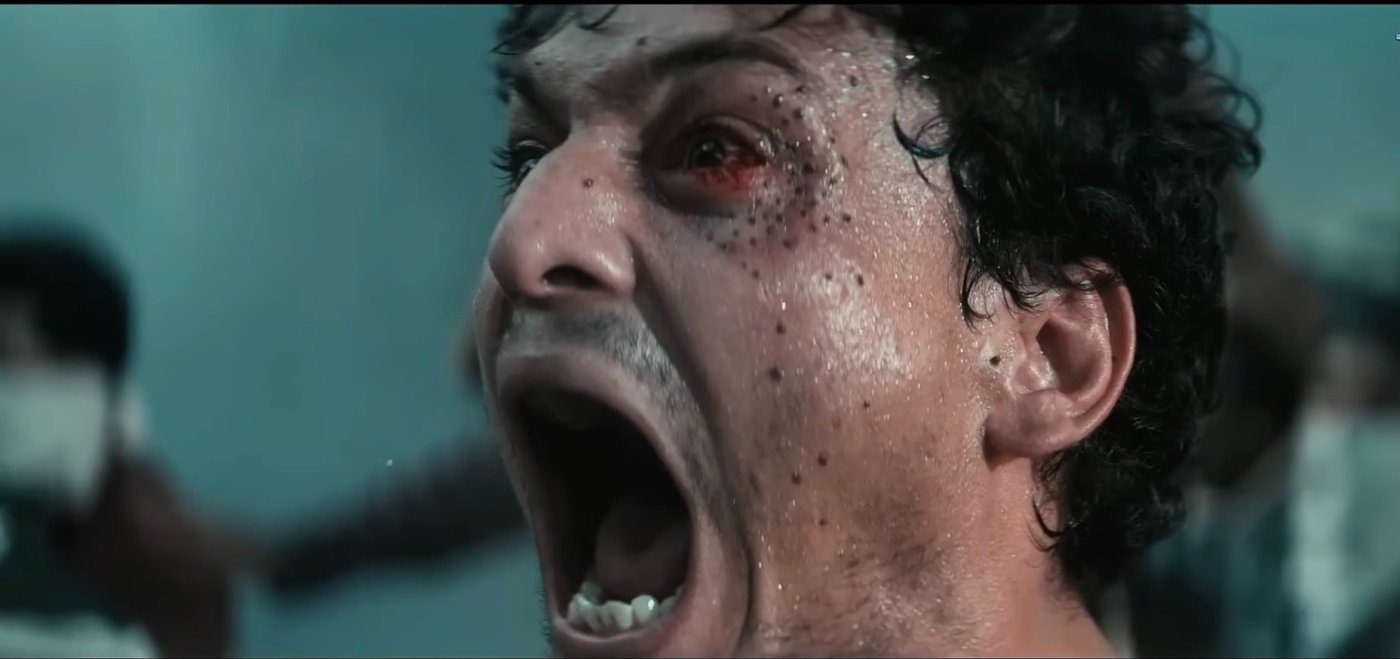
Bengaluru: “I had 92 pellets hit my face. Who says pellets are not lethal? Ask us. Pellets killed our dreams and hopes. They bruised our souls. They made our lives hell.”
— A young Kashmiri man, in Amnesty International's 2017 report, ‘Losing Sight in Kashmir: The Impact of Pellet-Firing Shotguns’
Film critic Anupama Chopra called director Neeraj Yadav’s last film, Tere Ishq Mein, “inanity disguised as profanity.” In that one, Yadav’s hero intimidates a Chinese aircraft flying into Indian territory, burns down a woman’s house with Molotov cocktails, and does all the things Indian men do when they’re rejected in love, including throwing a liquid on her face. He’s a true hero of the manosphere, a “spiritual” successor (as the film crew described their lead) to the equally toxic Raanjhanaa.
But if the trailer for Chauhaan, Yadav’s latest, is any indication, he’s taken the propaganda film to a darker place than his contemporaries. The Kerala Story films (2023 and 2026) and Hamare Barah (2024) try to legitimise outlandish Islamophobic conspiracies; Bastar: The Naxal Story (2024) recasts human rights activists as terrorists; and the never-ending hagiographies such as PM Narendra Modi (2019) and Swatantrya Veer Savarkar (2024) just create mountains out of men.
If previous films fed us exaggerations, Chauhaan does just the opposite. It takes something horrific that actually happened to Muslim citizens and tells you it was no big deal.
Muslims, Always Villains
Muslims have always been the villains in propaganda films, but here the state arrives as spectacle: Ajay Devgn, a stud in all black (the director can’t decide whether he’s Indian army or National Security Guard), a skull mask covering his nose and mouth.
The humiliation is cemented when he plays Chumma Chumma De De on a boombox while facing down a mob of protestors. Is this the most casual dismissal of historic suffering committed to a big screen in recent memory? Please note, this trailer doesn’t even bother with the usual fig leaf, Pakistan.
You can watch the trailer here.
Devgn’s monologue exonerates the state before it’s even accused. He opens with “galati hamari nahi thi,” (the fault wasn’t ours) and then describes pellet guns as causing “limited damage.” Cue camera zooming into a protester’s bloodshot, pellet-torn eyes.
It’s true the Indian army once called these weapons “non-lethal.” But they were contradicted almost immediately by international experts and by extensive reporting in the Indian press.
“The Indian forces call it a pellet gun, but it is a pump-action shotgun,” a spokesman for the UK-based Omega Research Foundation, which monitors military technologies, told Time magazine.
Thousands Injured, 1,000 Blinded
The only silver lining here is that enough people still remember the era when we thought it was fine to fire shotguns loaded with iron pellets at our own citizens. In a country that blacks out anything resembling honest reportage from Kashmir, Chauhaan might accidentally become a Gen Z refresher course, a reminder of a documented atrocity that has been rebranded as heroism on the big screen.
According to official data cited in The Hindu, roughly 10,000 Kashmiris were hit by pellets between 2010 and 2016, 60% of those injuries occurring in just four months, July to October 2016. More than 1,000 people lost vision, partially or fully, to the tiny iron balls fired from police and CRPF pellet guns, according to Article 14’s reportage.
A 2019 study by Srinagar’s Institute of Mental Health and Neuroscience found that at least 85% of pellet victims developed psychiatric disorders, with those who suffered eye injuries hit hardest.
“I felt too sad when I saw the trailer,” one pellet gun victim who is blind in one eye and who has hundreds of pellets lodged in his body told me. “Vision loss is not even the main thing. You can’t even spend 20-25 minutes in the sun without the skin getting irritated and the whole body swelling.”
“Until I breathe, these pellets will keep giving me pain,” he added.
The guns are hunting weapons repurposed for crowd control. They fire pellets with no controllable trajectory, at roughly 1,100 km/h. The Facebook page of a now defunct Pellet Victims group lists 1,432 registered members who have lost their vision in one or both eyes to pellet fire, 32 of them women. No prizes for guessing why the non-profit had to shut down.
Photographer Camillo Pasquarelli depicted how horrible these guns were in his series ‘Valley of Shadows’ where he juxtaposed black and white portraits of pellet gun victims alongside their medical x-rays. The x-rays depict how the lead pellets stay lodged in the brains and bodies of their victims.
Stalking Kashmir
Chauhaan also extends Bollywood propaganda’s stalker obsession with Kashmir. The same terrain worked over by Uri: The Surgical Strike, Article 370, The Kashmir Files, and the Dhurandhar films.
All but the last came out in the window between the 2019 and 2024 general elections, which tells you something even before you watch a frame. Nobody watching Shammi Kapoor romance a Kashmir Ki Kali in 1961 could have guessed that Bollywood’s favourite honeymoon backdrop would end up as ground zero for its most hateful cinema.
And it’s telling which Kashmir gets chosen now. Pulwama, birthplace of Hizbul Mujahideen commander Burhan Wani, and site of the 2019 suicide attack that killed more than 40 paramilitary soldiers, has replaced Gulmarg as the propaganda brigade’s preferred location. Not for the scope of its cinematography but because it’s a minefield of real grief that can be mined again, tweaked and distorted until it serves a majoritarian script. “No ya, this is not propaganda,” my childhood friends from south Mumbai will say to me. “It’s just a great action film.”
Kashmir, the trailer says, is a land of “Pathans.” Not Kashmiris. Not citizens. A vague, conveniently Muslim-coded catch-all ripe for our Rajput hero to show up and, to use the trailer’s own framing, give them their answer. For propaganda makers, Kashmir is Ground Zero of the Hindu-Muslim binary, and the abrogation of Article 370 is the key turn in a civilizational battle.
Identifying The ‘Demons’
And talking of the Rajputs, one website says the Chauhans were described as “one of the four Agnikula Rajput clans” that originated to “fight against the Asuras or demons”. The trailer clearly identifies the “demons” for its audience.
One of the loudest objections came from the Kshatriya Parishad, upset that a Rajput clan name has been dragged into what it calls “contemporary communal politics.”
“Such attempts also betray a profound ignorance of Indian history. The subcontinent's past cannot be reduced to simplistic communal binaries.There are numerous examples of Afghans and Rajputs fighting alongside one another: Mahmud Lodi fought under the leadership of Maharana Sanga at the Battle of Khanwa; Hakim Khan Sur commanded a contingent in the army of Maharana Pratap at Haldighati; Farid Khan, who later became Sher Shah Suri, is traditionally associated with military service under Raja Raisal Shekhawat in his early career; and Maharaja Vikramaditya Tomar laid down his life fighting alongside the Lodi forces in the First Battle of Panipat,” the statement said.
While I'm grateful they spoke up, all our energy can now be spent debating whether or not a 12th-century warrior’s surname was used respectfully.
And the minimising of a mass-blinding campaign remains a footnote.
(Priya Ramani is on the Editorial Board of Article 14.)
Get exclusive access to new databases, expert analyses, weekly newsletters, book excerpts and new ideas on democracy, law and society in India. Subscribe to Article 14.