
New Delhi: On weekday mornings in Delhi, couples such as K* and B*, an inter-caste couple from North East Delhi, both in their early 20s, arrive at sub-divisional magistrate offices carrying the paperwork required to marry under the Special Marriage Act (SMA), 1954.
The SMA provides a civil route to marriage, particularly for interfaith couples who wish to marry without converting to either partner’s religion. Inter-caste couples also use it to formalise marriages outside traditional religious ceremonies.
They bring identity documents, photographs, affidavits and witnesses. They wait to be called, answer questions from officials, and move between counters as their applications move through the administrative process.
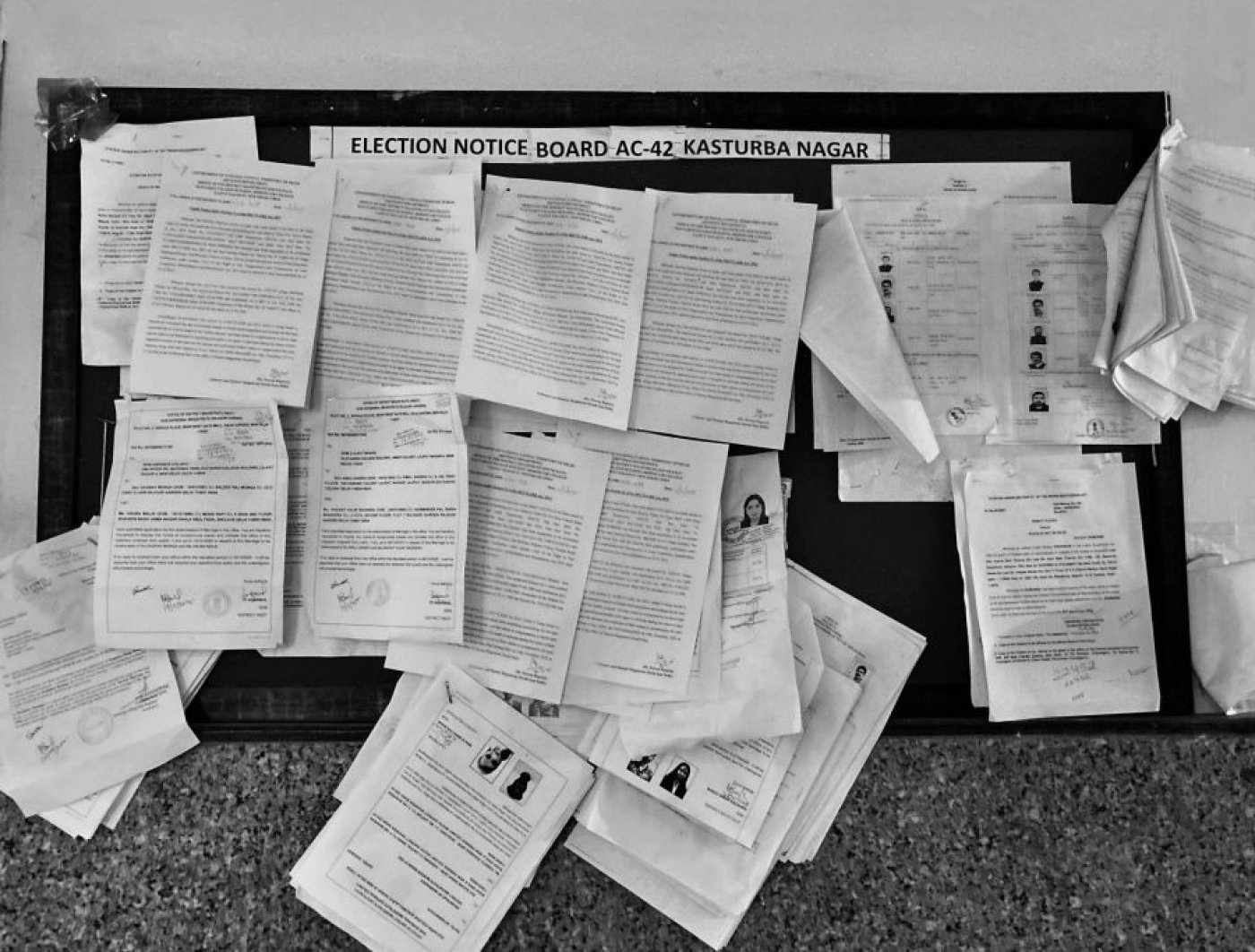
Under the SMA, a couple’s intention to marry becomes part of an official public record. A notice is entered in the Marriage Notice Book and displayed on a notice board for public inspection.
For K and B, the process exposed their plans to marry before they were ready to tell their families. Within a week of filing their notice under the SMA, their families knew.
“Someone had taken a picture. It reached them before we could say anything,” said K.
The photograph was taken of the notice displayed at the marriage officer’s office. Their families called off the marriage.
It took the couple a year of persuasion and even threats to take their own lives to convince their families to let them marry. Even after finally getting married, they continue to live in fear of intervention from their families and right-wing groups that disapprove of inter-caste or interfaith marriages.
Their story is not unusual.
Official data show a widening gap between SMA applications and registrations in Delhi, demonstrating that many SMA applicants do not end up getting married by the end of the 30 days.
A Widening Gap
On paper, the SMA process is straightforward: establish identity, satisfy the statutory conditions—such as being of legal age and unmarried—give notice of the intended marriage, wait 30 days and, if no valid objection is sustained, have the marriage solemnised and registered.
Under Section 7, any person may object to the proposed marriage within 30 days, but only on grounds specified in the Act, such as an existing spouse or failure to meet the prescribed age requirements.
Neither a couple’s religious differences nor their decision to marry without their parents’ approval can, by themselves, constitute grounds for an objection.
Once displayed, however, the notice becomes accessible beyond the couple and the officials processing their marriage. The couple has little control over who sees the information or what consequences its disclosure may bring, including pressure from disapproving families and threats from right-wing groups.
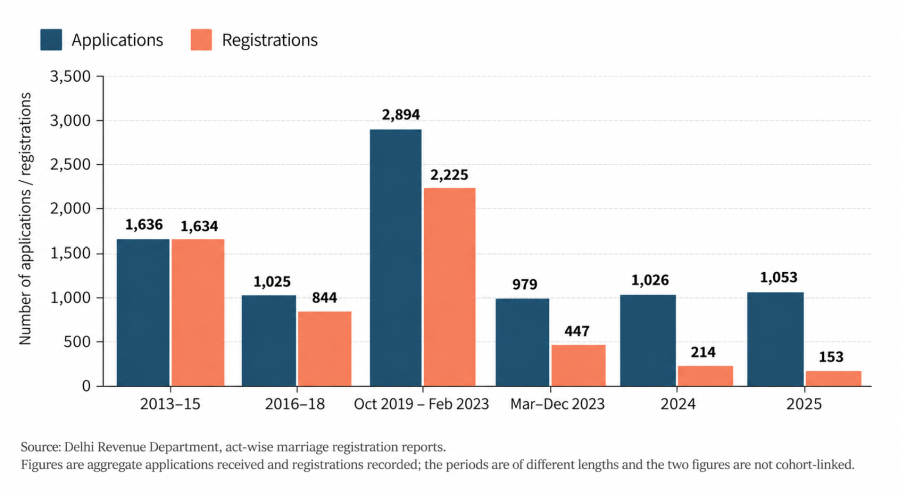
Data published by the Delhi revenue department records of marriage applications and registrations available on its website and accessed by Article 14, show that between 2013 and 2015, Delhi recorded 1,636 applications under the SMA and 1,634 registrations, a difference of just two.
From 2016 to 2018, the revenue department recorded 1,025 applications and 844 registrations, a difference of 181. Between October 2019 and February 2023, there were 2,894 applications and 2,225 registrations, a difference of 669.
Between March and December 2023, Delhi recorded 979 applications under the SMA and 447 registrations, a difference of 532. 2024 saw 1,026 applications under the SMA and 214 registrations, a difference of 812. In 2025, the department recorded 1,053 applications and only 153 registrations.
The data indicate a sharp decline in the proportion of registrations relative to applications recorded under the SMA in Delhi.
While over 99.88% of couples who applied for a marriage under the SMA registered the marriage between 2013 and 2015, the proportion fell to 82.34% in 2016-2018, 76.88% between October 2019 and February 2023, 45.66% between March and December 2023, 20.86% in 2024 and just 14.53% in 2025.
The data do not show how many couples abandoned the process due to outside pressure or were prevented from marrying, or if they shifted to another legal route or registered their marriages later.
But the widening gap raises alarms about what happens between an application and a registered marriage under the SMA, and why so many more couples do not go through with the marriage they applied for.
When A Notice Goes Public
The photograph of K and B’s marriage notice was not an isolated instance of a couple’s plans becoming public. For couples marrying under the SMA, notices displayed can be circulated and brought to families' attention before the couples are ready to disclose their plans.
Previously, the notices were sent directly to the applicant’s official residences.
This change followed a 2009 Delhi High Court ruling in Pranav Kumar Mishra v. Government of NCT of Delhi, in which the court held that Marriage Officers could not require notices to be sent to applicants’ residential addresses or impose additional police verification.
Practices, administrative rules and procedures also vary across states. In Haryana, for example, a 2018 checklist for interfaith marriages included newspaper publication and physical address verification, requirements the Punjab and Haryana High Court later directed officials to drop.
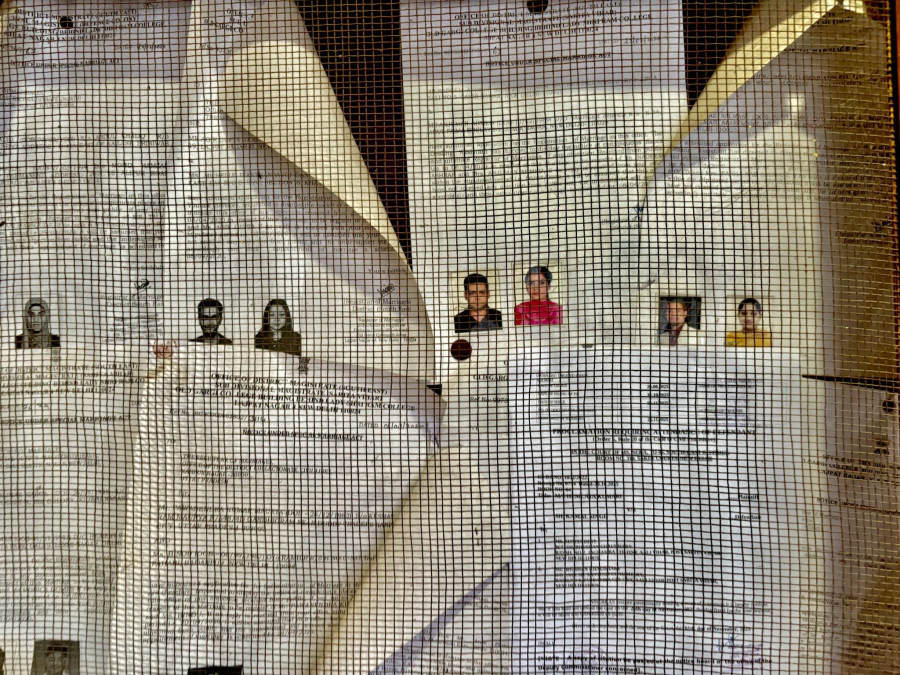
F*, who married under the Special Marriage Act in 2021 and has worked with interfaith couples at Dhanak Of Humanity, a Delhi-based not-for-profit supporting couples navigating relationships and marriages across religious and caste boundaries, said, “Even if notices are only displayed at the office, someone can take a copy and show it to your family, and you can still get into trouble.”
S* and Y*, a 31-year-old Muslim woman and Hindu man, had been together for three years when they decided to marry through the court before having a religious ceremony. “We knew there would be paperwork. But we didn’t realise it would be put up like that,” said S. “It felt like an announcement we never made.”
F said that in many cases right-wing vigilante groups circulate details of the public marriage notices online and in WhatsApp groups.
SMA & ‘Love Jihad’
Interfaith marriage is uncommon in India. A 2021 Pew Research Center survey found that 99% of married Indians said their spouse followed the same religion as them, while 67% said it was very important to stop women in their community from marrying outside their religion.
Among Hindus, preferences for religious segregation were also closely associated with views of religious and national identity and with support for the BJP.
An interfaith couple’s decision to marry can bring scrutiny from families and right-wing vigilante groups. Article 14 has previously reported on this scrutiny, including the ways in which ‘love jihad’ narratives have shaped responses to Hindu-Muslim relationships.
In 2018, in Ghaziabad, a mob assaulted Sahil Khan, a Muslim man, outside a government office where he and his Hindu partner, Preeti Singh, had gone to register their marriage.
The incident was part of a wider system in which interfaith marriages were being monitored through marriage-registration offices and Hindutva vigilante online networks. In a Scroll report, Hindutva vigilantes described networks of clerks and lawyers who passed on information about interfaith marriages, while others monitored marriage notices and social media.
A 2025 study by Mohammad Amaan Siddiqui, published in Third World Quarterly, based on 188 public posts, found that ‘love jihad’ narratives portrayed Hindu women as vulnerable and called on parents and Hindu men to protect or control them. Some posts also advocated collective action, including rallies, boycotts, legal complaints, violence and evictions.
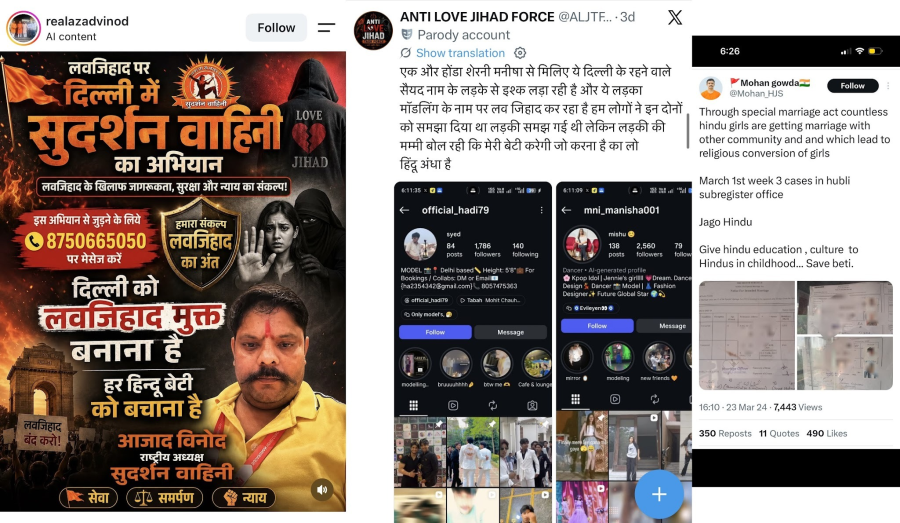
Recent social-media posts continue to frame Hindu-Muslim relationships as “love jihad” and call for intervention.
In June 2026, Hindu-nationalist supporters affiliated with the Jeev Jyoti Jivan Foundation assaulted a Muslim youth in East Delhi after accusing him of approaching a Hindu woman’s parents about marriage.
The same framing circulates online. A Facebook group titled Love Jihad Update is devoted to material around alleged ‘love jihad’ cases and Hindu-Muslim relationships, along with photos of SMA notices.
In Delhi in 2026, a video from a Ram Navami procession in Shakurpur showed participants demanding a stricter law against “love jihad” and questioning Chief Minister Rekha Gupta over what she was doing to protect Hindu women. The accompanying caption described the procession as a demonstration of Hindu society’s unity to protect its “sisters and daughters” and Sanatan culture.
Aathira Sujata, from Kerala, told Article 14 that in November 2019, a few days after she and her husband, Shamim, applied to marry under the SMA in Calicut, he received a Facebook notification of a post containing digital copies of their application along with those of about 120 other couples. The documents included addresses, parents’ names, photographs and other identifying details.
The post described the Hindu women among the applicants as “naive Hindu women” who had been brainwashed by Muslim men. Comments discussed forming groups across districts, using the addresses to reach couples’ homes and informing parents who did not know about the proposed marriages. The posts were reported and removed.
By then the material had already moved to WhatsApp. A few weeks later, Sujata’s mother learned the news after a neighbour recognised Sujata’s name and forwarded it to her on WhatsApp.
For Sujata, the incident exposed how right-wing networks frame Hindu women in relationships with Muslim men as naive and in need of rescue. “I don’t need some Hindu ‘brother’ to come and save me,” she said.
Establishing Jurisdiction
For M*, a Muslim man from Hospet in Karnataka, the SMA began with a question of where he could apply.
Couples from across the country often come to Delhi to apply under the SMA in order to avoid the news of the marriage reaching their family, but Sections 5 and 6 of the SMA require couples to notify the marriage officer in a district where at least one of them has resided for at least 30 days.
For M, this was not a problem as he was in a long-term relationship with a Hindu woman from Delhi-NCR. Yet as they were concerned about her family finding out, they used his uncle’s Delhi-NCR address to establish jurisdiction.
Javed Ahmad, an advocate who has worked with couples marrying under the SMA for 15 years, told Article 14 that applicants must provide both their temporary and permanent addresses.
In such cases, he said, Marriage Officers may ask for local witnesses—section 11 of the SMA requires three witnesses to sign the marriage declaration—to establish that the couple actually lives in Delhi and is known in the neighbourhood.
For couples who have come to Delhi precisely because they have little or no support at home, this can create another hurdle. They have to find people in the city willing to stand as witnesses to their marriage and provide their own identities and addresses to the office.
In another case involving a Muslim man and a Hindu woman from North-West Delhi, their families learnt of the couple’s plans to marry before the notice was displayed at the Marriage Officer’s office.
The couple said the disclosure made it harder to find people willing to participate formally in their marriage. “My family and friends are all scared,” the man said. “They do not want to be witnesses.”
Asif Iqbal, the co-founder of Dhanak, told Article 14 that the couple challenged the requirement for Delhi-based witnesses in court, but after three or four hearings, they decided not to pursue the challenge further. Dhanak then arranged three Delhi-based witnesses to finalise the marriage.
In some cases, Iqbal said, couples have been forced to use shelter-home addresses to establish jurisdiction without directing the marriage process to the home where their family lives.
The Cost of A Court Marriage
For B*, a geologist and government officer from Varanasi in Uttar Pradesh, the question was where she and her Hindu partner could marry safely. They chose Hyderabad in October 2025.
“North India never seemed like an option because of the high presence of right-wing vigilante groups,” she said. “These groups have links even inside the registrar’s office, from where the information can leak very easily.”
In Hyderabad, the couple booked an early appointment to limit the number of people around them. Officials still asked whether they were marrying without telling their families and urged them to bring their families along.
B said the online process she used required biometric identification, although a colleague who applied offline did not have to undergo it.
Biometric procedures differ across states: West Bengal, for instance, introduced mandatory biometric recording for marriages under the SMA in November 2023.
Their biometrics appointment, scheduled for 11 am, was completed around 5 pm after officials cited a technical problem. B suspected the delay was deliberate.
Iqbal, who has worked with interfaith couples navigating the process, believes these difficulties reflect a broader pattern of discouragement. “Now there is an unwritten instruction that interfaith marriages have to be discouraged,” he said, particularly “when the man is Muslim”.
B told Article 14 that she had to bribe a clerk Rs 8,000 after being told the process could be completed faster.
Advocate Javed Ahmad said he regularly cautioned couples against promises of same-day marriages under the SMA.
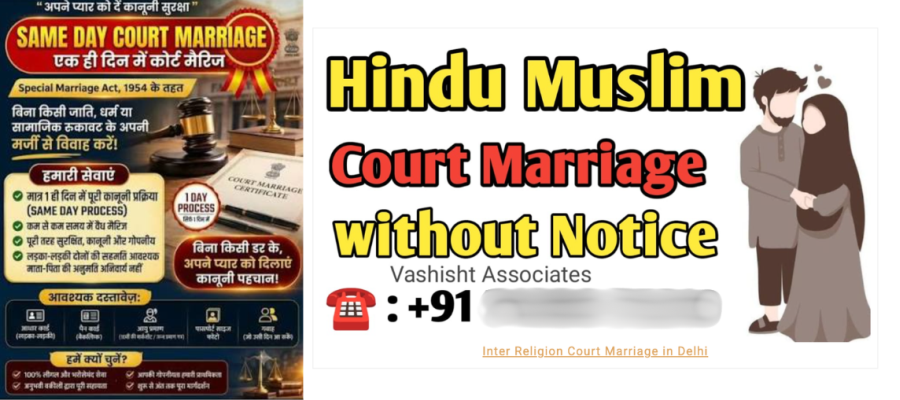
Several couples that Article 14 interviewed said lawyers had told them they could pay to speed up the process. In some cases, the amounts they described went up to Rs 50,000.
They described a process that operates differently for couples with higher financial means.
Those who can afford intermediaries can pay to navigate bureaucratic hurdles and expedite parts of the process. Those who cannot are left to negotiate the same delays and uncertainties on their own.
Navigating Around the SMA
“What we are seeing is that when the boy is Hindu, people find a way around it,” Iqbal said.
One route, he said, is an Arya Samaj marriage followed by registration under the SMA. “There isn’t very much scrutiny, so the matter goes through,” he said.
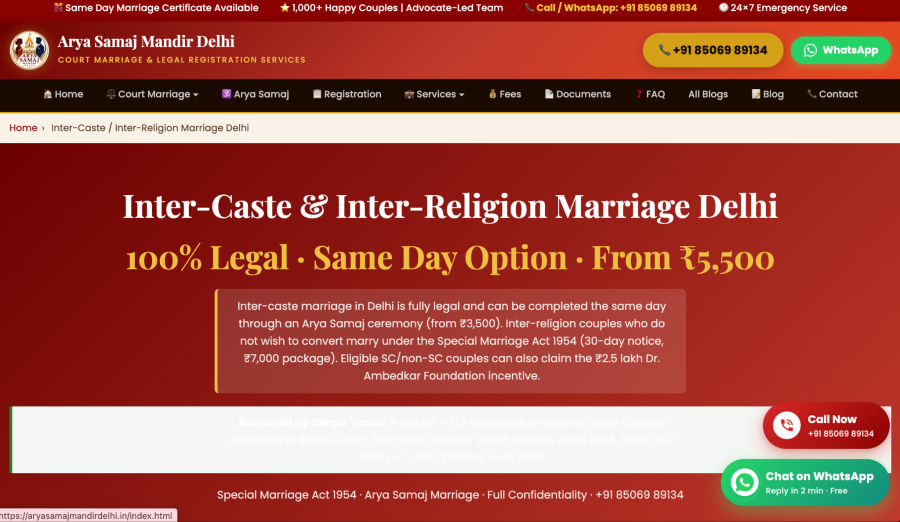
An Arya Samaj-Delhi legal guide says its marriages are intended for Hindus, Buddhists, Jains and Sikhs. A non-Hindu partner, it says, can marry through the institution after voluntarily embracing Hinduism through a Shuddhi, or purification, ceremony. Parental consent is not required for adult couples, according to the guide, and a marriage solemnised at an Arya Samaj temple can subsequently be registered with the government.
Anthropologist Perveez Mody, in The Intimate State: Love-Marriage and the Law in Delhi (2008), wrote about Delhi's love marriages in the 1990s and documented Arya Samaj temples as a route for couples seeking to marry outside their families’ approval, including through conversion ceremonies for non-Hindu partners.
The legal position is more complicated than the language of a temple certificate suggests. In October 2016, a single-judge Madhya Pradesh High Court directed Arya Samaj temples to notify couples’ families, display marriage notices, and carry out additional checks.
In June 2017, the High Court’s Gwalior Bench set aside those directions, holding that the single judge could not impose new requirements beyond the existing legal framework.
The Legal Challenges
The risks created by making an intended marriage public have been before the courts for years. But the courts have not always agreed on what, precisely, the law requires them to protect couples from.
In the 2009 case of Pranav Kumar Mishra and Another vs Government of NCT of Delhi, Justice S. Ravindra Bhat noted that unwarranted disclosure could expose couples to parental interference and, in some cases, endanger their lives.
The requirement to publish notices, even in government offices, has also faced a constitutional challenge.
A 2020 petition, Nida Rehman vs State of NCT of Delhi, argued that the notice-publishing procedure exposes couples, particularly those entering interfaith marriages, to interference from families and others. It also questioned why couples marrying under the SMA must undergo a process of public scrutiny that does not apply to marriages solemnised under personal, religious laws.
The petition has remained unresolved for more than five years. In December 2025, the Supreme Court declined the Union government's request to transfer the case from the Delhi High Court.
The Allahabad High Court took a different approach in 2021 and again in 2026. In those cases, the court allowed the interfaith couples to marry under the SMA without publication of the notice or the objections process, recognising that compulsory disclosure could expose couples to interference and violate their privacy.
These rulings, however, applied to Uttar Pradesh and did not automatically change the procedure in Delhi, where couples still face public display of their notices.
In Salamat Ansari and Others vs State of Uttar Pradesh and Others (2020), the Allahabad High Court held that an adult’s choice of partner, irrespective of religion, is protected under Article 21 of the Constitution. The judgment affirmed that interfaith relationships cannot be interfered with solely because the partners belong to different religions.
Despite these rulings, for Iqbal, who himself married across religious lines and has spent years working with interfaith couples, the scrutiny surrounding Hindu-Muslim marriages is becoming harder to navigate. He said he feared the climate around these relationships will grow harsher and the administrative hurdles facing couples will continue to multiply.
Yet, when asked what he thought would happen next, he said, “People will continue to fall in love. And as long as they do, they will continue to find ways to question the barriers placed before them, and fight it.”
*Name withheld on request.
(Uthara U R is an independent multimedia journalist based in New Delhi who works on socio-economic and political issues.)
Get exclusive access to new databases, expert analyses, weekly newsletters, book excerpts and new ideas on democracy, law and society in India. Subscribe to Article 14.