
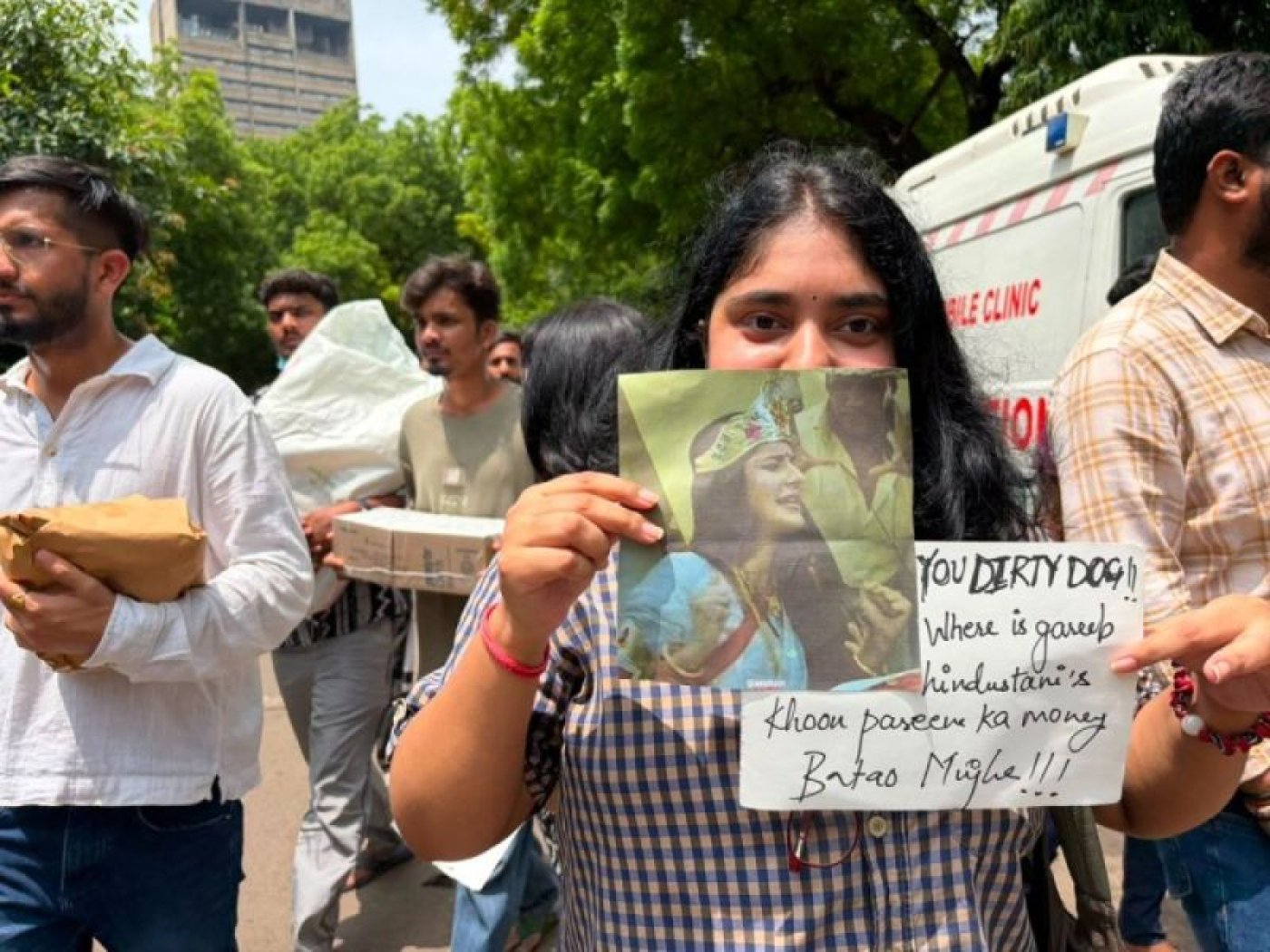
Ahmedabad, Gujarat: The NEET-UG 2026 paper leak put students on the streets in what became known as the Gen Z protests and cost union education minister Dharmendra Pradhan his job.
The government’s answer is a tougher law. As for the one it already has, the agencies it covers can’t, or won’t, show it’s working.
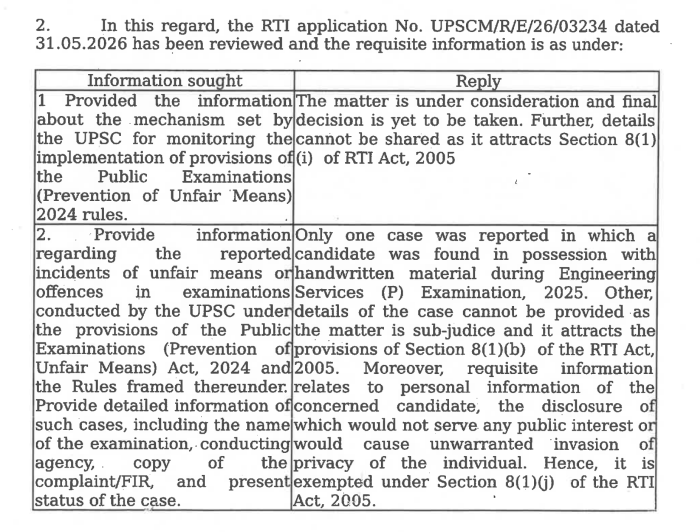
Nine right-to-information (RTI) applications filed by Article 14 found that the Union Public Service Commission (UPSC) has not set up the monitoring mechanism the Public Examinations (Prevention of Unfair Means) Act 2024 requires.
Here is what we found:
- The UPSC’s own reply says the matter is “under consideration”.
- The National Testing Agency (NTA), which ran the National Eligibility Cum Entrance Test (NEET), says it has a committee but would not explain how it works.
- The Staff Selection Commission (SSC) and the Institute of Banking Personnel Selection (IBPS) declined to answer.
- The department of personnel and training (DoPT) first said it held no information on cases under the Act. After an appeal, it disclosed 29. Only one agency described any of them, and just one.
Meanwhile, the government is promoting the Public Examinations (Prevention of Unfair Means) Amendment Bill 2026, which adds tougher penalties, special task forces, fast-track courts and time limits for investigations and trials.
Prime Minister Narendra Modi said it would make India’s examination system “more robust.” Union home minister Amit Shah called it a “significant milestone”.
That is a pitch that the government has offered before.
When Parliament passed the original bill in 2024, union minister Jitendra Singh described its aim as “curbing corrupt practice by a few unscrupulous elements that play havoc with the future of our youth”.
The law covers the bodies that run India’s biggest recruitment and entrance exams: the UPSC, SSC, Railway Recruitment Boards (RRBs), IBPS and NTA. Together they handle tens of millions of applications and registrations a year. The Indian Express has reported at least 48 paper-leak instances across 16 states between 2019 and 2024.
UPSC: ‘Under Consideration,’ 2 Years On
The UPSC has run some of India’s most competitive examinations for decades and has largely avoided allegations of large-scale irregularities. Yet it has still not set up the monitoring mechanism the law requires.
Rule 9 of the rules says: “Every public examination authority shall set up a mechanism for monitoring the implementation of provisions of the Act.”
The Commission’s Central Public Information Officer (CPIO) did not initially respond to our RTI. Only after a first appeal on 30 June did the CPIO reply, on 31 July, stating that “the matter is under consideration and final decision is not taken yet.”
Article 14 emailed the UPSC secretary and Himanshu Kumar, joint secretary (examinations), on 29 August 2026, asking why the mechanism is still not finalised. There has been no response. We will update the story if there is one.
IBPS: Covered By The Law, But Refuses RTI
IBPS is one of India’s largest recruiters. Its website says it conducts roughly 500 examinations a year and processes about one crore registrations annually.
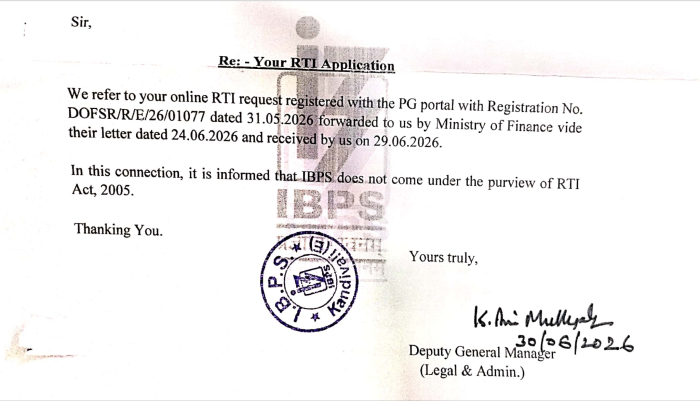
An RTI application was filed on 31 May 2026 with the finance ministry’s department of financial services, asking how IBPS monitors implementation of the Act. The ministry transferred the question to IBPS on 23 June.
IBPS replied that it falls outside the Right to Information Act, 2005, and declined to provide the information.
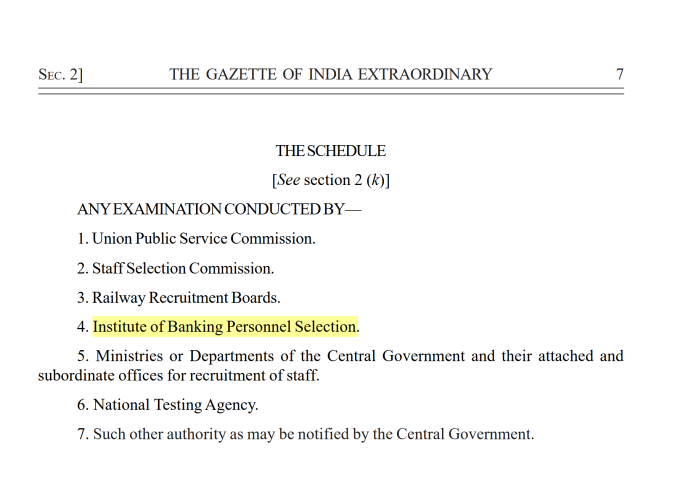
But Section 2(k) defines a “public examination” as one conducted by an authority listed in its Schedule, and the Schedule lists IBPS.
This isn’t a new argument. In 2010, the Central Information Commission ordered IBPS to appoint a public information officer, treating it as a public authority. The Delhi High Court set that order aside.
Article 14 emailed Sanjay Lohiya, secretary of the Department of Financial Services, on 29 August, asking how IBPS can remain outside the RTI Act when the law names it as an examination body. We are yet to receive a response and will update the story if we do.
NTA: A Committee, But No Answers
The 2024 Act came into force after the NEET-UG 2024 paper leak, which the Supreme Court described as “an admitted and undisputed fact.” It is now being amended after another alleged NEET leak. The NTA ran both exams.
Our RTI asked how the NTA monitors the Act, how many malpractice cases it has recorded, and what became of them. The NTA said it has an Unfair Means (UFM) Committee to examine cases and recommend action. It gave no details of how the Act itself is monitored or implemented.
On cases, it said the information is “not maintained in the format sought,” adding that the RTI Act doesn’t require it to compile information in a new format. It also refused to share Form 1 and Form 2, prescribed under the 2024 rules for the officer in charge and the exam centre to fill out whenever an offence is detected, citing ongoing investigations.
Article 14 emailed the NTA on 29 August asking how the UFM Committee identifies, examines and decides cases. There has been no response. We will update the story if there is one.
RRB: 35.8 Million Appearances, No Documented Monitoring
In the 2024 recruitment cycle alone, Railway Recruitment Board exams saw more than 35.8 million candidate appearances, including 10.8 million for the Level-1 exam for entry-level posts.
We filed an RTI with RRB Ahmedabad (each RRB is a separate entity) asking about the monitoring mechanism. Its reply said only that “RRB takes necessary actions whenever required as per the provision of the Act.” That doesn’t say whether any dedicated mechanism exists, though the law requires one.
Article 14 emailed RRB Ahmedabad on 29 August asking why it has no permanent mechanism, as Rule 9 requires. It had not responded at the time of publication. We will update the story if it does.
SSC Refuses, Citing ‘Sanctity, Security And Integrity’
The SSC is among India’s biggest recruiters: 20,567,642 candidates applied or qualified for stages of its twenty exams in 2024-25, for posts such as income tax inspectors, auditors and accountants. The 2024 Act names it explicitly.
Asked about its monitoring mechanism under the law, the SSC replied that “divulging the requested information may compromise the sanctity, security and integrity of future examinations.”
An agency whose job is to assess candidates fairly declined to say whether it is complying with the law that governs it.
Article 14 emailed the SSC helpdesk asking how disclosing its Rule 9 mechanism could compromise future exams. The SSC is yet to respond. We will update the story if it does.
CBT: A Promise, And A ‘Guidance Note’
Pradhan, who stepped down after the protests, had announced that NEET-UG would move entirely to computer-based testing (CBT) from 2027.
Under Rule 5, the National Recruitment Agency (NRA) must prepare norms, standards and guidelines for CBT, which the Centre must publish. The NRA isn’t listed as a separate public authority and has no website, so on 31 May 2026 we filed an RTI with DoPT asking for the NRA’s consultation process and a copy of the guidelines. DoPT transferred it to the NRA on 16 June.
On 27 August, 72 days after the transfer, the NRA responded with a “Guidance Note” on CBT. The RTI Act requires a reply within 30 days. The NRA withheld the consultation process, citing confidentiality.
On 1 September, we emailed the NRA’s secretary and other officials asking whether the Guidance Note is the “Guidelines” the Rules require, or whether those are still being prepared, and about the consultation. The NRA replied on 23 September without answering.
The Rules also require the Centre to notify the CBT norms. We filed an RTI with DoPT to ask whether that has happened. DoPT transferred it to the NRA on 16 June, and the NRA’s 23 September reply said nothing about notification. DoPT has not responded to our 29 August email on the subject.
29 FIRs, And Nobody Knows What Happened To Them
Our RTIs asked for cases registered under the Act, copies of FIRs, and the status of investigations. The answers contradicted each other.
On 16 June, DoPT’s CPIO and under secretary, Jasmine (who goes by one name), said the department had no information on cases registered under the Act. After a first appeal on 18 June, DoPT disclosed on 2 August that 29 FIRs had in fact been registered.
Article 14 emailed DoPT secretary Rachna Shah on 29 August asking about the discrepancy and for details of the 29 FIRs, including their status. DoPT has yet to reply. We will update the story if it does.
The agencies deepened the gap. Only the UPSC provided information on a single case. RRB Ahmedabad said it had filed none. The SSC, NTA and other bodies gave nothing comparable. That raises questions about coordination and record-keeping in how the 2024 law is enforced.
As the government sells its amendment as a landmark reform, the RTI replies from UPSC, IBPS, NTA, RRB and SSC leave the original law’s compliance machinery, including the Rule 9 monitoring mechanism, unproven. And the data that would show whether the law is actually being enforced (cases registered, investigated and prosecuted) is still not public.
(Suchak Patel is an Ahmedabad-based independent writer and journalist.)
Get exclusive access to new databases, expert analyses, weekly newsletters, book excerpts and new ideas on democracy, law and society in India. Subscribe to Article 14.