
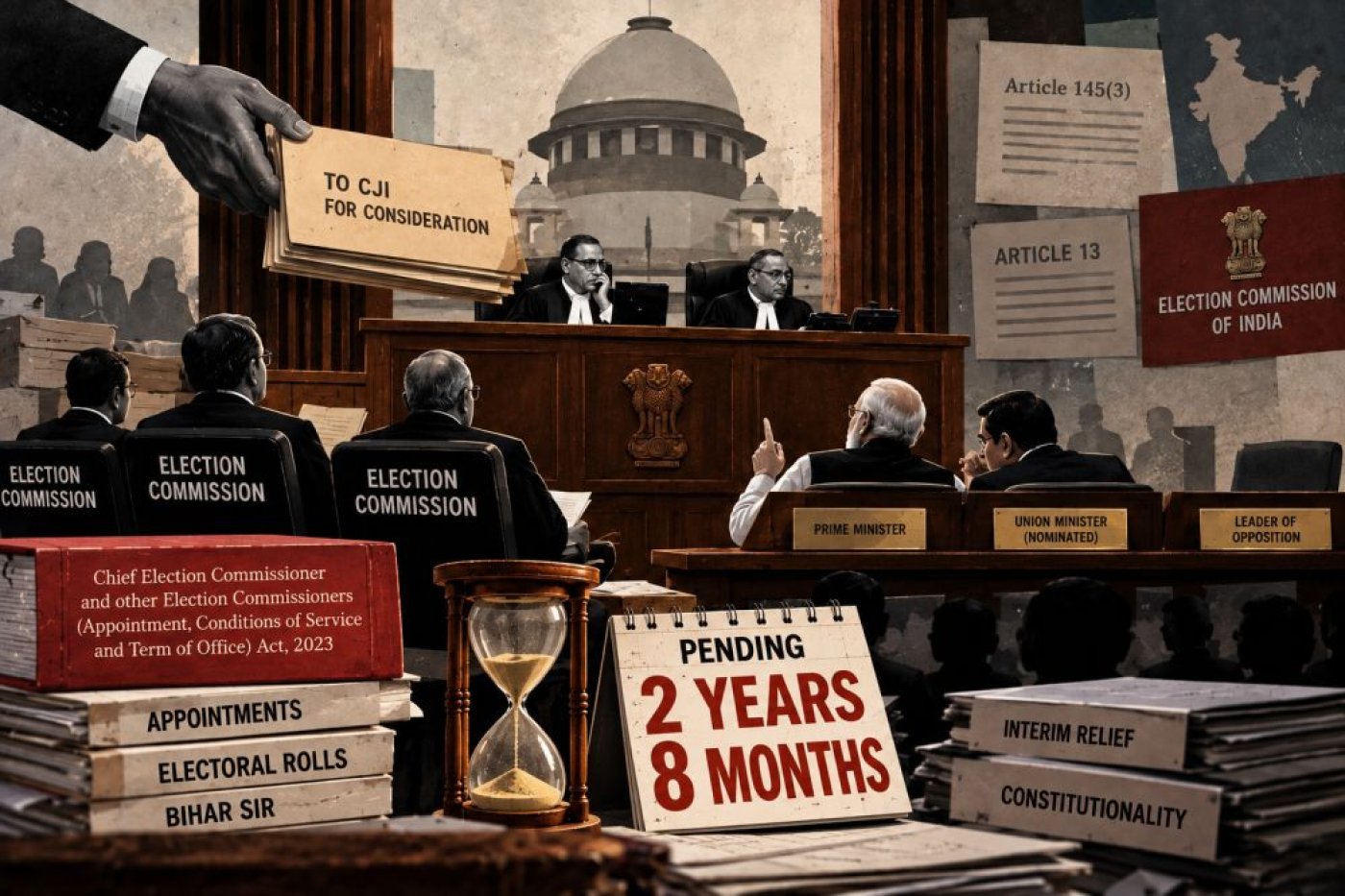
New Delhi: On 23 September 2026, the Supreme Court left undecided whether the law governing the appointment of India’s chief election commissioner and election commissioners is constitutional.
The two judges hearing the challenge disagreed not on the law itself, but on whether it needed to go before a larger bench. They sent the matter to the Chief Justice, with no date fixed for the next hearing.
The 2023 law replaced the Chief Justice of India on the panel selecting election commissioners with a Union minister nominated by the Prime Minister. The challenge has now been pending for two years and eight months.
The judges, Dipankar Datta and Satish Chandra Sharma, disagreed over whether Article 145(3) required the case to go before a Constitution Bench. Their split verdict left the question unresolved and sent the matter back to the Chief Justice to decide whether a larger bench should hear it.
The delay reveals a larger problem: the Chief Justice decides which bench hears a case and when, but the Supreme Court has no published rules explaining how it makes those decisions.
That discretion can keep a law in force while its constitutionality remains unresolved.
A Dubious Track Record
This is not the first time that the Supreme Court’s handling of high-stakes cases has raised questions about how the Chief Justice assigns cases to benches:
- In January 2018, a petition seeking an independent probe into the death of CBI judge B H Loya, who had presided over the trial in the 2005 Sohrabuddin Sheikh encounter case, was listed before a bench led by Justice Arun Mishra, junior to nine other sitting judges. The assignment was one of the triggers for an unprecedented press conference by the Court’s four senior-most judges. They accused then Chief Justice Dipak Misra of assigning politically sensitive cases to “benches of preference”.
- Months earlier, the same Chief Justice faced a similar controversy in the medical college bribery case. The Court’s then senior-most judge had referred a petition seeking an independent probe to a five-judge Constitution Bench. The Chief Justice convened a seven-judge bench of his choosing the next day, overturned that referral, and sent the case to a new three-judge bench, which dismissed the petition.
- In 2019, Chief Justice Ranjan Gogoi constituted a special bench to consider allegations of sexual harassment against him—and then sat on it himself. The move raised questions about judicial propriety and safeguards against conflicts of interest.
None of these episodes formally changed the Court’s roster rules. Each involved a departure from the usual process for assigning a case to a bench, without a clear public explanation.
Hours after Justices Datta and Sharma signed their joint order, a habeas corpus appeal was listed before Justice Sharma in a different courtroom, outside the roster category designated for such cases. The appeal concerned the daughter of the very Chief Election Commissioner whose appointment process was under challenge, as a lawyers’ body pointed out in a letter to the Chief Justice.
A curative petition filed by lead petitioner Dr Jaya Thakur now seeks recall of the 23 September order. It says Justice Sharma’s son has been standing counsel for the Election Commission before the Madhya Pradesh High Court since July 2024—a connection not disclosed during the proceedings and that came to light only through media reports on 25 September.
The senior counsel who certified the petition said he had no doubt Justice Sharma decided the case on its merits, but that recusal would have been appropriate.
Neither episode, on its own, proves misconduct. Together, they show what opaque case-allocation practices can conceal—and why the public needs to know how and why cases are assigned.
Article 13 of the Constitution says laws that violate fundamental rights are void. But that guarantee means little if a person cannot get a court to declare a law unconstitutional while it still matters. A law can remain in force simply because no bench has ruled on its validity.
What The Delay Has Cost
The stakes are not abstract.
The Chief Election Commissioner and other Election Commissioners (Appointment, Conditions of Service and Term of Office) Act, 2023 replaced the Chief Justice of India on the selection committee with a Union minister nominated by the Prime Minister. The panel now consists of the Prime Minister, his own minister and the Leader of the Opposition, who together choose the officers who run India’s elections.
Since March 2024, this panel has appointed two election commissioners and elevated one of them, Gyanesh Kumar, to Chief Election Commissioner in February 2025. The appointment came hours after, according to contemporaneous reporting, the Leader of the Opposition walked out of the selection meeting in protest, and two days before the Supreme Court was due to hear the challenge to the law.
The Commission, now led by Kumar, spent 2025 defending the special intensive revision of Bihar’s electoral rolls, which excluded some 6.5 million names from the draft list. The Supreme Court later directed the Commission to publish the reasons for each deletion.
Opposition parties called the exercise a mechanism for disenfranchisement and an “exercise in exclusion”. The Commission called the allegations baseless and, at times, declined to answer specific questions about the exercise at a press conference convened by the CEC himself.
Whichever account is right, the dispute shows what is at stake in Dr Jaya Thakur vs Union of India (2026): the body making these decisions, and the person leading it, hold office under a selection process whose constitutionality remains unresolved.
A Challenge That Outlasted Its Urgency
The Act came into force on 2 January 2024, and the challenge reached the Supreme Court that same day. A stay application followed on 5 January. On 12 January, a bench of Justices Sanjiv Khanna and Dipankar Datta declined to halt the law.
Further applications for interim relief also failed. The Act was used to appoint two election commissioners before the 2024 general election. After Chief Justice Khanna recused himself on 3 December 2024 and Chief Justice Surya Kant did the same on 20 March 2026, Justices Datta and Sharma finally began hearing the challenge on 6 May 2026.
By then, the law had already governed two appointments and a change in the Commission’s leadership.
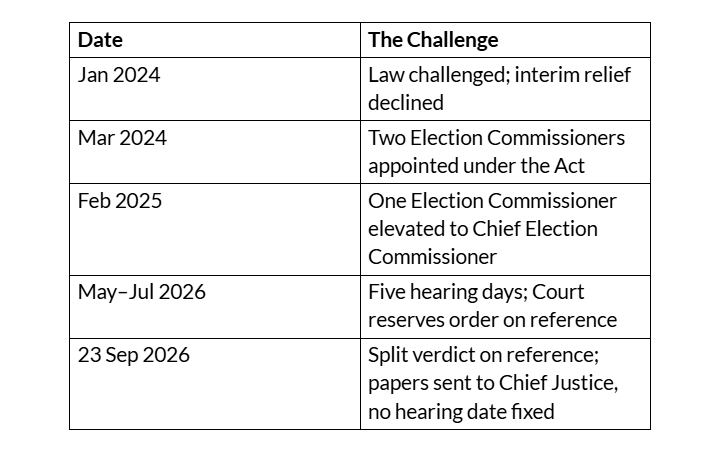
Timeline compiled from Dr Jaya Thakur vs Union of India, 2026 INSC 1040, and contemporaneous reporting.
The hearing took an unexpected turn after the petitioners had finished arguing their case. The Attorney General began responding to the challenge on its merits but, midway through, argued that Article 145(3) required the case to go before a five-judge bench.
The Solicitor General backed the request. According to Justice Datta’s account of the hearing, neither the Union’s written response nor its opening arguments had sought a larger bench.
On 30 July, the judges reserved their decision on that question alone. Two and a half years after the first plea to halt the law, the Court was still deciding who should decide its validity.
What The Split Obscured
Fifty-five days later, Justice Datta rejected the request to send the case to a larger bench; Justice Sharma agreed.
Justice Datta’s opinion, nearly as long as a judgment on the merits, nevertheless examined several questions that any bench deciding the case would eventually have to confront.
Citing the Attorney General’s concession that a Cabinet minister on the selection panel would “probably” not vote against the Prime Minister who nominated him, Justice Datta took up the petitioners’ comparison to a cricket match in which one team picks the umpire. He observed that the minister offered no independent counterweight, leaving the Leader of the Opposition with a “largely ornamental” role.
These were preliminary observations, not a final ruling, and Justice Datta made clear that they would not bind the bench deciding the case. But a considered judicial assessment of this gravity, reached and then set aside rather than resolved, is itself a cost of the two-and-a-half-year delay.
Both law officers had addressed the substance of the challenge before the question of a larger bench arose. The Attorney General’s argument turned on how the current selection panel came into being.
In 2023, in Anoop Baranwal vs Union of India, a five-judge Constitution Bench found that Parliament had not passed a law governing the appointment of election commissioners, despite the Constitution requiring it to do so.
Until Parliament acted, the Court used its powers under Article 142 to put in place an interim arrangement: the Prime Minister, the Leader of the Opposition and the Chief Justice of India would jointly select the commissioners.
The Attorney General argued that this arrangement was temporary. The Court had filled a gap, not prescribed a permanent formula, and Parliament remained free to enact a different one, as it did later that year.
The Solicitor General added that an executive majority on a selection panel did not, by itself, establish bias, and that trust in constitutional officeholders should not give way to an assumption of bad faith.
On whether the challenge needed to go before five judges, the government cited precedents holding that a law does not automatically require a larger bench simply because it is new, raises novel questions or concerns the Constitution. These included Madras Bar Association vs Union of India (2026) and State of Jammu & Kashmir vs Thakur Ganga Singh (1960). Justice Datta accepted this reasoning and rejected the request.
Justice Sharma read the same precedents differently and concluded that a larger bench was required. This was a genuine disagreement over the law. But it does not explain why a request raised midway through the government’s response interrupted a hearing already underway, or why resolving it took 55 days after five days of hearings.
The joint order shows that both judges understood the cost of further delay. It notes that Anoop Baranwal took eight years from filing to judgment, while the Jai Bir Singh reference had been pending far longer. The judges acknowledged that no one could say when a pending reference would be resolved, calling the resulting delay a source of “institutional embarrassment”.
Yet, having identified this danger, they sent their disagreement to the Chief Justice rather than to a three-judge bench, reasoning that such a bench could not settle a dispute over whether five judges were required.
That may be a defensible reading of the 2013 Supreme Court rules. They say that a bench which considers a larger bench necessary “shall refer the matter to the Chief Justice, who shall thereupon constitute such a Bench.” But “thereupon” sets no deadline. The order names none either.
The Deeper Problem
The Supreme Court Rules require every matter to be heard by a bench of at least two judges, chosen by the Chief Justice of India. This is an internal administrative rule, not a law passed by Parliament.
But the Constitution does not let that distinction override fundamental rights. Article 13 says any “law” that takes away a fundamental right is void. Its broad definition of “law” includes rules, including those of the Supreme Court.
The Court has struck down its own rules on this basis. In Prem Chand Garg vs Union of India (1962), it held that a rule requiring people to deposit security money before filing a case violated their fundamental right to approach the court.
The analogy is imperfect. That rule prevented people who could not pay from filing a case. The two-judge rule does not, on its face, block access to the Court. But the underlying point remains: a rule valid on paper can still defeat a constitutional right if its operation is allowed to drag on indefinitely.
A law remains in force while it is being challenged. If it is unconstitutional, someone still has to assemble a bench willing to say so.
The delay in the ECI appointments case does not, by itself, make the two-judge rule unconstitutional. But it raises a fundamental question: what is the Constitution’s promise that an unconstitutional law is void worth to a voter if the Court rules only after an election has already been conducted under that law?
There is another layer to this.
In 2019, in a judgment on whether judges’ assets should be made public, Justice D Y Chandrachud wrote that a judge’s oath to act “without fear or favour, affection or ill-will” was a real obligation, not a formality, and that judicial power carried a duty to account for its use. The case concerned disclosure of judicial assets, not roster allocation, so its reasoning cannot be transplanted wholesale.
But it sharpens the underlying question: if an administrative decision about which bench hears a case, and when, can determine whether a constitutional challenge is heard at all, shouldn’t the public be told why that decision was made?
A Problem Larger Than One Case
The pressure on the Court’s docket is real and should not be minimised. Between the 1950s and 2005–09, total disposals by Constitution Benches fell sharply.
At present, 29 Constitution Bench matters remain pending: 22 before five-judge benches and five before seven-judge benches, according to July 2026 data.
In fairness to the Court, it has not been uniformly passive on questions concerning the ECI. In the Bihar revision litigation, a bench directed the Commission to publish, district by district, reasons for excluding voters from draft rolls and warned that it would intervene if the exercise led to mass exclusion.
The same institution that can act swiftly when a case reaches an available bench has left unresolved for two and a half years a challenge to the law governing the appointment of its own adjudicators. The difference is not simply capacity; it is which bench holds the file, and when.
A different allocation is administratively possible. During Chief Justice U U Lalit’s 74-day tenure in 2022, 17 Constitution Bench matters were listed, with all 30 judges then on the Court hearing at least one such matter. Each of the six senior-most judges led one, according to Supreme Court Observer.
The pattern was not mechanically enforced. But it showed that a published rotation, with stated criteria for departures, is workable—not merely aspirational.
The Oath & The Docket
In Campaign for Judicial Accountability (2018), the Supreme Court rejected the argument that a matter involving the conduct of senior judges required special handling outside the Chief Justice’s ordinary control over listing.
It held that the “master of the roster” convention rests on settled practice and rules, not a Chief Justice’s personal discretion. In the Court’s words, it is followed “on account of the principles of law”.
Justice Datta’s opinion in this case opens with the observation that ours is “a government of laws, not of men”—a principle he ultimately invoked to justify deciding the reference question himself rather than referring it onward.
On 23 September, the validity of the law governing the appointment of India’s election commissioners was left for another bench to decide, with no hearing date fixed.
The Court need not promise a particular outcome in the election case. It must give the challenge a bench and a timely answer.
(Sarthak Gupta and Prannv Dhawan are New Delhi-based advocates. Both previously served as law clerks in the Supreme Court.)
Get exclusive access to new databases, expert analyses, weekly newsletters, book excerpts and new ideas on democracy, law and society in India. Subscribe to Article 14.