
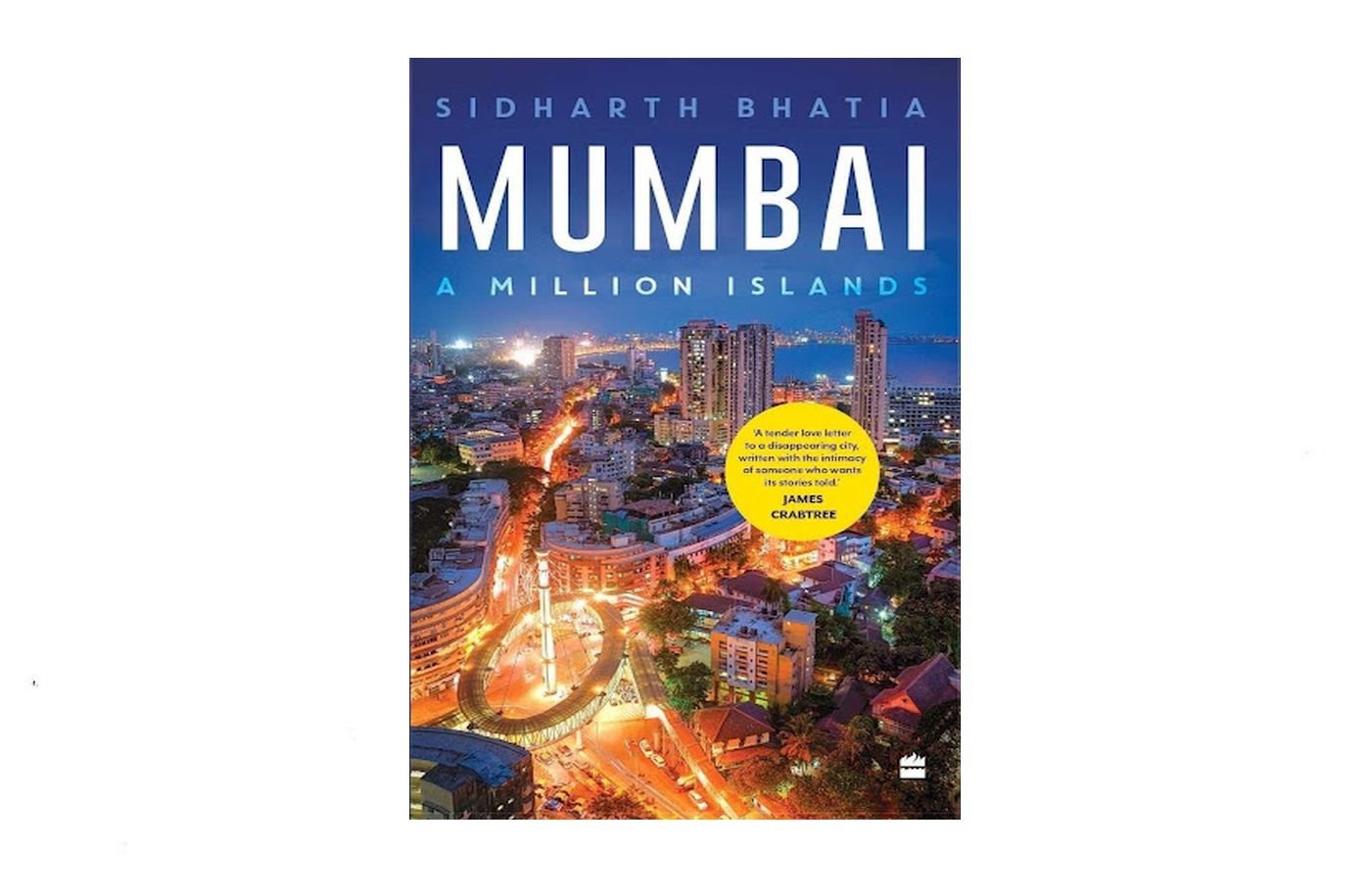
Written by senior journalist Sidharth Bhatia, Mumbai: A Million Islands examines how India’s most celebrated city has been repeatedly broken apart.
Beginning with the colonial merging of seven islands, the book traces how each phase of “development” has created new islands—of wealth, power, exclusion and memory loss. Through reportage, history and lived encounters, Bhatia shows how infrastructure projects, the real estate boom and policy choices have displaced working class communities, hollowed out public space and normalised inequality.
In advance praise for the book, actor Shabana Azmi writes, “As we watch luxury apartments being built around us, millions of citizens live without basic amenities. And many of them have been shifted to the peripheries of the city, making them further invisible. Sidharth Bhatia's timely book brings them and their lives into the public eye.” The relentless transformation of the financial capital, the demolition of slums and struggles of residents pushed to distant resettlements provide a canvas for Bhatia’s evocative look at everyday solidarities being weakened.
Mumbai emerges in this telling not as a grand city but as a fragmented archipelago, where access to housing, mobility and dignity is unevenly distributed.
—-------------------------------------------------------------------------------------------------------------------------
Excerpt
Though redevelopment is not new in the city, I was intrigued by the prospect of an entire neighbourhood being transformed, where the old one disappeared and an entirely new-looking landscape came up in its place. In Kamathipura’s case, it would not merely be a physical change—towers where low-rise structures once stood—but a profound social one. The very name had for long signified something unsavoury and sleazy. Could this century-old perception be changed by altering its landscape? And what did the locals think about it?
I entered Kamathipura from the Bellasis Road side, at the corner where Alexandra Cinema once stood. The small theatre, one of the oldest in Mumbai, was a big draw for Kamathipura’s residents and showed old semi-porn and English films, the titles translated in the most inventive fashion. Alexandra’s titles always raised a big laugh in the city; they would now be called memes: Blow Hot Blow Cold became Kabhi Naram, Kabhi Garam, and a Laurel and Hardy film was called Ullu ke Paththe. The cinema fell on bad times, then in 2017, it quietly turned into a mosque and Islamic centre run by a trust; the front has been shuttered to discourage anyone peeping in.
Within a minute of my entering Kamathipura, a young man comes up to me and begins mumbling something—the undertone is difficult to catch in a crowded street, but ‘chokri’ catches my ear. The best course is to keep moving; after a few steps, he drops back. Clearly, I am not worth investing time in.
This ritual continues for a little while more as others too approach and then withdraw. It is still daylight, but a few women, looking hopeful, are already out on the streets. The majority of the people bustling about, however, are shoppers, vendors and others going about their business. Many of the women are in burqas, quite a few in saris worn in the Gujarati style. A few are with children; there are any number of schools in the area, including a few schools run by missionaries and very sought after by parents in the neighbourhood. An English-medium school is a ticket to a good future. Parents everywhere have the same aspirations, and many children have gone on to study further and leave the area.
The streets to the venue of the meeting have posters and buntings announcing the event. Directions to the venue are swiftly provided—no one gives me a second glance.
The hall itself is a smallish affair, with a capacity of about 250 people. A few chairs are taken, mainly by middle-aged folks—these are not the kinds in white-collar jobs. The first two rows are reserved for the VIPs who will come—the minister and his entourage and some local movers and shakers. Someone is fiddling with the sound system.
People keep trickling in, and I can hear hushed whispers about the latest whereabouts of the minister. Indians have vast reservoirs of patience and don’t get restless while waiting, especially for a Very Important Person. We are ten minutes behind the scheduled timing of the meeting, so no one looks particularly bothered. The smarter ones know they must come later. The humidity is getting oppressive by now.
By and by the hall fills up, the women on one side, the men on the other. In the third row, two men have occupied the chairs on my right. After a while I turn to them and ask, ‘So what do you think the minister is going to say today?’ They take stock of me, for perhaps ten seconds, and one of them replies: ‘We have been hearing all this for years. He will come, promise quick action, declare he and his government are different, get some applause, and leave.’ The rest is left unsaid, but I can hear it: ‘And things will remain the same.’
A volunteer approaches me with an enquiring look. ‘I am a guest of Shri Patel,’ I say. He immediately requests me to shift to the front row—clearly, I am a VIP by association on this occasion.
Shortly after, the minister arrives. Jitendra Awhad is a well-known face, an aggressive spokesman of the Nationalist Congress Party on television and is now handling the housing portfolio. He has a casual swagger, but like many other politicians, has the ability to connect with the general public, an invaluable skill in a local representative. He sits down next to me, and we are introduced. The word ‘press’ seems to please him. ‘I am planning a book on Mumbai’s slums,’ he tells me.
The speeches begin, and Sailesh Mahimtura of the eponymous architectural firm steps forward to make a presentation of what could be in store for the precinct if all things go well.
Mahimtura’s slides begin with a brief history of the place and then a photograph offers an aerial view of Kamathipura and its environs at night. The lit-up streets appear well laid out among low-lying structures, many of them triangular, hugging the street corners, with majestic towers in the far background, their lights twinkling, as if to say, we are the future. It’s the vista of any modern metropolis anywhere in the world.
Soon we get to see the harsh reality in the daytime—buildings looking as if they will fall down any minute, the corroded insides and the façades with patchwork and wooden doorframes that should have been discarded years ago. This is the life of thousands of people, which they have no choice but to stoically accept.
So, when the slides move from these grim images to what is on offer, it is a sense of relief. In English, the new slides list these coming attractions: mini cricket ground, clubs with gyms, theme park, jogging track, amphitheatre, stilt parking, good quality elevators, and buildings with good quality fittings, tiles, plumbing and switches and wiring, crucial in old buildings where a jumble of wires can often cause electrical fires. It all seems so unreal and distant—and, having seen all this before, the locals can testify that it is unreal and distant.
A jumble of figures and calculations follow, all in very fine print, where a key operative point is at the very end—the developer will make a profit of over ₹2,000 crores, or roughly $300 million. All this provided the whole project is given for development to one group, which will then raze all the buildings and work on the open land.
Then comes the part where dreams are woven, with a texture so fine that it has the ability to mesmerize. The ‘Concept Design’ part of the presentation begins with a top shot of the entire area, probably taken from Google Maps. It offers a remote and
detached overview, which shows neither grime nor the messy reality of the ground. The next slide, in soothing green, replaces that with a bird’s-eye view of buildings laid out in a spacious and well-planned way, surrounded by gardens, parks, playgrounds and tree-lined streets. And next to this densely packed cluster of buildings, presumably tall ones to fit in all the residents, a vast, open space, also in green, with the legend ‘Sale Area’ printed on it. It’s all there, transparent, for anyone to see that almost half of Kamathipura will be sold to buyers in the open market. The old-time residents will get 500-square-foot apartments, highly subsidized, the landlords will be paid off, and the profits will come from the open sale.
Going by the plans and the layouts, the living spaces designed for the residents are something most may never even have dreamed of, much less experienced—two bedrooms of about 90 square feet each, two ensuite toilets, a kitchen with a counter and a sink, a living room with a dining room attached—it’s the kind of flat any young couple starting out would love, if they could afford it. The three-dimensional model, created on a computer, is even more dazzling—beds, cupboards, large flat-screen televisions; it is an unimaginable luxury for those currently living in Kamathipura, where many people live in a cramped 180 square feet area.
The buildings, especially on the upper floors, will have generous views of the city, and at the street level—as per the architects’ vision—will be broad pavements to walk dogs, shops selling Prada and Louis Vuitton, and hatted white women in shorts, cycling. At this point, the presentation ends, and the stardust in the air settles down.
(Excerpted with permission from Mumbai: A Million Islands published by Harper Collins India.)
Get exclusive access to new databases, expert analyses, weekly newsletters, book excerpts and new ideas on democracy, law and society in India. Subscribe to Article 14.