
New Delhi: If I were a Kashmiri, I would be anxious, fearful and filled with dread. I would be depressed and in despair.
I am a non-Kashmiri, but I still despair. We all should.
Two stories caught my attention last week: one tucked away on a website and another splashed across the front pages of all newspapers.
US ambassador Sergio Gor made headlines with his trip to Srinagar, where he described Jammu and Kashmir as an “important part of India.” He also signalled that Washington would review the travel advisory that cautions US citizens against travelling to the Union Territory. Gor’s visit marked the first standalone trip by a US ambassador since Jammu and Kashmir (J&K) was stripped of its special constitutional status and the state downgraded and cleaved into two union territories in 2019. While in Srinagar, Gor referenced Kashmir’s paradisical terrain, saying, “It’s an incredibly beautiful place.”
The second story revealed how Kashmiris are being treated in that same ‘beautiful place.’ Decode, a website, reported how GPS-enabled ankle monitors are showing up in Kashmiri homes. Safina Nabi's investigation revealed how lower courts in Jammu and Kashmir “are strapping electronic tracking devices onto people as a condition for bail, even after India's Supreme Court ruled that such real-time surveillance of an accused person violates the right to privacy”.
The monitors do more than just violate the right to privacy. Kashmir is the only place in the entire country where a device is physically fastened to a person’s body.
The problem is that Kashmir and Kashmiris have become part of the government’s toolkit. The toolkit can be an idea that strikes one person in the Establishment, or a collective brainwave. Each time it is used, it erodes dignity and weakens constitutional protections.
The toolkit, always first tested in Kashmir, is sometimes applied in other parts of India. In the Bhima-Koregaon case (read Article 14’s investigation on the security playbook it helped create), for instance, the Supreme Court made GPS tracking a bail condition. The Supreme Court ordered activists Vernon Gonsalves, Arun Ferreira, and Shoma Sen to share their locations with the investigating officer at all times, until the same court later ruled against GPS monitoring.
That is why we should all despair, as Kashmiris and non-Kashmiris.
The Narrative
Kashmir’s history and geography were altered on 5 August 2019, when the erstwhile state was downgraded and a harsh curfew imposed. The move fulfilled the BJP’s political promise to strip J&K of its special status.
But before I detail the many firsts that stand out as prime examples of how the state—and then the state-turned-union-territory—makes the region a laboratory for experiments, let's briefly look at Gor and Washington’s travel advisory.
The advisory guards against US citizens flying in as tourists. Tourism, by all means, is important. It is bread and butter for a vast section of people: hoteliers, shikarawalas, pony operators, guides, the handicraft sector and shawl weavers. But is tourism the only yardstick for judging normalcy? Is it the only way to determine peace?
Peace has been and will continue to be tentative. The killing of tourists at point-blank range, in April 2025, at a meadow in Pahalgam, bore testimony to how the tide can turn. The bullets flew without notice, showing up the Establishment for the lack of intelligence. The union territory’s government had lulled itself into a narrative: normalcy has returned; the abrogation of Article 370 has ensured that bloodshed is a thing of the past.
In Kashmir, the present lies linked to the past, and both determine the future. Reams have been written on how Gor’s statement describing J&K as “an important part of India” endorses New Delhi’s position and how it sends a message to Pakistan, even though Pakistan’s Asim Munir is Donald Trump’s favourite field marshal.
Listen to Kashmiris, and you might understand why they view themselves as pawns on a geopolitical chessboard: people who chose to stay in India on the basis of constitutional guarantees that have since been eroded.
The concertina wire that defined physical boundaries, cutting colony from colony, district from district in August 2019, is now the mental boundary, producing fear and anxiety, dread and despair.
The Experiments
Let’s look at a few experiments that have alienated, humiliated and dehumanised the ordinary Kashmiri. The ankle monitor is only the latest example of how the young and the old—out on bail—remain under digital arrest; their movements transmitted through the strap tied to their leg.
Another Kashmiri was tied—not with an ankle monitor—but to an army jeep, on 9 April 2017. Farooq Ahmed Dar, a shawl maker, was out that day to cast his vote in a by-poll when an army Major, Leetul Gogoi, decided to use Dar as a human shield to guard against stone pelting around the polling booth. Gogoi hoisted Dar atop a jeep and literally tied him to an army jeep. Gogoi said he saved a dozen lives by turning Dar into a human shield, but is that the way out of a law-and-order situation?
In Kashmir, it was considered kosher even though the local police submitted a report, saying that Dar "had cast his vote at a polling booth in his native village." Quoting from the police report, NDTV reported that Dar was "picked up by the army during stone pelting and tied to the bonnet of a vehicle as a human shield under threat". It also said he was "kept under wrongful confinement" and was paraded before he was released.
The army was forced to set up an enquiry, but that was a mere formality. Gogoi received a commendation certificate from the then army chief, General Bipin Rawat, even before the enquiry was completed.
In Kashmir, individual voters can seem to matter less than the percentage. Dar, who displayed his voting slip, did not matter. Only the percentage did. In 2024, 66.38% cast their votes. The political parties in the fray promised to fight for the restoration of Article 370 and for statehood. Prime Minister Narendra Modi's government told the Supreme Court it intended to restore statehood to J&K, a promise Modi reiterated before the 2024 elections.
Yet only last month, chief minister Omar Abdullah led a protest in New Delhi demanding the restoration of J&K’s statehood, to lend voice to a promise the Centre has not bothered to clarify.
Omar Abdullah’s march coincided with the Cockroach Janata Party’s protest call, seeking the resignation of Union education minister, Dharmendra Pradhan. The all-too familiar playbook that included the use of pellet guns and Internet shutdowns—tried and tested in Kashmir—was applied to Jantar Mantar. Not with the same ferocity or for the same duration, but it was applied.
New Delhi’s Expanding Powers
New Delhi does what New Delhi wants, and the lieutenant governor in Srinagar has more powers than the elected chief minister. Omar Abdullah has no jurisdiction over the security apparatus.
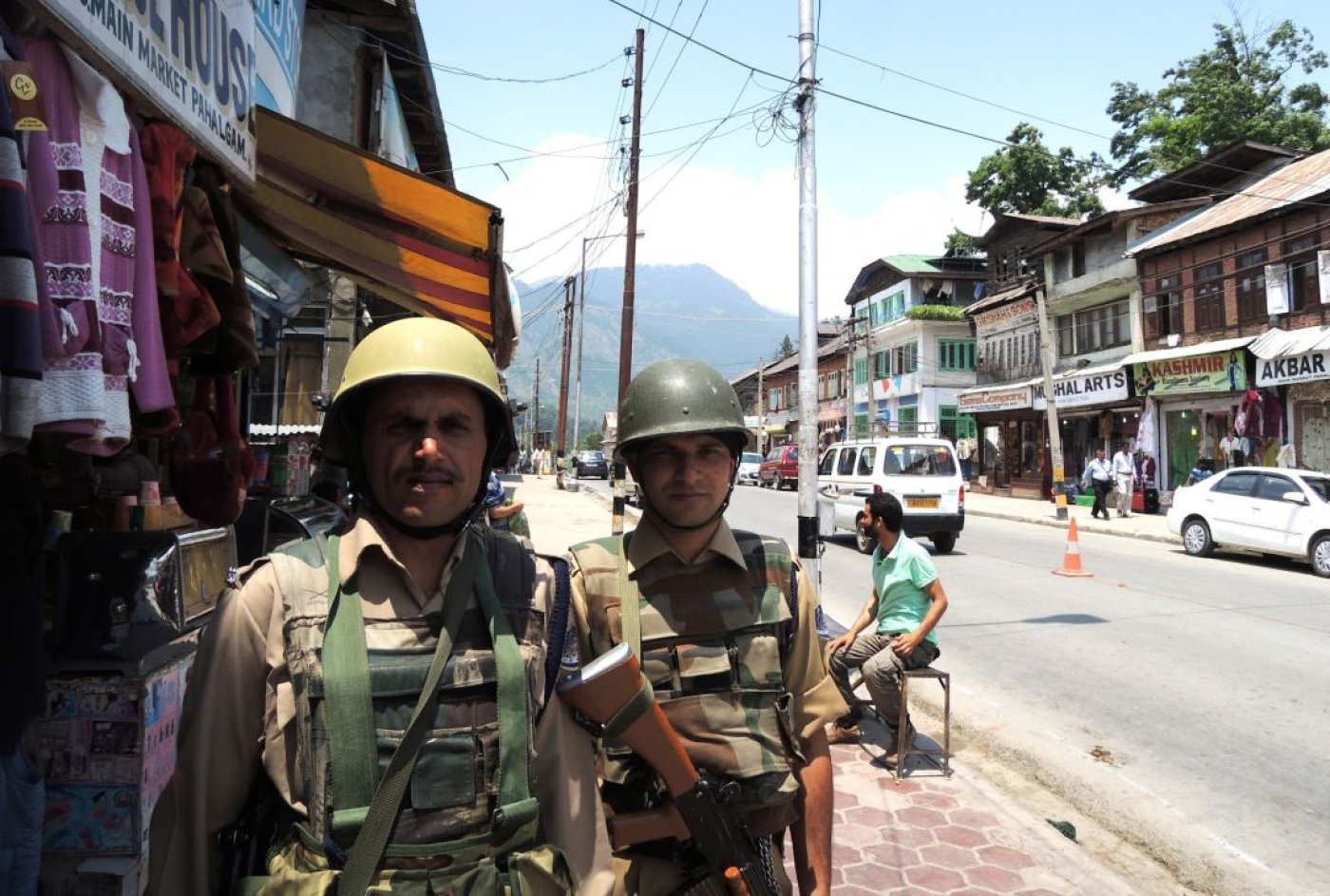
That apparatus can deny passports, dismiss government officials without giving a reason, detain and arrest, and, after the Pahalgam attack, bring down homes on suspicion of involvement. In Yogi Adityanath’s Uttar Pradesh, the bulldozer has served a similar purpose, bringing down the homes of suspects whose trials have not even begun.
In Kashmir, the security apparatus summons journalists to police stations over media reports. In New Delhi, officials dictate lines to journalists through WhatsApp groups, including journalists derisively labelled ‘godi media’.
In Kashmir, the security apparatus picks up youth it considers overground workers (OGW), an acronym unique to Kashmir, and sends them to prisons outside the UT. When the apparatus talks about OGWs, it is referring to those sympathetic to militants; to unarmed informers who pass on information to those wielding guns against the state. Thousands were similarly flown out of the Valley in the run-up to August 2019.
The UAPA, under which bail is an exception rather than the norm, is liberally applied in Kashmir and elsewhere in India. Umar Khalid and Sharjeel Imam are better-known names. Hundreds of lesser-known or unknown Kashmiris are also languishing in jail. The Kashmiri playbook is severe; it simply attracts less attention when the individuals involved are unknown.
Democratic Dismantling
In Kashmir, your phone can become a piece of deadwood, without notice. The Internet is blocked at will. According to a January 2023 report by Surfshark, a cybersecurity privacy company headquartered in Lithuania, Kashmir witnessed more Internet shutdowns and disruptions than any other region. Read that again—more than any other region, globally.
Need more evidence of how democracy can be throttled and freedoms curtailed?
For all those appalled by the use of pellet guns on protesting students at Delhi’s Jantar Mantar, where the Delhi police refused to register a first information report (FIR) until Rahul Gandhi, the leader of the Opposition, sat on a dharna, remember, those lethal guns were first used in Kashmir. Pellet guns can maim and blind, and they have done just that in Kashmir.
According to a 2022 study by the Indian Journal of Ophthalmology, 777 patients with pellet wounds in their eyes were admitted to Kashmir’s hospitals within a span of four months in 2016, when the Valley went through an intense phase of protests, following the killing of Hizbul Mujahideen commander, Burhan Wani. You can read more details in my previous Article 14 editorial note.
Justice lies at the heart of conflict resolution. It is also the centrepiece of a just society, whether in Kashmir, Delhi or Uttar Pradesh. That is why these toolkits and playbooks matter beyond Kashmir. They are unconstitutional—and forewarnings of a far wider democratic dismantling.
(Harinder Baweja is an independent, investigative journalist and the author of A Soldier’s Diary: Kargil the Inside Story and They Will Shoot You Madam: My Life Through Conflict.)
Get exclusive access to new databases, expert analyses, weekly newsletters, book excerpts and new ideas on democracy, law and society in India. Subscribe to Article 14.