Chhatarpur district (Madhya Pradesh): The company chosen by Prime Minister Narendra Modi’s government to build the dam at the heart of India's first multibillion-dollar river-linking project donated Rs 60 crore exclusively to the ruling Bharatiya Janata Party (BJP) before securing the contract.
The company, Nagarjuna Construction Company Limited (NCC), an Andhra firm based in Hyderabad, donated Rs 60 crore exclusively to the BJP through electoral bonds between 2019 and 2022—Rs 20 crore in October 2019 and Rs 40 crore (here and here) in October 2022, according to election commission data.
According to the data, the NCC donated to no other political party.
The Rs 44,605-crore project was approved by the central government in 2021 and inaugurated in December 2024 by Modi, who said it would “boost socio-economic prosperity” in the arid Bundelkhand region, across Madhya Pradesh and Uttar Pradesh, by transferring water from the Ken to the Betwa River.
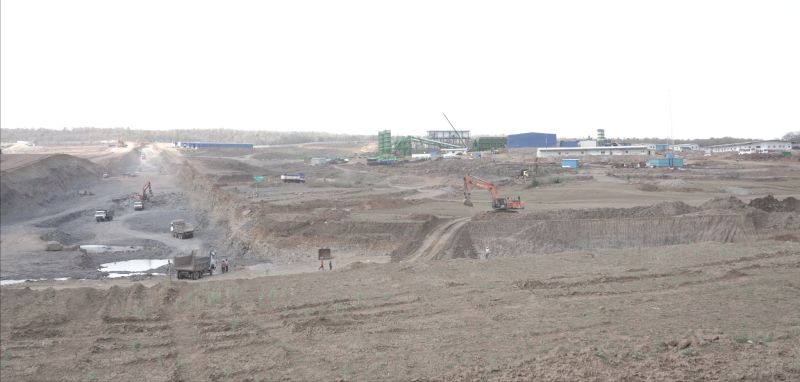
In November 2024, with the approval of the union jal shakti (or water resources) ministry, the Ken-Betwa Link Project Authority awarded NCC the Rs 3,389 crore (excluding GST) contract to build the Daudhan dam, which will submerge more than two to four million trees in the Panna Tiger Reserve and displace thousands from 22 villages, mostly Adivasis, and submerge 10 of them.
Opposition leaders and former bureaucrats have questioned why NCC, which had relatively limited experience in dam construction, was awarded the unusually large Daudhan Dam contract.
They also pointed to a broader pattern in which companies under investigation subsequently donated to the BJP through electoral bonds and received lucrative government contracts. NCC, which faced tax raids in 2018 and 2022, also donated to the BJP through electoral bonds in 2019 and 2022.
A Flood Of Contracts
Following the donations, NCC secured several major government contracts in BJP-ruled states.
In 2019-20, NCC had Rs 26,572 crore worth of projects.
By 2025-26, its order book had grown to Rs 83,004 crore—more than threefold in six years.
On 17 July, 2026, Madhya Pradesh leader of the opposition Umang Singhar and senior leader of the Indian National Congress (INC) raised the electoral bond question, asking whether NCC's Rs 60 crore donation to the BJP was connected to the dam contract. "Why is the government remaining silent? Is it because it has received donations?" he asked.
State Congress president Jitu Patwari said that the NCC was also constructing the BJP's state office in Bhopal. Linking this to corruption and political patronage, he said, “If the BJP wants, we are ready to debate this issue with documents on any platform”.
On 29 June 2026, Article 14 emailed a detailed questionnaire to Srinivasa Murthy, the company secretary and senior executive vice president (legal) at NCC, on the electoral bond donations, the Daudhan Dam tender, and its prior experience in dam construction.
We sent a reminder on 20 July 2026. There was no response. We will update this story if they respond.
On 15 July 2026, Article 14 sought comment via email from the secretary and chief information officer of the water resources department, ministry of jal shakti, as well as the director general and technical director of the National Water Development Agency (NWDA), an autonomous body that studies and plans water resource projects.
There was no response. We will update this story if they respond.
The Questions Asked
Former finance secretary Subhash Chandra Garg, under whose tenure as economic affairs secretary in 2017 the electoral bond scheme was formulated, in a written reply, told Article 14 that the connection between a donation to a political party through electoral bonds (or through the other trust scheme) and the award of a contract was “not so direct” and required investigation.
“Whether this party was favoured in any way, whether tender criteria were defined in such a way that this company was made eligible wrongly, or it restricted competition in its favour?” said Garg. “Or, was any favouritism/ illegality done in evaluating bids? This needs to be investigated professionally. If there is evidence to the effect that it was done, the fact of electoral bonds donation would establish the quid pro quo.”
Former secretary, department of economic affairs, and former principal adviser (energy) to the planning commission, E A S Sarma, in a written reply, told Article 14, “Considering the fact that NCC's involvement in dam construction is so far limited largely to execution of components of some major irrigation projects, it is surprising that the company has been awarded such a large project as Daudhan Dam…”
A donor company involved in the collapse of a defectively executed tunnel project had been let off lightly, said Sarma, referring to a tunnel constructed in Uttarakhand by the Navayuga Group, another Andhra company, which donated Rs 55 crores (45 crore in 2019 and 10 crore in 2022) in electoral bonds to the BJP.
Forty-one workers were trapped underground for 17 days in November 2023.
Navayuga Engineering was made to bear the costs of the 17-day rescue and paid each rescued worker Rs 2000,000 as ex gratia, plus a two-month bonus. A government inquiry later recommended identifying officials responsible for the lapses and initiating penal action.
As of January 2024, police had not filed a case against the contractor for the tunnel collapse.
Calling for a judicial inquiry about possible quid pro quos, Sarma said, “Looking at the donations received by BJP through Electoral Bonds from private companies, it appears that companies subject to ED/CBI investigations have, in several cases, contributed through electoral bonds or, in many cases, those companies that have contributed to BJP have been favoured with remunerative contracts.”
Wajahat Habibullah, a former chief information commissioner (CIC), in a written reply, told Article 14, "All indicators show that the establishment not only favours but actually induces investors to donate election bonds. There is no better indicator of this than the government's endeavour to keep these donations outside the purview of the RTI Act."
Limited Dam Experience
The EPC tender for the 96.7-metre Daudhan Dam, issued in August 2023, required the lead bidder to have at least two years’ experience in the previous decade building major civil structures, including dams or tunnels for water-resource or hydropower projects.
Bidders also had to have built at least one concrete dam of 40 metres or more and one earth, rockfill or composite dam of at least 35 metres.
CRISIL Intelligence noted that the project would require expertise in dam building, earthworks and concrete structures.
Yet NCC’s own website, a 2024 infrastructure-industry research report and a 2025 CRISIL report do not identify any prior standalone dam constructed by NCC. Its portfolio lists water-supply schemes, irrigation pipelines, roads and buildings.
Its only cited dam-related work before Daudhan was a Rs 366.70-crore irrigation project in Andhra Pradesh, executed in a joint venture—and the tender required any qualifying previous dam project to be worth at least Rs 700 crore.
The company’s next major dam-related project, the Barnar Reservoir in Bihar, came in September 2025, almost a year after the Ken-Betwa contract.
As protests continue, questions are being raised about how the dam contract was awarded.
Donations, A Contract
When the tender was floated in August 2023, no company initially bid, Hindustan Times reported in January 2024. The deadline was extended twice, to January and then March 2024, amid concerns over costs, engineering challenges and construction inside the core zone of the Panna Tiger Reserve.
The Modi government introduced electoral bonds in 2018, calling it a transparency move.
But the scheme allowed donations to flow without a public record and choked off opposition funding. A Reporters Collective investigation in March 2024 found that the State Bank of India (SBI), which issued the bonds, kept records accessible to the government.
In February 2024, the Supreme Court struck down the scheme, holding that it violated voters’ constitutional right to know how political parties are funded, that unlimited corporate donations were unconstitutional, and ordered the SBI to release the data, which revealed NCC’s exclusive donation to the BJP.
NCC had not purchased electoral bonds before March 2018, when the income tax department searched its premises on allegations of tax evasion. Its first purchase—Rs 20 crore, donated exclusively to the BJP—came in October 2019, more than a year later.
A second donation of Rs 40 crore followed in October 2022.
The company disclosed that the income tax department searched its premises in November 2022 on allegations of tax evasion.
Electoral bonds remained on sale until January 11, 2024.
Political parties redeemed Rs 12,769 crore through electoral bonds. The BJP received the largest share – about 48% or Rs 6,060 crore. The Trinamool Congress received Rs 1,609 crore, and the INC around Rs 1,421 crore. Among regional parties, Bharat Rashtra Samithi received Rs 1,214 crore, the Biju Janata Dal Rs 775 crore, and the DMK Rs 639 crore. The Aam Aadmi Party got 66 crore, and the AIADMK received just Rs 6.05 crore.
Nearly two years after its second donation, on 28 November 2024, the Ken-Betwa Link Project Authority informed NCC that it had emerged as the successful bidder for the engineering, procurement and construction EPC contract for the Daudhan dam.
The company is expected to complete the project in eight years.
Orders From BJP States
In the final months of 2022, around the same time NCC donated Rs 40 crore to the BJP, the company secured a series of government contracts from states ruled by the BJP or its alliance partners.
In Gujarat, in October-December of 2022, the Water Resource Development Corporation Ltd. awarded the company a Rs 707.30 crore lift irrigation order; in Karnataka, in that same period, a Rs 334.31-crore drinking water project and a Rs 378.62 crore transmission project.
In 2023-24, NCC formed a joint venture with J Kumar Infraprojects to build twin tunnels from Film City in Goregaon to Khindipada in Mulund for the Mumbai Municipal Corporation, valued at Rs 6,300 crore.
The company also secured orders worth Rs 8,398 crore for smart meter projects in Maharashtra in October-December of 2023.
Between January and March 2025, NCC won new projects worth Rs 20,831 crore, including infrastructure development in the Andhra Pradesh Capital Region and the redevelopment of a medical college and hospital in Bihar.
In July 2025, it received a Rs 2,269 crore order from the Mumbai Metropolitan Region Development Authority for Line 6 of the Mumbai Metro, marking the company's entry into the urban transport and metro rail sector.
In September 2025, Bihar's Water Resources Department awarded the company a Rs 2,090 crore order for the Barnar reservoir and dam structures in Jamui district.
The same year, NCC received a Rs 6,828 crore mining order from Central Coalfields Limited—one of the largest contracts in its recent history—and a Rs 2,062 crore contract from Assam's Public Works Department for the expansion of Gauhati Medical College and Hospital.
How NCC Qualified
The tender document empowered the KBLPA (Ken Betwa Link Project Authority) to reject any bid for “any other cause”.
In February 2023, the technical advisory committee recommended relaxing the work-experience criteria—originally drafted by NHPC in 2019—to allow wider participation.
In March 2023, KBLPA held a pre-bid meeting with leading water resources companies to discuss the tendering and execution processes.
NCC was the only eventual bidder not invited to the meeting.
When the tender was first opened on 11 August 2023, it reportedly failed to attract any bids.
The tender evaluation committee decided not to change the eligibility conditions.
Following directions issued by the jal shakti ministry in January 2024, the tender process was reviewed, and six companies eventually submitted bids.
The Dainik Bhaskar report on 19 June, 2024 identified the bidders as NCC, Dilip Buildcon (Rs 3,420 crore), HSCL-RVNL joint venture (Rs 3,614 crore), Larsen & Toubro (Rs 3,699 crore), Patel Engineers-Mahalakshmi Infra joint venture (amount not specified), and Megha Engineers-Ritwik Infra joint venture.
Megha Engineers-Ritwik Infra was reportedly disqualified due to lack of dam-building experience, while NCC emerged as the lowest bidder.
Neither the ministry for jal shakti nor the national water development agency (NWDA) disclosed how the bids were evaluated or why NCC was selected.
Their annual reports only state that the contract was awarded to NCC.
Disputes & Delays
In 2010, the ministry of health and family welfare awarded NCC a Rs 147.89 crore contract to construct a medical college and hostel at AIIMS Bhopal, to be completed in 15 months.
It was delayed, leading to disputes over responsibility and payments.
The ministry later challenged an arbitral tribunal's award in favour of NCC before the Delhi High Court, alleging NCC had raised "inflated claims".
The comptroller and auditor general (CAG), in its 2018 performance audit of the Pradhan Mantri Swasthya Suraksha Yojana, found that contractors across four new AIIMS—including Bhopal—received excess payments of Rs 19.62 crore due to higher bills and violation of contract.
NCC has also faced scrutiny over public contracts.
In 2010, Madhya Pradesh blacklisted the company for allegedly submitting false information, though the Madhya Pradesh High Court quashed the order in 2016.
In 2011, the Central Information Commission sought an explanation from the National Highways Authority of India about awarding a Rs 36.5 crore highway contract to NCC in 1999 despite it not being the lowest bidder.
In 2013, India Today reported that a confidential income tax department report named Narottam Mishra, then a minister in Madhya Pradesh's BJP government, for accepting bribes from NCC to clear mega infrastructure projects.
The report alleged NCC had paid “heavy bribes” to Mishra and senior bureaucrats.
Mishra denied the allegations.
The Income Tax Appellate Tribunal ruled in his favour in November 2014, finding that the report was based on “inferences” and “suspicions” without any “direct nexus”.
Thousands Will Be Displaced
In May 2025, Article 14 reported allegations of broken promises and violations of compensation and forest laws.
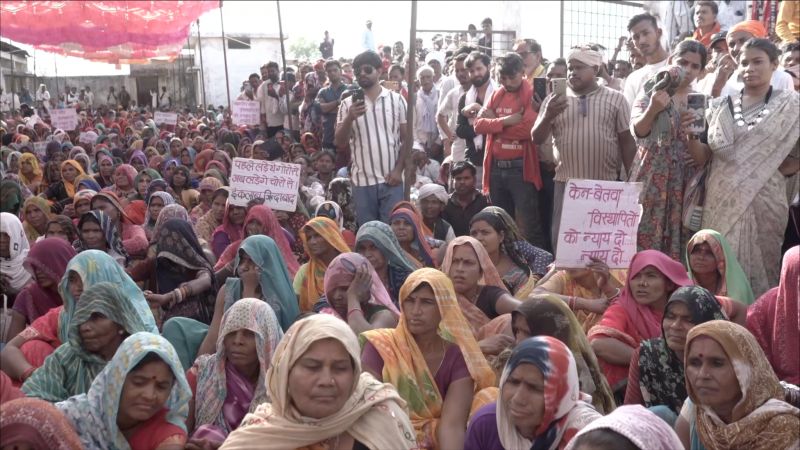
Protesters continue to demand fair rehabilitation, gender-equal compensation, an inquiry into alleged irregularities—or that the project be scrapped altogether.
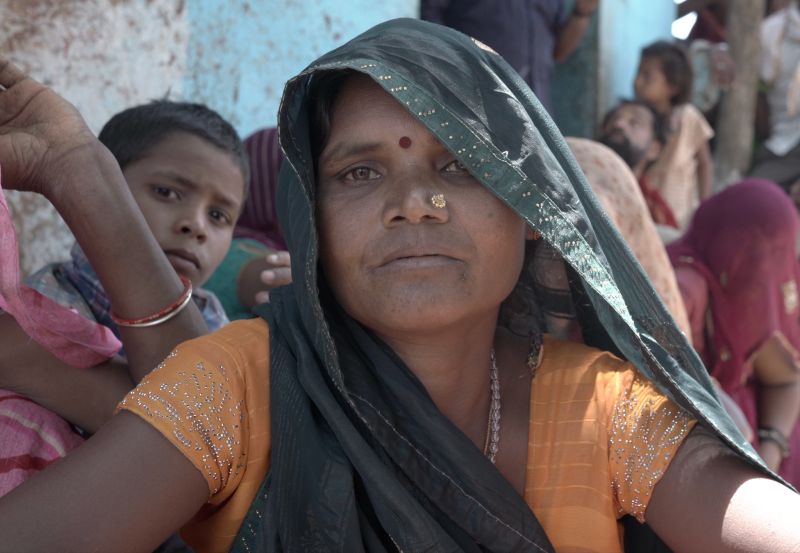
After police suppressed protests against the Ken-Betwa river-linking project in April 2026, villagers returned to the protest site on the Barana river, a Ken tributary, in Chhatarpur district in May and July.
On 19 July, police again dismantled the protest, clearing the site in a pre-dawn operation and detaining scores of demonstrators, including protest leaders.
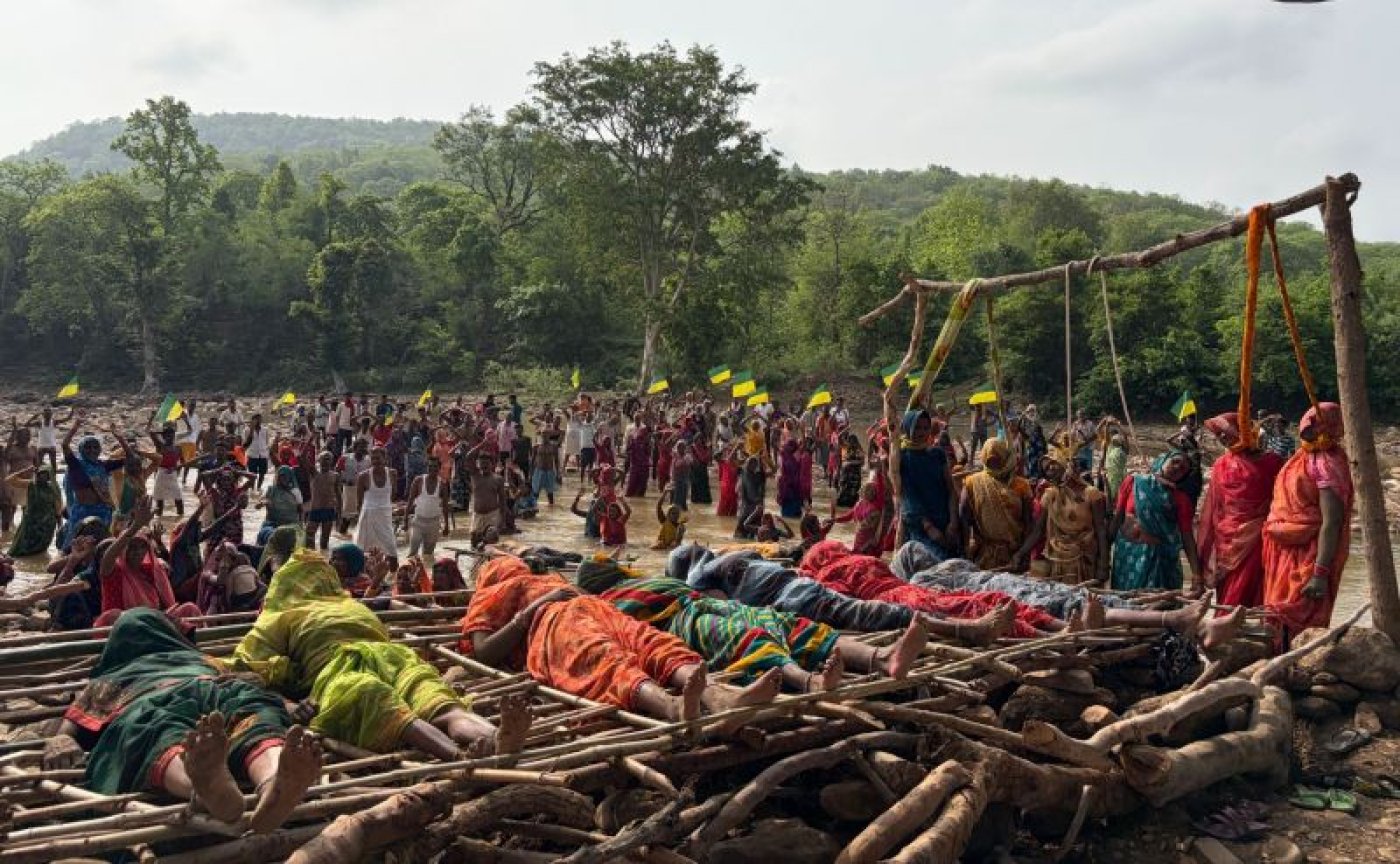
Tribal and other communities facing displacement had returned to the banks of the Barana, a tributary of the Ken, where they lay on symbolic funeral pyres under the slogan nyay do ya mrityu (justice or death).
“By the Ken River, I swear this agitation will not end until we get justice,” said Kallu Bai, an Adivasi woman from Mainari village, demanding resettlement packages for women and children, and a village in exchange for their doomed village.
“Otherwise, the government can take its machinery and leave,” she said. “We don't want any dam.”
(Rizwan Rahman is an independent journalist based in Delhi, covering indigenous communities, human rights and climate change.)
Get exclusive access to new databases, expert analyses, weekly newsletters, book excerpts and new ideas on democracy, law and society in India. Subscribe to Article 14.