
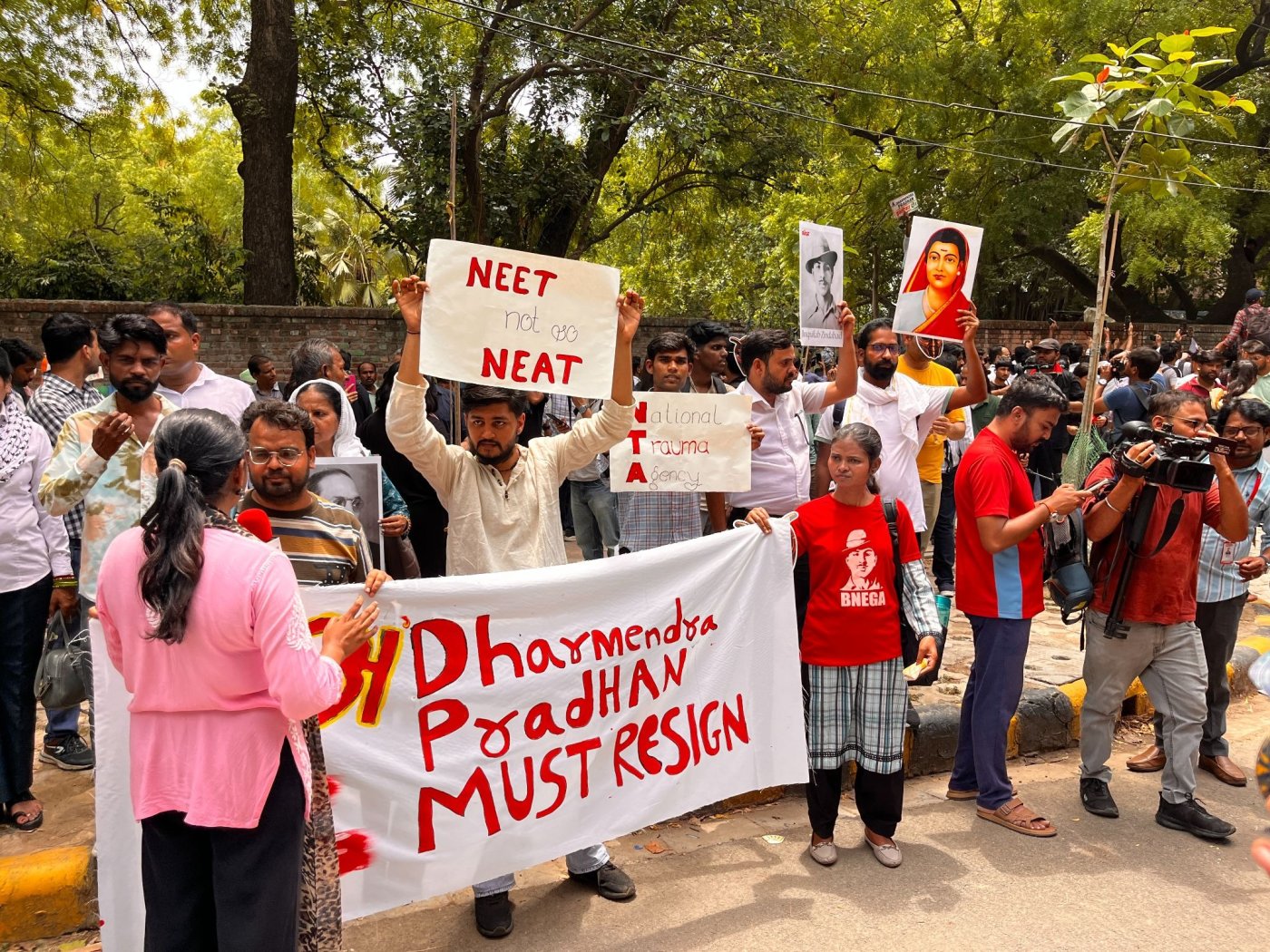
Mumbai: If you were unsettled by the recent news of the death by suicide of a student in Nagpur—the note she left behind said she lacked the courage to sit for the re-test of the national medical entrance exam, the National Eligibility-cum-Entrance Test (NEET, cancelled due to a paper leak after being held in May)—then you are already engaging with the emotional scaffoldings of India’s education system. And if you are a parent or a student, you are familiar with fear, exhaustion, precarity and the overwhelming sense that a single examination, a single score and a single percentage point can dictate the worth of an entire life.
The Supreme Court of India has acknowledged as much.
In January 2026, the court discussed the interim findings of the National Task Force on Student Mental Health and Suicide Prevention in Higher Educational Institutions, which the court had constituted. Led by a former Supreme Court judge, the task force has been asked to identify the causes behind student suicides, examine institutional failures and recommend preventive reforms.
Its findings: In the 15–29 age group, suicides are the second-highest cause of death among males and the highest among females. “Such is not the case in any other age group…” the court noted, observing further that India’s suicide rate among young people significantly exceeds global averages. “The youth of this country are increasingly becoming more vulnerable to suicide than the overall population,” said Justices J B Pardiwala and R Mahadevan.
More importantly, the court warned against the tendency to reduce every student suicide to individual failure. Blaming students’ lack of resilience and their inability to cope, the court observed, let institutions routinely evade scrutiny of “institutionally normalised stressors” that shape students’ lives.
Strictly speaking, the court was referring to colleges and universities, not the examination machinery of NEET, the Central Board of Secondary Education (CBSE), or the Common University Entrance Test (CUET), the latter two of which were also hit (here and here) in recent weeks by serious glitches with lasting consequences for students. For millions of students, that distinction hardly matters.
Student Frustration
Student trauma in India does not suddenly appear at the gates of a university. By the time students get to university, most have already spent years in an education system that conflates endurance with learning, with hyper-competitive examinations focused on rote learning and a culture that treats young people less as learners than as units moving through a high-pressure sorting mechanism.
Across the country, millions of children move from one class to the next, carrying report cards, marksheets, and certificates, but often without confidence in reading, comprehension, or basic numeracy. In 2024, just 48.8% of rural Indian children in Std III were able to read at Std II level. The proportion of children in Std III who could solve a 2-digit numerical subtraction problem with borrowing stood at 33.7%, according to the widely acknowledged Annual Status of Education Report (ASER) by non-profit organisation Pratham.
Particularly in rural India, access to education has expanded, but quality has not kept pace. For too many children, education becomes a long exercise in survival through extra tuition, coaching classes, and examinations, rather than curiosity or intellectual growth.
Then comes the great narrowing of adolescence and post-adolescence: the entrance examination. The recent disruptions in the CUET, the repeated controversies surrounding NEET, and the irregularities in expensive contracts awarded by the CBSE reveal a system that places unbearable pressure on young people while failing to guarantee even basic reliability in return.
Students in India travel across cities and states to take such exams. They prepare for years; they spend months in coaching class hubs; they live huddled in hostels, often spending the family’s last savings. The accumulated inter-generational anxieties of entire families hang heavy over examination halls—only for students to then encounter malfunctioning systems, delayed schedules, cancelled papers, leaks, confusion and re-tests.
An Abnormal Adolescence
For millions of young Indian students, sleeping little, studying obsessively, having forfeited a normal adolescence, uncertainty, delays and procedural failures become devastating. The consequences are the visibly rising mental distress among IIT-JEE/ NEET aspirants and those appearing for recruitment exams for the railways or other government jobs.
The latest crisis has taken the form of India’s already restive students, in the millions, backing the Cockroach Janta Party, originally launched as a dark joke in response to the Chief Justice of India calling unemployed youth and activists ‘cockroaches’. The official response to students’ outrage follows a templatised pattern—deny the scale of the problem, dismiss criticism as anti-national, and replace accountability with lip service or spectacle.
Political rhetoric around education increasingly focuses on branding exercises. Faced with the reality that not one Indian university figures among the world’s top 100 in the QS world university rankings, the Press Information Bureau of the government of India announced that 54 Indian universities now appear in the overall QS list, a five-fold increase since 2015, and including eight Indian debutants in the 2025 list. (The latter includes Galgotias University.) Countries with a fraction of India’s population and resources—South Korea, Taiwan, Saudi Arabia, and New Zealand—have built institutions ranked among the top 100.
This is not a matter of vanity. Good universities can shape the intellectual life of nations. They produce research, scientific innovation and critical inquiry. They attract talent instead of exporting it. For a country that has bestowed on itself the moniker of Vishwaguru, India’s inability to build even a handful of genuinely world-class universities should be regarded as a profound national failure.
Declining Freedom, Rising Rhetoric
Meanwhile, academic freedom has shrunk sharply. In 2026, the Academic Freedom Index developed by the Varieties of Democracy (V-Dem) Institute, a global collaborative social science data collection project headquartered at the Department of Political Science, University of Gothenburg, Sweden, placed India among the bottom 10%-20%, alongside Syria, Sudan, Russia, El Salvador and Gaza.
From a theatrical adaptation of Mahasweta Devi’s short story Draupadi to professor Nivedita Menon’s comments on Kashmir to a 2017 invitation to student-activist Umar Khalid to speak at Delhi’s Ramjas College, the Sangh parivar has taken frequent umbrage to free expression on campus; police have detained teachers and students for protesting genocide; students who protested poor administration or poor facilities at Benaras Hindu University, Jawaharlal Nehru University (JNU) and other institutions of higher education have been met with suspensions, sometimes arrests. The cumulative effect is a university culture increasingly wary of dissent, experimentation and intellectual risk.
In 2025, the Niti Aayog released a report titled ‘Internationalisation of Higher Education in India: Prospects, Potential and Policy Recommendations’, alluding to the “retreat of leading nations of the Global North that have traditionally hosted international students”, Asia’s emergence in education, and the avenues this opens up for India in the global higher education space. On cue, the executive summary harkened back to India’s “ancient legacy of world-class learning,” exemplified by Nalanda, Takshashila, Vikramshila, Kashi, Ujjain, etc.
The same report cited current data on India’s brain drain—in 2021–22, India hosted 46,878 inbound international students, and sent 11.59 lakh students abroad. The latter number rose to 13.36 lakh by 2024. In the decade since 2013-14, payments for studies abroad rose by over 2,000%, according to the Reserve Bank of India.
“The Amrit Kaal is an opportune time for India to reclaim its historic position as a global hub of knowledge and talent, given its favourable demography…” the Niti Aayog report said. There is something bleakly revealing about this moment. The generation that constitutes the much-vaunted demographic dividend increasingly finds itself anxious, desperate, underemployed and institutionally disregarded, while now justifiably enraged at being called vermin.
A Dying Dividend
India’s demographic dividend phase began around 2005, when working-age Indians, aged 15 to 64, outnumbered the elderly and the young. It is expected that this period will last until 2055, a five-decade period during which we have already squandered two, with no commensurate growth in employment for this ‘working’ population.
We know from the experience of the past decade that the dividend does not accrue automatically; squeezing it out requires young Indians to be healthy, skilled, employed, attending great schools, universities and vocational institutes. It needs women to thrive in these colleges and workplaces.
Instead, the latest National Family Health Survey (2023-24, data released in May 2026) shows that 23% of rural women aged 20-24 years were married before age 18, unchanged from the previous round of data collection in 2019-21. Only 39.7% of women aged 15-49 years in rural India had 10 or more years of schooling as per the 2023-24 data, lower than in 2019-21 (41%). Women in rural India aged 15-19 years who were already mothers or were pregnant at the time of the survey was 7.9 % in 2023-24, worse than in 2019-21 (6.8%).
Youth, on its own, is no asset in the absence of structural and institutional support and investment in their education and employability. With such institutions absent, middle-class Indians have taken it upon themselves to go to extraordinary lengths to create opportunities for the household demographic dividend, including loans to send them abroad, an obsession fuelled partly by the fraying emotional contract between citizens and their government.
This double whammy in Indian higher education is easily overlooked. The real crisis is not declining standards alone. It is also an erosion of belief that the system is transparent, fair and treats everyone the same.
Azim Premji University’s 2026 State of Working India report calls the transition from education to employment a major challenge, particularly for graduates. Graduate unemployment in the age group of 15 to 29-year-olds is high, nearly 40% among the 15 to 25-year-olds and 20% among the 25 to 29-year-olds. Only a small share secure stable salaried jobs within a year of graduation. As many as 367 million young Indians are in the 15-29 age bracket, about one-third of the working-age population. Of them, 263 million are not in education and constitute the potential workforce. “The pace of employment creation for this young generation in the coming decade will be critical in determining whether India’s demographic dividend can be translated into an economic one,” the report said.
Without jobs and with abysmal standards in education and education governance, a generation of Indians educated enough to aspire for more but finding it mostly out of reach is coming to terms with a bitter truth: what India has perfected is the theatre of success in the education sector. There is a self-congratulatory spectacle and performance, but the promised golden future for our youth remains deferred.
(Kavitha Iyer is a member of the editorial board of Article 14.)
Get exclusive access to new databases, expert analyses, weekly newsletters, book excerpts and new ideas on democracy, law and society in India. Subscribe to Article 14.