
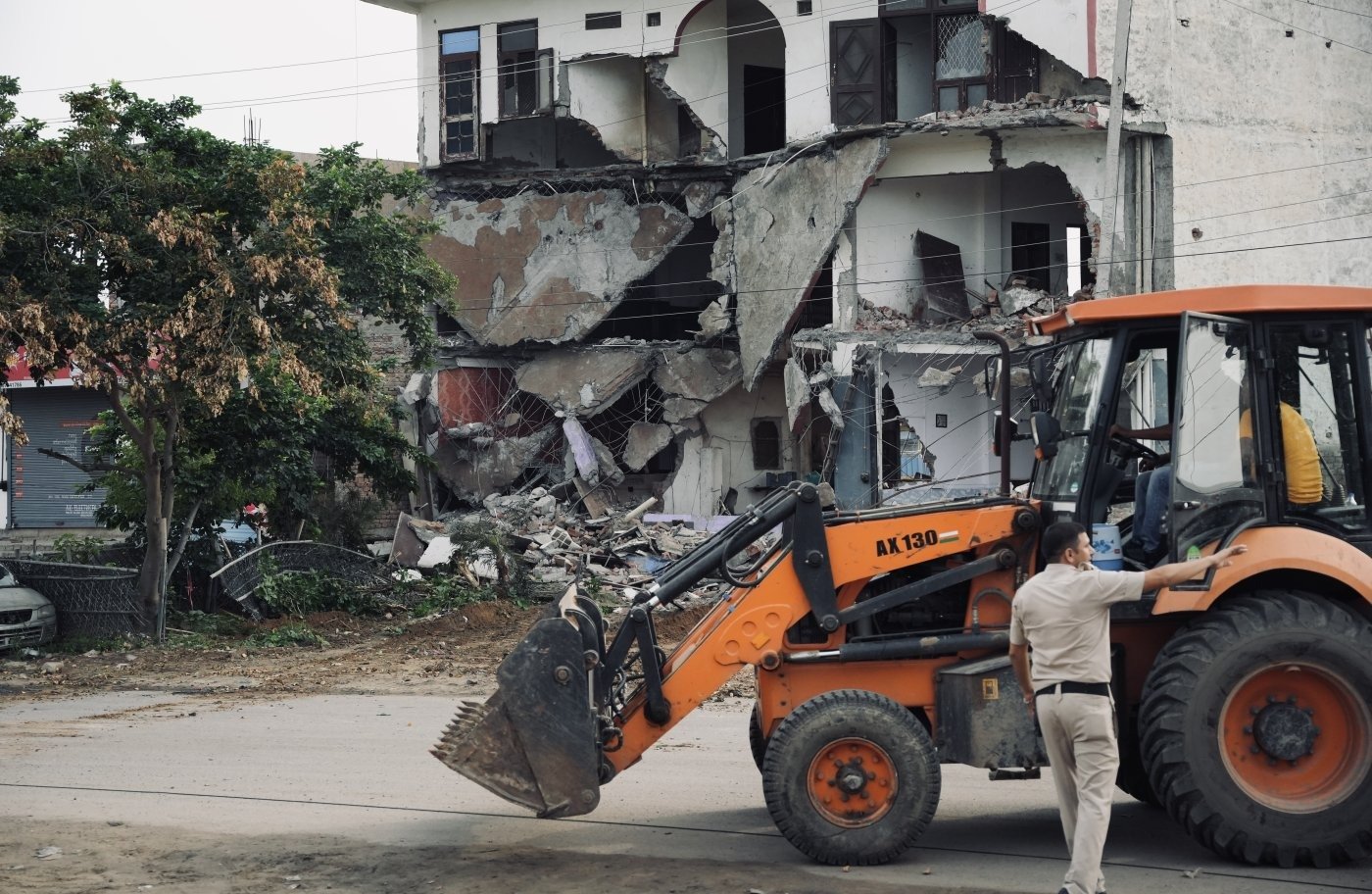
New Delhi: The use of the bulldozer, or more accurately the JCB backhoe excavator, as a retributive, political weapon began in Uttar Pradesh (UP) in 2020, spreading rapidly across states ruled by the Bharatiya Janata Party (BJP). It peaked in August 2023 when, over four days in Nuh, Haryana, JCBs razed between 500 and 1,250 structures across a 50-km area, nearly all Muslim owned.
In my journeys to Nuh at that time, the landscape resembled a battleground. Rage and despair had peaked among the residents of Nuh, one of India’s highest Muslim-majority districts outside Jammu and Kashmir, and identified by the government’s think tank, Niti Aayog, as the most underdeveloped district in the country in 2017.
Tensions rose after cow vigilante groups killed three men in two separate incidents (here and here) on suspicion of cow slaughter. Videos linked prominent Bajrang Dal activists to the incidents, but few arrests followed. Bajrang Dal leader Monu Manesar posted a video with sexualised taunts against Muslims announcing a visit to Nuh, prompting the arrival of busloads of armed Hindu extremists.
Six people, three Hindus, two Muslims and one Sikh, were killed in the violence that erupted around noon on 31 July 2023 after a religious procession organised by a Hindu militant organisation, the Vishwa Hindu Parishad—and infiltrated by Hindu extremists wielding swords and firing guns—made its way through Nuh. The violence reached Delhi’s doorstep. Rioters from both communities burnt vehicles and shops. A mosque in Nuh was set on fire on 2 August.
Then, the State stepped in, detaining nearly 150 Muslims, including minors, and demolishing Muslim properties.
In Nuh town, at least 30 permanent buildings, including a four-storey hotel, were demolished, along with medical stores, vending kiosks, and repair shops. Scroll.in reporters documented demolitions in villages like Tauru, Nalhar, Nagina, and Firozepur Jhirka, 50 km away, targeting Muslim-owned homes, garages, pharmacies, labs, stores, eateries, and bakeries—many built under government schemes.
Residents received as little as 10 minutes' notice in some cases.
Action Against Rioters—And A High Court
As the BJP government in Haryana started arresting people and demolishing the shops of alleged rioters, claiming they were “illegal constructions”, the Punjab and Haryana High Court, taking suo motu cognisance, stayed the demolitions, questioning whether buildings belonging to a “particular community are being brought down under the guise of law and order problem” and if the state was conducting “an exercise of ethnic cleansing”.
Three days after this observation, the bench of Justice G S Sandhawalia and Justice Harpreet Kaur Jeevan was replaced by Justices Arun Palli and Jagmohan Bansal ahead of the next hearing on 11 August.
With Muslims being the overwhelming number of those arrested, fear of retribution or being implicated in false cases stopped many Muslims from filing complaints, Article 14 reported.
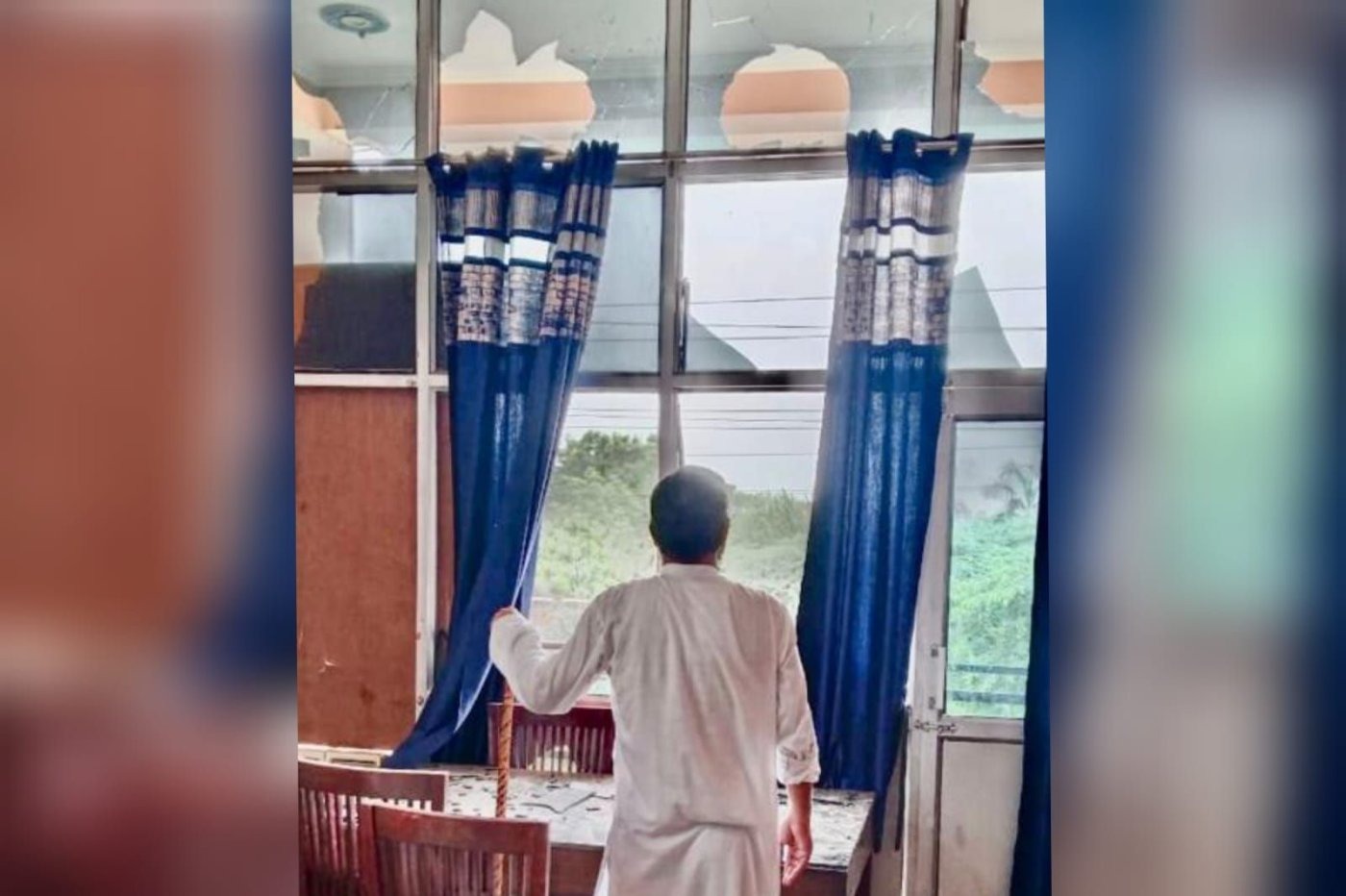
Nationally, such demolitions echoed patterns in Uttar Pradesh and Madhya Pradesh, where states cited anti-encroachment laws but disproportionately affected Muslim properties post-2020 protests against India’s new citizenship law, criticised as being discriminatory to Muslims.
The demolitions gained real ground in 2022, as demolished properties belonging almost entirely to Muslims after communal riots incited by Hindu extremists in four BJP states over several months, as Article 14 had reported.
Such demolitions, mostly carried out by JCB—Joseph Cyril Bamford Excavators Ltd, to use the full form of the company that makes them, deny citizens a host of rights, including the fundamental right to be heard. In most cases, no notices were served, as many laws require and various court judgments have confirmed.
The cases filed by police follow a template of partisan investigations and legal action, often with dubious evidence.
A year after the Nuh demolitions, an undergraduate student and nine other Muslim men accused in the killing of the Bajrang Dal activist remain jailed under India’s anti-terror law, despite obvious inconsistencies in witness testimonies. A two-month Article 14 investigation revealed conflicting witness accounts, copy-pasted confessions and unsubstantiated claims of links with terror group Al Qaeda.
Supreme Court Order Ignored
After repeated and widespread demolitions, the Supreme Court, on 9 November 2024, banned demolitions without prior notice and hearing, deeming them illegal. Yet demolitions persisted, leading to contempt notices (here, here and here). In Maharashtra, for instance, police razed a Muslim family's scrap shop after a complaint that their teenage son had cheered for Pakistan during a cricket match.
The demolitions after the Supreme Court order were not limited to BJP states. In Punjab, run by the Aam Aadmi Party, the government demolished homes of drug peddling suspects, claiming proceeds funded them.
In UP's Hata, part of a mosque was demolished without hearing from the management. In Sambhal, a Muslim family's factory faced similar action without notice.
In Gujarat's Beyt Dwarka, in January 2025, over 250 Muslim homes, mosques, and dargahs were razed, displacing fisherfolk, while sparing Hindu neighbours. A month later, a decades-old Kushinagar mosque was demolished. Five months after the Supreme Court order, a large-scale eviction unfolded in Ahmedabad’s Chandola Lake, as authorities demolished 4,000 structures at 3 am and detained 890 people, including 219 women and 214 children.
Authorities linked the drive to the April 22 Pahalgam terror attack killing 26 tourists, including Gujaratis. The deputy commissioner of police claimed the lake harboured "Bangladeshi aliens and anti-national elements," including an al-Qaeda module. The Gujarat High Court refused a stay, citing the lake as a notified water body, exempting notice or rehabilitation.
Uttar Pradesh demolished over 250 structures across Nepal-border districts like Pilibhit, Shravasti, Balrampur, Bahraich, Lakhimpur Kheri, Siddharthnagar, and Maharajganj in 2025, including mosques, madrasas, and mazaars or shrines. In Shravasti alone, 149 structures were razed on government and private land. Lucknow saw a madrassa and other properties targeted.
In Uttarakhand's Kashipur, five mazaars in Kundeshwari were demolished under heavy police security, as officials claimed they were illegally built on government land. "These tombs have been here for decades... They were part of our identity," resident Mohammad Rizwan was quoted as saying in Clarion India. "This is not justice, this is punishment for being Muslim," added social worker Parveen Ahmed.
Government records showed 537 Muslim religious structures were razed in Uttarakhand in 2024-25.
In Ramnagar, Uttarakhand, a mazaar was removed from a college ground for distracting students. In Chhattisgarh, officials evicted 60 Muslim forest families while sparing Hindu neighbours. In Bareilly, post-clashes over "I Love Mohammad" posters, a Muslim wedding hall was bulldozed.
Instant Justice via Demolitions
Other states, too, freely ignored the Supreme Court order, using demolitions as swift punishment for alleged crimes by Muslims in 2025.
In Rajasthan's Jaisalmer, five shops of men accused of murdering a Hindu anti-poaching farmer were razed. In Beawar, notices were issued to an entire Muslim neighbourhood, including a mosque and graveyard, after sexual assault accusations.
Uttar Pradesh's Meerut saw a housing project partially demolished over claims of exclusive Muslim sales and an internal mosque. Madhya Pradesh's Sehore razed a home for alleged conversions to Christianity. Bhopal targeted three Muslim men's homes in a so-called love jihad case. In Ujjain, seven Muslim men were beaten in public and their homes demolished for alleged slaughter of a pregnant cow.
All these cases reflect a national pattern where demolitions bypassed trials, mirroring UP's pre-2024 "bulldozer justice" under Yogi Adityanath, now emulated elsewhere despite court bans.
The Role Of The JCB
Many excavators and bulldozers have been used to deliver retribution to Muslims, but the leading tool has been the brand now known generically as JCB, a British company that is now a multinational producer. The JCB has become a symbol of Hindu nationalism, used by the BJP and its supporters to menace Muslims and signify victory over them.
In 2022, after Bengali Muslims' homes were demolished in Delhi's Jehangirabad slum, BJP spokesperson G V L Narasimha Rao tweeted—then deleted—that JCB stood for "Jihad Control Board."
In 2024, over 120 writers urged JCB to end its literature prize sponsorship, accusing the company of hypocrisy over its links to "bulldozer justice" against Muslims.
The South Asia Solidarity Group's January 2025 report, "Stop JCB’s Bulldozer Genocide", detailed the JCB's complicity in attacking Muslim homes. It noted JCB chairperson Anthony Bamford's UK Conservative ties and Boris Johnson's 2022 India photo-op on a JCB days after Jahangirpuri.
Amnesty International's February 2024 report confirmed the use of JCB machines in 33 of 63 demolitions. The group argued JCB violated human rights due diligence laws by enabling extrajudicial punishment targeting Muslims after displays of Hindutva power. Nationally, JCB became synonymous with such actions, used in over two dozen states since 2017.
The wide use of JCB machines reveals that JCB is the “brand of choice” for these purposes, reported Amnesty, noting that for victims, the brand’s name has become a generic term for bulldozers.
Fourth of a six-part series.
(Harsh Mander is a peace and justice worker and writer. Omair Khan provided research support. This work was supported by Diaspora In Action for Democracy and Human Rights.)
Get exclusive access to new databases, expert analyses, weekly newsletters, book excerpts and new ideas on democracy, law and society in India. Subscribe to Article 14.