
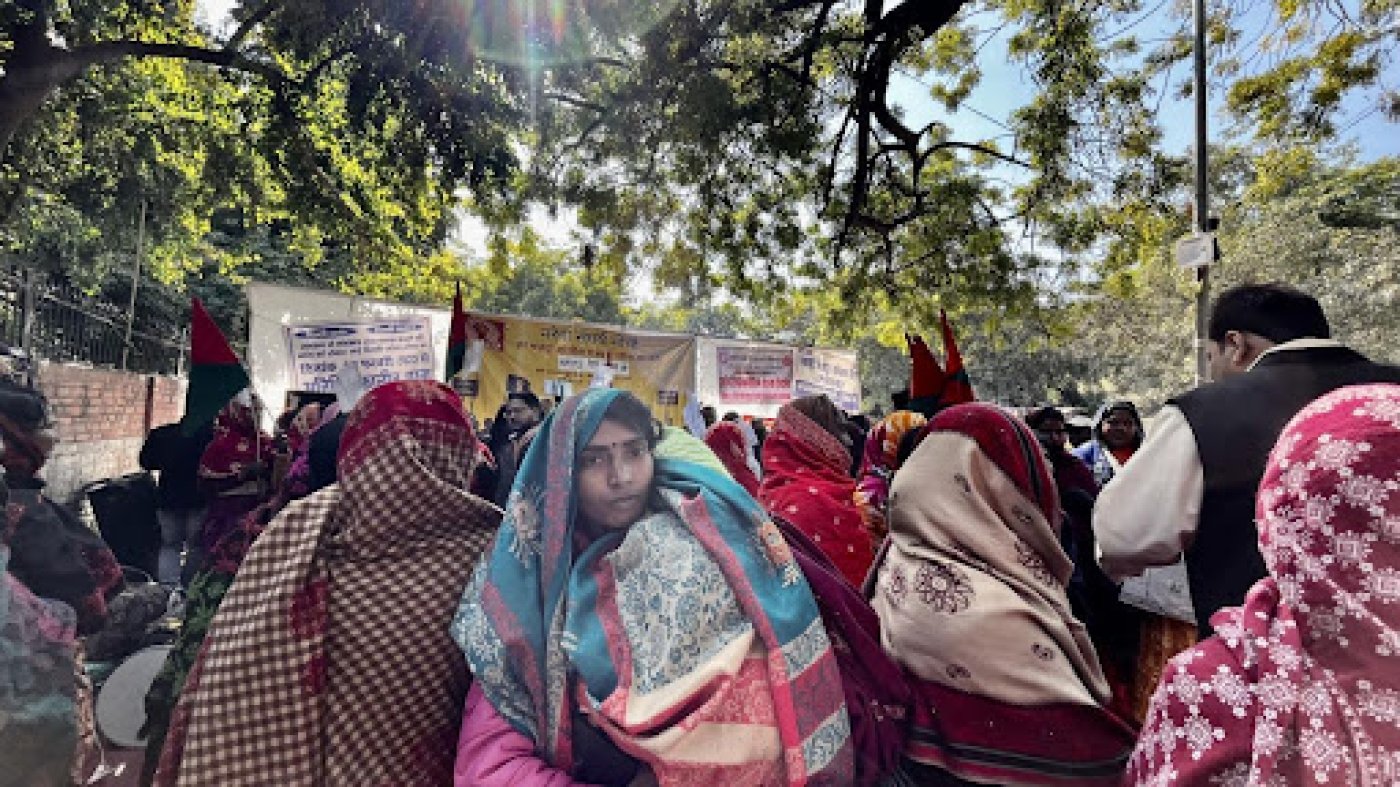
Mumbai: “An insult to Mahatma Gandhi,” some opposition leaders declared on Friday, 19 December, 2025, after the hasty repeal of the Mahatma Gandhi National Rural Employment Guarantee Act (MGNREGA), 2005. Others saw the hand of the Rashtriya Swayamsewak Sangh with what has been called the world’s largest make-work programme, citing its long-standing discomfort with Gandhi. Still others mocked the manufacture of acronyms that now occupies centre-space in policy-making. They were referring to Viksit Bharat–Guarantee for Rozgar and Ajeevika Mission (Gramin)—or G-RAM-G, the law that will replace MGNREGA.
All of this is true. All of it could sustain columns of commentary, but we’ll skip forward from the political theatre, because the damage is real and substantive.
At this moment, nearly 121 million Indians who are currently active MGNREGA workers and their families find their lives and livelihoods fundamentally altered by a decision that Parliament spent barely a couple of hours discussing.
The government argues that “the overall architecture of MGNREGA had reached its limits”, and that G-RAM-G represents an upgrade—one that fixes structural weaknesses while enhancing employment, transparency, and accountability. This claim collapses under even cursory scrutiny.
The problems most often cited as evidence of MGNREGA’s failure—underfunding, delayed wage payments, and weak enforcement of statutory guarantees—are not design flaws. They are all failures of administration.
“MGNREGA has captured the world’s attention with its demonstrated achievements and innovative design,” said an open letter signed by Nobel laureate Joseph E Stiglitz, World Inequality Lab co-director Thomas Piketty and other economists on 19 December. “To dismantle it now would be a historic error.”
The question of whether MGNREGA needed replacement—and if so, with what—is answered by recent memory.
When millions of Indians, forced out of jobs and rented homes during the Covid-19 lockdown in March 2020, walked back to their villages, demand for work under MGNREGA surged dramatically. In FY 2020–21 alone, the central government spent Rs 1.11 lakh crore on the programme as 85.3 million households sought employment. For these families, the scheme functioned exactly as intended, as a survival mechanism and a safety valve against hunger and debt.
The MGNREGA guarantees 100 days of wage employment each year to any rural household whose adult members volunteer to do unskilled manual work. Crucially, it is demand-led: people seek work when they need it, not when the state finds it administratively convenient.
That principle, central to the Act’s moral and economic logic, is now under threat.
A Shift In Fiscal Responsibility
In explaining the transition from a central sector scheme to a centrally sponsored one, the Press Information Bureau deployed a smattering of euphemisms—“local nature of rural employment”, “regional realities”, “cooperative partnership”, “objective parameters”. The core shift, however, is that under G-RAM-G, states will now be required to finance 40% of the employment guarantee bill.
Many states are already grappling with constrained finances and, predictably, the poorest states will suffer first.
The new scheme increases the total number of days of work promised, from 100 to 125 a year. This is hardly pathbreaking. Back in 2014, a decision was made to increase NREGA work days from 100 days to 150 days in Maoist-affected districts and for tribals who are beneficiaries under the Forest Rights Act; the Odisha government in 2022 decided to provide an additional 200 days of employment under MGNREGA in 20 migration-prone blocks of four districts.
In any case, the number of workers who received the full quota of 100 days of work is small—just 4.07 million families in 2024-25.
The Fallacy of ‘Seasonal Suspensions’
Most bewildering is G-RAM-G’s proposed 60-day suspension of employment guarantee work during sowing and harvest seasons, justified on the assumption that labour is more productively employed on farms during these periods. This betrays a profound misunderstanding of rural life.
Agrarian distress is often most acute precisely at sowing and harvest. When the monsoon arrives late—or arrives and then disappears; when fields flood just before harvest—these moments have historically seen sharp spikes in demand for MGNREGA work. The programme has functioned as a buffer against such uncertainty.
The suspension proposal also rests on a false binary—one that treats farmers and workers as separate categories. In reality, many farmers are MGNREGA workers. Small and marginal cultivators routinely supplement farm incomes through the programme. The idea that rural households may be slotted neatly into fixed occupational identities exists only in technocrats’ spreadsheets, not in rural India.
After all, public works programmes do more than smooth consumption; they reduce uncertainty about future income. This also allows farmers to take risks, investing more at sowing time, for instance, knowing there is a safety net if the season fails.
Meanwhile, in one stroke, the new law invisibilises the millions who do continue to seek MGNREGA work during the kharif or monsoon crop season. In July 2025, during peak sowing time, 870,000 households sought work in Maharashtra, 920,000 in Jharkhand, and 520,000 in Odisha. Across India, 16.5 million people demanded work that month alone. G-RAM-G says little about them.
MGNREGA has had a measurable impact on rural wages, particularly at the lower end of the labour market. A mandated 60-day suspension can only distort this trajectory.
Wages, Women, and Work
The programme has also been transformative for women. By offering work close to home, equal wages, and predictable payment systems, MGNREGA expanded women’s participation in the rural workforce and strengthened their bargaining power within households. Any new law that fails to centre gender will quietly erase these gains.
In 2018, I met Shailaja Naravade in Marathwada, a woman farmer who had just been elected president of an all-women farmer-producer organisation. She described the drought of 2003, two years before the MGNREGA was enacted. At one point, there was no food, she said, and they were eating at the neighbours’ home. A land-owning caste, they had never worked on anyone else’s fields and certainly not at employment guarantee sites that were operational in Maharashtra since the drought of 1972. Finally, it was her mother-in-law who decided that between wounded pride and living on charity, they should choose to work. The two signed up for work at a stone-breaking site. They wore their best sarees to work the next day.
Narvade and the women she befriended at the construction site, and later mobilised, became champions of land ownership for women in Marathwada.
That brings us to the deeper question about the manner in which laws are now made. Some of India’s most consequential social legislations were not products of speed or executive fiat, they were forged through prolonged public engagement—through negotiations with social movements, state governments, administrators, and those who would eventually be governed by them. The Right to Information Act, the Forest Rights Act, and MGNREGA itself emerged from years of debate, contestation, and revision.
The repeal of MGNREGA reflects a deeper reordering of who wields power in our democracy. Laws were once borne out of dialogue with workers, states and social movements; they are now drafted within the executive and presented to Parliament.
In replacing a rights-based guarantee with a scheme governed by administrative discretion, the state is not achieving better legislative efficiency; it is quietly hollowing out accountability.
(Kavitha Iyer is a senior editor with Article 14 and the author of ‘Landscapes of Loss’, a book on India’s farm crisis. This is a version of an editorial sent to subscribers.)
Get exclusive access to new databases, expert analyses, weekly newsletters, book excerpts and new ideas on democracy, law and society in India. Subscribe to Article 14.