
Bengaluru: On the endless scrolls of mobile phones and in reams of newsprint, the numbers emerging from India’s ‘special intensive revision’ of electoral rolls are so humongous as to desensitise us to their meaning: 20.7 million names excluded from the draft rolls in Maharashtra; 28.9 million in Uttar Pradesh; 10 million in Karnataka; 9.7 million in Tamil Nadu; 9.1 million in West Bengal; 6.1 million in the third phase alone.
Over more than 430 days, the SIR has rolled out across 30 states and union territories. The names excluded have now crossed 133 million. But these numbers represent people—voters who in turn represent, if you can still call it that, the world’s largest democracy. The voter rolls are you and me and everyone eligible to vote. Such a mass exclusion, in an exercise beset by chaos, confusion and confrontational callousness, threatens not just our votes but India’s constitutional promise of universal franchise. What we are witnessing is mass disenfranchisement on a scale that threatens that promise.
This process has been road-tested. It unfolded—disastrously—in Assam from 1997 to 2019 through the cruel “D-voter” (doubtful voter) system and the National Register of Citizens (NRC), ostensibly to identify and exclude undocumented Bangladeshi migrants. Article 14 has tracked what followed: In 2020, we found Bengali-speaking Muslims subjected to arbitrary citizenship proceedings in which even documentary proof or making it to the NRC did not seem to matter. By 2025, even these legal fig leaves were falling off, as Assam pioneered a new model of mass disenfranchisement, empowering bureaucrats to declare people illegal migrants and expel them within 24 hours, bypassing even the dubious proceedings of quasi-judicial Foreigners Tribunals.
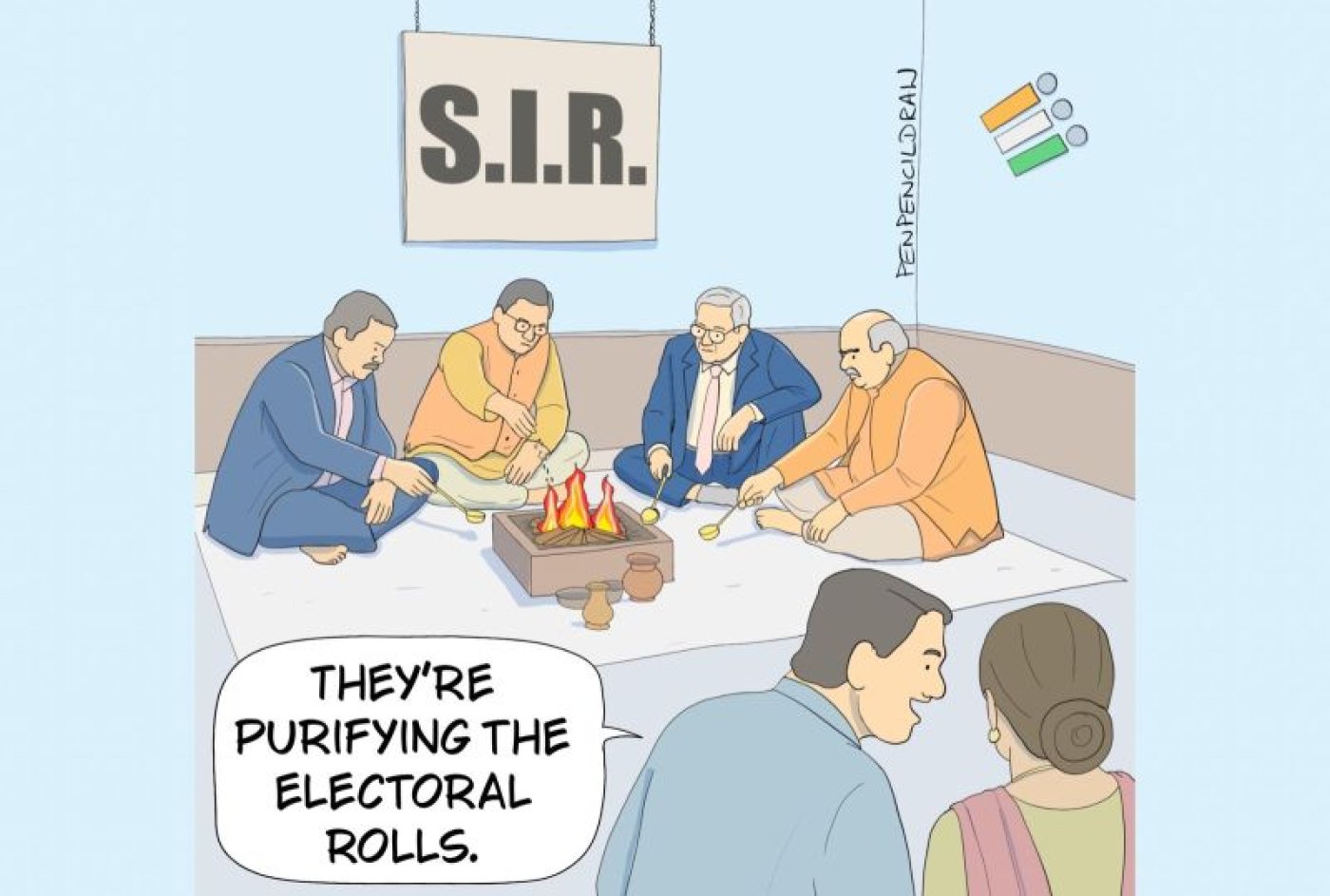
Strong indications suggest a backdoor NRC is now being replicated nationwide through the SIR of electoral rolls. This time, a much wider class of citizens is being subjected to arbitrary standards of documentation and inclusion, as the once-independent Election Commission embraces the ruling party's goals. The fact that the home minister and the chief election commissioner (CEC) use the same term—“purification”—with its unmistakable religious imagery, to describe SIR tells us something about the exercise’s political origins and intent.
The SIR is creating an adarsh, or ideal, voter—documented, traceable, legitimate, and, above all, acceptable to the state—and casting everyone else as someone whose right to vote must first be proved. As someone recently said to me on Twitter, after demonetisation, we now have devoterisation, unfolding with equal mayhem. What we are witnessing is either extreme incompetence or deliberate action, or both.
The Mayhem
The failings of this unconstitutional quest present themselves every day. Names secretly struck off even before the SIR begins, as in Delhi, where 1.1 million names disappeared—no forms were generated, no notices issued; lists riddled with spelling mistakes; voters marked ‘shifted’ or ‘absent’ when they weren’t; or simply missing from voter or deleted lists, despite submitting the forms the Election Commission demands.
The ‘block-level officers’ or BLOs, the spearhead of the SIR (mostly school teachers, clerks, engineers and other government officials dragged away from their regular duties), are harried, often elusive and unclear about what they are doing, or simply not showing up at our doorsteps, as we are assured they most certainly must.
My BLO, an amiable revenue department official, was helpful, available on WhatsApp, but clearly could not cope with the scale of his SIR duties. When I found out where he was and went to collect my SIR form, he asked if I could distribute forms to everyone in my building. What about going door to door, as the Election Commission requires? I asked. “They may say, but that is impossible,” he replied.
In city after city, reports pour in of the mandated door-to-door verification stuttering or absent: in parts of Hyderabad, officials found only about 5% of households had been reached; in Karnataka, 35 BLOs faced show-cause notices after complaints that they were not visiting homes; and in Mumbai, more than 300 BLOs initially stayed away from the exercise.
After the online and offline detective games that millions must endure—helped greatly by others' experiences, detailed in my neighbourhood WhatsApp group—I tracked down the 2002 voting details for myself and my mother in a constituency on the other side of town. Clutching the prized forms like they were gold, I submitted them. When both our names appeared on the draft electoral roll on 24 August, I heaved a sigh of relief.
I could not have been more wrong.
The Trauma Comes Home
Two days ago, the neighbourhood WhatsApp group was in ferment. Many had discovered—in the mysterious way these things are discovered in India—that they had received notices to appear before a “magistrate” with documents proving their family links or birth credentials. I sympathised with my mostly Muslim and Christian neighbours, but felt secure because I was on the draft roll—and, secretly, because I was Hindu and upper class.
Then someone posted the list of those summoned. Page after page seemed to contain the entire neighbourhood. And then I found my name on it. The Election Commission has now posted the reasons for the notices online. Mine says “self-name mismatch”. But the spelling of my name is exactly the same as it was on the electoral roll 24 years ago in 2002. So what, exactly, is the mismatch?
In any case, no one knows why the Election Commission has set 2002 as the reference year nationwide for establishing voter credentials. It is as arbitrary as anything else about the SIR.
The BLO is supposed to deliver a notice explaining why I have been flagged, but he says it's impossible. Of the documents on the list of acceptable proofs, I have only my Class 10 marks card and a passport. Remember, the government has already said that a passport is not proof of citizenship, which the CEC has said is one of the goals of this exercise. I have no birth certificate. So, if the SIR eventually morphs into an NRC, my Class 10 marks card appears to be my only hope of eventually proving that I belong to this country.
Others are worse off. Many work outside Bengaluru or abroad and may not even know their voting rights—and perhaps their citizenship—are at stake. Those outside our WhatsApp group may never hear about the notices. When I went to collect mine, I found the BLO right in front of me, besieged by people in a jam-packed school classroom. He couldn't simply hand over the notices: each had to be painstakingly scanned, and an acknowledgement torn off.
After 45 minutes of sweaty chaos, I gave up and left. Similar scenes were reported citywide that day.
The Right To Belong
What began as a bureaucratic exercise has become a chaotic, traumatic and unfair test of whether citizens can prove their right to vote—and, for millions, their right to belong to India.
Of the documents on the list of acceptable proofs, I have only my Class 10 marks card and a passport. Remember, the government has already said that a passport is not proof of citizenship, proving which, the CEC has said, is indeed one of the goals of this exercise. I have no birth certificate. So my Class 10 marks card appears to be my only hope of proving that I belong to this country.
Others are far worse off. Many make their living out of town or abroad and may not even know that their voting rights—and perhaps their citizenship—are at stake. Some, particularly those not on the WhatsApp group, may never hear about the notices until a kindly neighbour tells them.
My hearing is at a local government college on 28 September. The last date for the official “claims/objections” process is 22 October, leaving the “magistrates”, or electoral registration officers, less than 60 days to decide the electoral—and possibly citizenship—fates of 4.38 million in Karnataka, of which 2.4 million are in Bengaluru alone. The hearing is at the end of a lane that is dug up and accessible only by two-wheeler, making it impossible for my 90-year-old mother to reach. The BLO says physical presence is mandatory. I am hoping her hearing will be held at home, as it is supposed to be.
The BLO pleads, indicating the disorder around him, how can I come? Then, he says, she is 90 sir, does she really want to vote? I bristle. She has voted for decades and will continue to do so until she can. Finally, he says, can you pick me up and drop me? I agree. He says, ok come on the date of her hearing. If people waiting do not object, I will come. So much for all those promises of reaching every voter. It’s bunkum.
As I write this, a frantic message arrives. The sender says her mother has received a notice too. She is in Malaysia with her family and won't be back until early October, but her hearing is scheduled for 11 September. She has no idea what to do. After I document my own experience (https://x.com/samar11/status/2096081977967526118?s=20), more messages and calls arrive from people whose sons, daughters or they themselves cannot return by the date of the hearing. I have nothing to offer them.
The Suspicion
No one denies that electoral rolls need periodic revision. Voters may have moved, died or been duplicated. But the numbers being excluded here are so vast that they exceed the populations of entire countries. The Election Commission, not us, is responsible for finding out who has moved, died or been duplicated—and it is not meant to deny people their right to vote while it does so. A revision conducted in such a hasty, shambolic and traumatising fashion deserves only suspicion.
Even if we accept the strongest case for large-scale removal—that many of those scrubbed from the draft rolls are dead—the numbers are nowhere near sufficient to explain the scale of exclusion. The Sabar Institute, a small think tank that has provided us with intensive data analyses of the rolls, points out that 94% of those marked for deletion in Delhi are verified as alive, as are 92% in Hyderabad. As for those who have moved, moving does not mean they stop being voters. It is for the Election Commission to ensure that they can cast their votes.
These analyses are not easy because the Election Commission has made any independent scrutiny of its operations increasingly difficult. It continues to publish electoral-roll data largely as image files rather than machine-readable datasets, making it laborious to search, compare and analyse millions of entries—even though the Commission itself maintains the data in easily accessible structured form.
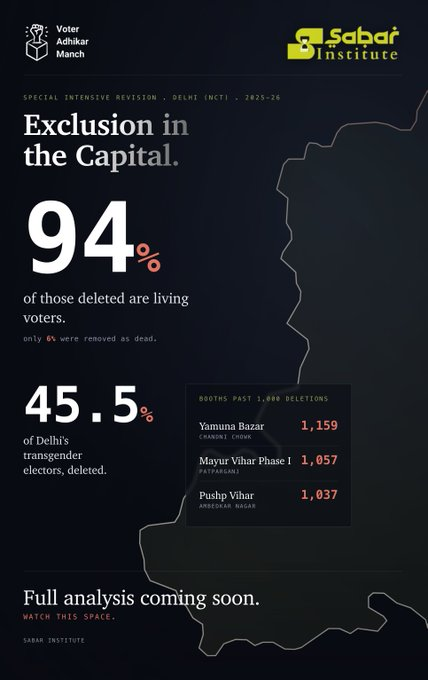
It is clear now that while anyone with privilege can be struck off, those who bear the most stress and trauma of the Election Commission’s special inquisition are the disadvantaged and dispossessed or women and minorities. For instance, Adivasis in Jharkhand have abandoned their work and lined up to display whatever documents they possess, scenes we have already witnessed in Bihar and West Bengal and are now unfolding everywhere, from heaving cities to remote backwaters. In Hyderabad, Muslim names account for 40.7% of those marked for deletion. In Mumbai, more than 3.6 million voters were excluded from the draft rolls, with deletion rates approaching 40% in several constituencies with large Muslim populations. In Delhi, 45.5% of transgender voters were excluded from the draft roll.
The SIR process has descended into such a farce that we can only watch aghast, grit our teeth and endure, or, like a former chief election commissioner, resort to humour. “For decades, India worried about population explosion. Every Census brought alarming headlines. There were Five-Year Plans, family-planning programmes, red triangles, slogans and seminars on population stabilisation. Demographers warned us that Indians were multiplying too fast,” wrote former CEC S Y Quraishi. “We need not have worried. The solution seems to have arrived from an entirely unexpected quarter: the Election Commission of India.”
Later, Quraishi, in an interview to The Wire, said, “Almost 15% of the population just wiped out, through a very artificial process. It is very sinister. It is very mischievous”.
What is the BJP or the government’s complicity in what the Election Commission is doing?
The Complicity
The government’s hand was always apparent in appointing Gyanesh Kumar as CEC. Before he was, Kumar, as a senior home ministry official, was involved in two of the BJP’s key ideological projects: the J&K Reorganisation Bill and setting up a trust to oversee construction of the Ram temple in Ayodhya. Kumar’s appointment was part of a larger change. Prime Minister Narendra Modi's government had laid the groundwork for appointing bureaucrats of its choice to the Election Commission.
A selection panel headed by Modi appointed Kumar as election commissioner just six weeks after he retired. He became CEC the following year under the same government-dominated appointment mechanism. In October 2024, writing for Article 14, investigative reporter Suchak Patel used the right to information law to reveal how one election commissioner was appointed hours after his resignation from government service, and two were selected from a list of 212 and appointed within 24 hours.
As for the BJP, its motives and methods often appear to coalesce with the Election Commission. As chief election campaigner, Modi has received a free pass from the Commission despite repeated complaints of breaches of its rules, whether by appealing for votes through inducements and using religious and communal slurs (here and here) in election speeches. Kumar has ignored Opposition complaints and responded to their delegations with hostility.
In the SIR, BJP workers or agents have been linked to attempts to delete Muslim names en masse. The latest case was in Jharkhand this week, with previous attempts reported from Odisha, Madhya Pradesh, Bihar, Uttarakhand and Assam, ranging from hundreds of Muslim voters in individual constituencies to 6,500 in Uttarakhand and 78,384 in Bihar’s Dhaka constituency. In Maharashtra, the BJP openly mobilised its cadre to use the revision of rolls to identify “ineligible” voters, invoking West Bengal's deletion of alleged infiltrators. The implications of these machinations are ominous.
As I wrote in March, millions of Bengali Muslims know now that spelling mismatches and birthdate errors can end not just their voting rights but also land them in detention centres and removal from Indian territory. The way the Election Commission revised the voter roll in West Bengal was so ham-handed that it appeared to not only dovetail neatly with the BJP’s desire for victory but also with the party’s larger project, which, as home minister Amit Shah put it, is to”‘detect, delete and deport”, a reminder of the party’s long-standing desire to create a national register of documented citizens. It failed in Assam, the laboratory, but the SIR serves as a handy backdoor to that ambition.
Over the years, the BJP has enthusiastically promoted its desire for an adarsh, or ideal, citizen. Now, the effort to create the adarsh voter is well underway. If the SIR is used to create a nationwide NRC, it may end up giving the government the data and means to, at best, arbitrarily make millions stateless, or, at worst, detain all those left out. Only a mass mobilisation might stop it, but too few Indians realise what is at stake.
(Samar Halarnkar is the founding editor of Article 14.)
Get exclusive access to new databases, expert analyses, weekly newsletters, book excerpts and new ideas on democracy, law and society in India. Subscribe to Article 14.