
Bengaluru: That an official communication from the country’s supposedly independent institution conducting supposedly free and fair elections would carry the seal of the ruling party is an indicator of two things: incompetence or complicity. In the case of India’s Election Commission, there is ample and growing evidence that it is guilty of both.
Issued on 19 March 2026, it was a routine letter, as you see below.
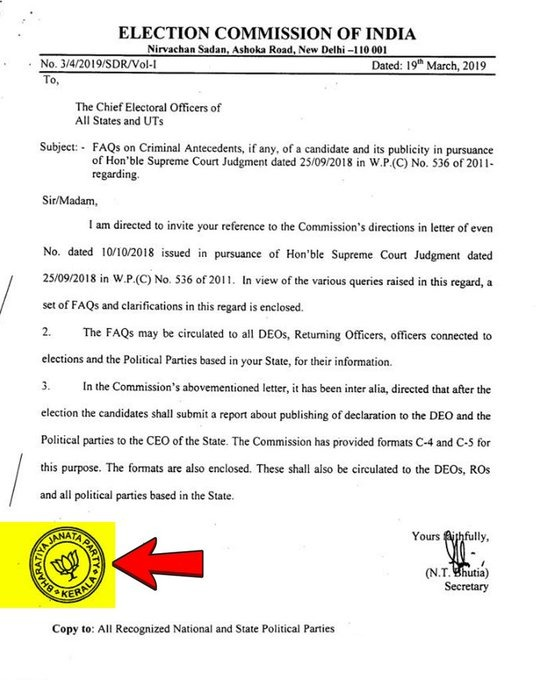
The incompetence is self-evident. The suspicions of complicity—hardly the first time—came because of the bumbling overreaction that followed.
Few bought the Election Commission’s “clarification” that the letter was “a clerical error”. Social media companies and hundreds of those who shared the letter received vague, misspelt threats from the police, who accused them of “abatement (sic)”—of what it wasn’t clear. The police claimed each post “blatantly insults” the Election Commission and “undermines communal harmony”.
Such made-up charges are, of course, par for the course in the Orwellian police state of Modi’s New India (where last week the police arrested and a magistrate denied bail to Muslims who broke their Ramzan fast by eating chicken biryani on a boat on the Ganga). Armed with ever-draconian powers, New Delhi now censors anything it does not like and is decentralising these powers: Any “officer specially authorised” can block a post, video or other online content.
For instance, a year after it was given the power to take down social-media content, a home ministry unit blocked 111,185 “suspicious online content”, according to the ministry’s latest report (page 281). There are no meaningful explanations given for “disabling of access to any information, data or communication link being used to commit an unlawful act”, or clarifying—as with the Election Commission's attempt to censor its faux pas—what is unlawful about such content.
Designed To Fail?
As it turns out, the letter was merely a blip in a more ambitious project to dismantle the one-person-one-vote system by creating a subset of “unpersons”, as George Orwell termed persons who were vapourised in his book 1984, his dystopian prediction of times to come. M S Golwalkar, one of Hindutva’s leading ideologues, presented his vision of nationhood in 1939, arguing for a future in which minorities must “adopt the culture of the nation… or live at the mercy”.
A theocratic state of the kind he envisaged is now emerging, and although he never said so, it would have to be a one-party state, simply because the majority of Indians are unlikely to electorally agree. It follows that a single-party state can never be created unless the ruling party in New Delhi gains control over the election process.
The Election Commission is—there is no other way to say this—systematically transforming the election process to favour the Bharatiya Janata Party (BJP). The latest in a long line of evidence comes from West Bengal, where the Commission’s process of revising the voter list, the special intensive revision (SIR) as it is called, is so chaotic that it appears designed to fail and remove as many minorities from the rolls as possible. Simultaneously, it is taking over the official machinery overseeing the elections, replacing tens of police and election officers with its own choices.
On 23 March 2026, we reported how the revision of West Bengal’s electoral rolls had removed or placed over 12 million voters under scrutiny—with half of these, more than any other state, ‘under adjudication’ after the final roll—a process marked by data errors and opaque notices. “Never before has the ECI announced elections in a state with the fate of nearly 10 per cent electors undetermined,” former election commissioner Ashok Lavasa wrote in The Tribune last week. Nine of 10 districts with the highest number of voters under adjudication have a Muslim voter population of 50% or more, we found, and women had been deleted from the voter list at a rate 7.1% more than men.
Soon after, the Election Commission published a “supplementary list” of voters: Of 3.2 million, 1.28 million had been knocked off the rolls. But it wasn’t clear whose names had been deleted or even how many. The Election Commission said it would release a list of “deletions” and “inclusions”, but it did not, The Indian Express reported. Many families reported some included and others deleted: parents, not children, brothers, not sisters.
The tragedy of errors cascaded on.
- On 23 March, less than 24 hours after the Commission said it had released the “first supplementary list”, its website showed almost all Bengal voters, including those who had been cleared, as “under adjudication”.
- The next day, the Commission blamed the error on a “technical glitch”, meaning it had checked just about half of the voters it was scrutinising, leaving 3 million in limbo.
- On 27 March, came the second list, but web pages containing data about deletions or inclusions could not be accessed due to “technical glitches”, The Hindu quoted a Commission officer as saying.
- On 29 March, the Commission released a “third supplementary” list, without disclosing the number of voters excluded or included.
With West Bengal elections on 23 April, about 2.2 million names have appeared on the first two lists, leaving 1.5 million voters effectively missing from the voter roll. As we shall see later, the right to vote isn’t the only thing those left out of the SIR will lose. The implications are grimmer.
The Fading Of Hope
There is a “crucial difference” between verification and denial of the right to vote, former chief election commissioner S Y Quraishi wrote this week in The Telegraph. “The Constitution permits the State to verify eligibility; it does not permit it to deny the right to vote because that verification could not be completed in time.”
“For decades, the Election Commission has translated this constitutional command into practice. Its campaigns have stressed that no voter should be left behind. It has gone to extraordinary lengths to operationalise that principle, including establishing polling stations for a single voter in remote locations. The chief election commissioner himself proudly announced booths for two, three or four voters. These are not symbolic gestures. They reflect a settled institutional philosophy that inclusion is the core of electoral legitimacy,” wrote Quraishi. “It is precisely this philosophy that is now under strain.”
With the legitimacy of the electoral process in question, the Supreme Court, supposedly overseeing appeals against the Commission’s conduct, said on 23 March—even as the Commission was bumbling along—that it would “consider” a request to extend the last date to freeze the electoral rolls in West Bengal. “Right now, things are going well,” said a bench headed by the Chief Justice. If the Supreme Court considers the current mayhem and trauma inflicted on millions and their inability to appeal as normal, then there is little hope the Election Commission can be stopped.
In October 2025, after a similarly chaotic revision of voter rolls in Bihar (which we reported in July 2025), our analysis revealed three fault lines in recent years in India’s election process—tampering with electoral rolls, manipulation of the voting process, and skewed counting of votes—fuelled by partisan misuse, opaque systems, and an Election Commission increasingly unaccountable after new legal immunities.
In 2023, the Modi government laid the ground for that unaccountability by providing immunity to the chief election commissioner (CEC) and election commissioners from any civil or criminal case for action while in office. That may explain the belligerence of CEC Gyanesh Kumar, who after his appointment in 2025 has bent the Commission more towards the BJP than ever.
Kumar—who in his previous avatar as a bureaucrat played a key role in setting up the trust that runs the Ram temple at Ayodhya and executing the abrogation of Article 370 in Kashmir—has tussled with, mocked and ignored the Opposition and its complaints, ending in a desperate, unprecedented and symbolic attempt to impeach him in March. The government and the BJP, both fervent supporters of Kumar’s Election Commission, were having none of it.
A Chronology Of Capture
There is a chronology of events that points not just to the Election Commission's collusion with the government but also to New Delhi’s larger master project—using the slapdash revision of voter lists to turbocharge the equally chaotic removal of alleged “infiltrators”.
With little legal oversight, hundreds or thousands of people, mostly Muslim, have been deemed to be illegal immigrants in recent years. Many, especially in Assam, have been interned in detention camps, and others have been forced into Bangladesh. Parents have been sundered from children, spouses from each other. The logical next step in this plan is control over who gets to vote—and who does not.
In January 2026, the Election Commission told the Supreme Court that citizenship checks were limited to voter registration, not deportation. Yet, in Parliament, on 10 December 2025, home minister Amit Shah, defending the SIR, said his party intended to use it to “detect, delete and deport”. So far, 70 million names have been removed from voter rolls nationally. One of the endpoints of this exercise certainly appears to be deportation.
The nationwide drive to find and deport illegal Bangladeshi immigrants picked up pace in February 2025, when home minister Amit Shah ordered the Delhi police to crack down on illegal immigrants from Bangladesh and Myanmar. Article 14 reported in May 2025 how Bengali-speaking Muslims were being indiscriminately detained for days in different BJP-ruled states—Gujarat, Rajasthan, Delhi, Uttar Pradesh, Maharashtra, Odisha and Assam.
“Aap chronology samjh lijiye,” Shah had said in West Bengal in 2019. Understand the chronology. “First, the Citizenship Amendment Bill will be brought in,” said Shah. “All refugees (Hindus) will be given citizenship. The NRC (National Register of Citizens) will be carried out thereafter. Therefore, the refugees need not worry.” Infiltrators (Muslim), he said, should worry. The NRC is an official register intended to identify legal citizens of India and distinguish them from undocumented migrants. Except for Assam in 2019, it has never been conducted nationwide.
A Sleight Of Acronym
In Assam, where 1.9 million people were excluded from the NRC conducted under Supreme Court of India supervision, the exercise has stalled, with both state and union governments disputing its outcomes. Those left out continue to exist in a twilight zone, their legal status unresolved. With the NRC failing to move forward, the SIR can now be used to exclude the same populations through comparable administrative processes—with ominous implications.
On 21 March, as the Commission constituted 19 tribunals to hear “doubtful” cases under adjudication in West Bengal’s SIR, The Times of India reported that the “implications are much more than not being able to vote”.
“If the tribunals rule them as ineligible to be in the roll—essentially for being non-citizens—they will have to be confined to detention centres and deported to their country of origin,” The Times of India reported.
Millions of panicked Bengali Muslims across the country know, more than anyone, that spelling mismatches and errors in birth dates can land them in detention centres or removal from Indian territory. They know that the NRC, in the form of another acronym, has started.
Back in West Bengal, we will continue to quibble over and be distracted by the details of disenfranchisement.
As Quraishi noted, there are now two options available to the Election Commission in West Bengal: either use the existing voter roll or accept all pending applications for the coming elections with the proviso that they will be decided later. That it is a constitutional promise that every eligible Indian shall be a voter, he writes, is a matter of right. It is not subservient to the Election Commission's failure.
He does not say what is to be done if the failure is deliberate.
(Samar Halarnkar is the founding editor of Article 14.)
Get exclusive access to new databases, expert analyses, weekly newsletters, book excerpts and new ideas on democracy, law and society in India. Subscribe to Article 14.