
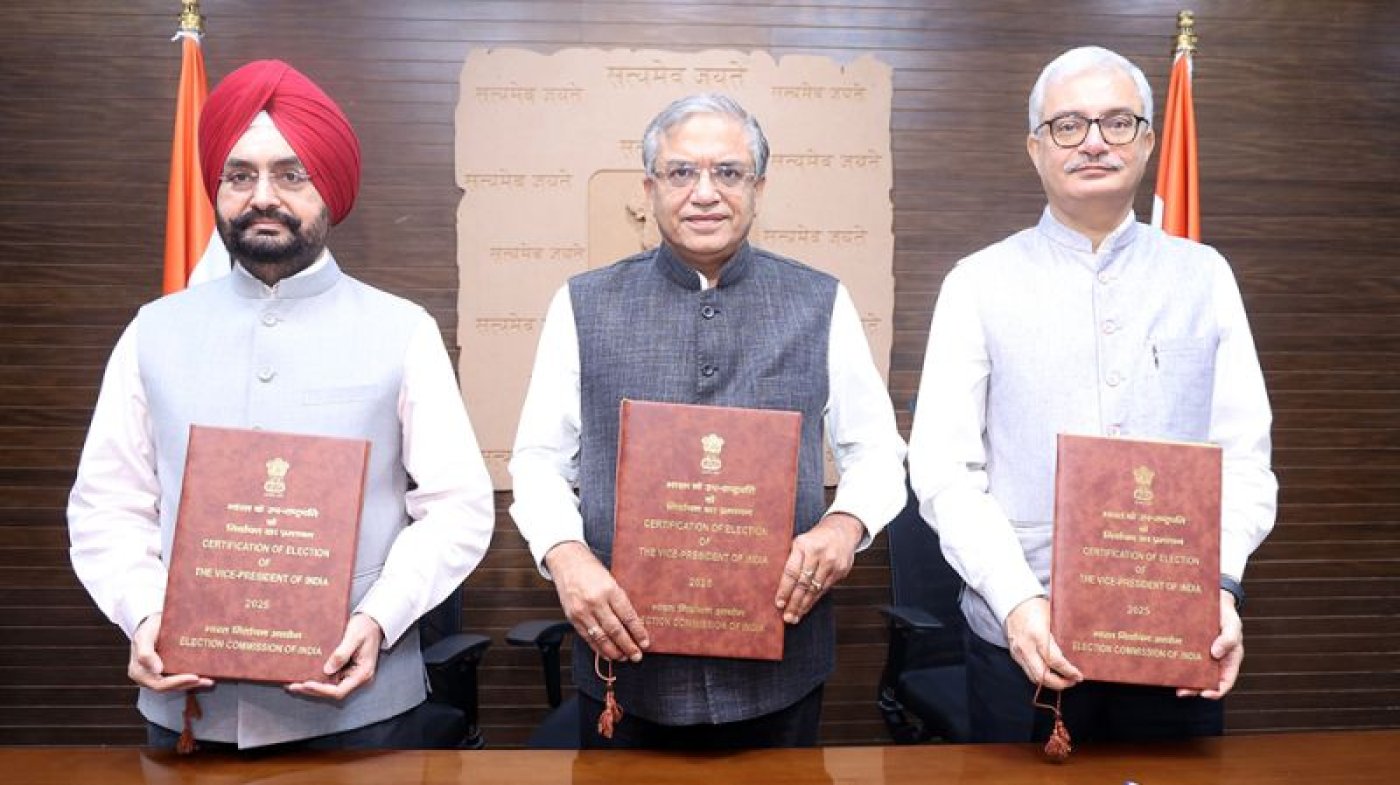
New Delhi: Unrest sweeping India over the subversion of its once-storied electoral system converges on one man: Gyanesh Kumar. But the roots of his alleged bias towards the ruling party lie in how he was appointed.
Much has been written about how the union government took over appointing the chief election commissioner (CEC) and his fellow commissioners. It removed the Chief Justice and created a 2:1 selection panel, in which the Prime Minister and a cabinet colleague can outvote the Leader of the Opposition.
But the Commission’s independence seems compromised long before that panel meets. The bureaucratic feeder system that decides who gets to the table compromises it.
Before the selection committee meets, section 6 of a controversial 2023 law that changed the process tasks a search committee with shortlisting five names. The cabinet secretary and two other secretary-rank officials head the committee, and the names come overwhelmingly from serving or retired Union secretaries.
Unsurprisingly, the record shows it.
Since mid-2001, 20 people have served on the Election Commission, all former civil servants: 18 from the Indian Administrative Service (IAS) and two from the Indian Revenue Service (IRS). None came from the judiciary, academia, politics or any other background.
The three current members, Gyanesh Kumar, Sukhbir Singh Sandhu and Vivek Joshi, are all IAS. Kumar is a Kerala-cadre officer of the 1988 batch, Sandhu is a former Uttarakhand chief secretary, and Joshi is a 1989-batch Haryana-cadre officer.
The search committee is no neutral filter, and it differs sharply from how two other democracies choose their election officials.
South Africa & The UK
Two Commonwealth democracies show what a different feeder pool looks like.
In South Africa, commissioners have been judges and lawyers, career election administrators, and academics, while in the UK they have included regulators, broadcasters, academics, party-nominated politicians, and at least one former senior civil servant as chair.
In South Africa, the Electoral Commission Act requires the President to appoint the commission’s five members, one of whom must be a judge, only after a process shared by Parliament and the judiciary. A panel chaired by the Chief Justice, along with the heads of the Human Rights Commission, the Commission for Gender Equality and the Public Protector, interviews candidates and submits at least eight names.
A National Assembly committee “proportionally composed of members of all parties” then nominates from that list, and the Assembly approves the nominees by majority vote. Candidates come from outside any single administrative cadre, and the executive does not control the shortlist.
The UK’s Speaker’s Committee on the Electoral Commission works differently but aims at a similar result. The Crown appoints commissioners after an address from the House of Commons, and a Speaker’s Committee sets the procedure and oversees it.
The Committee is not formally regulated by the Commissioner for Public Appointments, but it follows that office’s best-practice guidance. The Commons can also say no. In January 2018 it declined to appoint the Committee’s first nominee, forcing a fresh recommendation.
The PMO’s Remote Control
India’s 2023 Act runs the other way. The cabinet secretary, an officer who reports, functionally, to the Prime Minister’s Office, heads a committee that picks from among his own peers.
Section 8(2) then lets the selection committee appoint someone entirely outside the search committee’s panel. That collapses whatever discipline the shortlist stage offered into pure executive discretion.
The Act also requires appointees to have held secretary-level posts, so eligibility effectively rests with career bureaucrats. That creates what we call a “late-career incentive problem”.
A secretary a few years from retirement knows who hands out the good jobs afterwards: election commissioner posts, tribunal seats, a governor’s chair. All of them depend on the government’s goodwill. So, they have every reason to avoid any stance that might look like opposition, years before any appointment is on the table.
How The Process Was Rewritten
Article 324(2) of the Constitution left the appointment procedure to Parliament, a gap Parliament never filled in seven decades. The Supreme Court’s Constitution Bench stepped in on 2 March 2023 in Anoop Baranwal vs Union of India.
It set up an interim committee of the Prime Minister, the Leader of the Opposition, and the Chief Justice, and held that election commissioners’ protection from removal should mirror the CEC’s under the second proviso to Article 324(5).
Parliament responded with the 2023 Act, which replaced the Chief Justice with a Cabinet minister nominated by the Prime Minister. The challenge to that substitution has since gone unresolved for two and a half years.
In October 2024, documents that Suchak Patel, an Article 14 reporter, obtained using the right-to-information law, revealed how changes to the selection process of election commissioners enabled hasty overnight appointments with little scrutiny.
On 23 September 2026, a two-judge Supreme Court bench split on whether the petitions need a Constitution Bench. Justice Dipankar Datta questioned whether the current committee structure gives the executive an effective veto and inspires public confidence. The matter now awaits the Chief Justice’s administrative direction, with no hearing date.
As Article 14 reported, the delay shows how opaque bench allocation can leave a law in force while its constitutionality stays undecided.
Downgraded Status, Executive Control
The 1991 Act pegged the pay and service conditions of the CEC and election commissioners to those of a Supreme Court judge. Section 10 of the 2023 Act instead equates them with the Cabinet Secretary, a rank the government fixes on the Pay Commission's recommendation, not by statute.
This is more than symbolic. A commissioner whose service conditions the executive sets, and who issues binding directions to central ministries during the Model Code of Conduct, sits awkwardly beside the officials he is meant to restrain.
That imbalance has already shown up in practice.
Election Commissioners Sukhbir Singh Sandhu and Vivek Joshi formally objected at least 14 times over 10 months, The Indian Express reported on 25 September 2026.
The objections concerned decisions on voter registration, deletion and changes to Form 6—the document used to add new voters—during the ongoing special intensive revision (SIR) of electoral rolls, and some changes were labelled “unauthorised”.
The Election Commission says all decisions were ultimately unanimous, but that does not remove the weakness. Unlike the CEC, ordinary election commissioners lack equivalent constitutional protection on removal, and a dissent note carries no force once overruled.
The parity Anoop Baranwal envisioned, and the 2023 Act’s hierarchy of one CEC over the other two commissioners remain legally unresolved while the challenge is pending.
Way Forward
Here are our suggestions:
- Widen the talent pool. By law, reserve a share of search committee nominations for retired high court and Supreme Court judges, election-law academics and civil society technocrats. This would break the IAS monopoly on eligibility.
- Restore judicial oversight at the shortlist. Make the Chief Justice or a sitting Supreme Court judge a permanent search committee member, so the judiciary is involved at shortlisting and not only at the final panel.
- Add a cooling-off period. Bar consideration for constitutional posts for a fixed period after retirement from any post that carries executive discretion over appointments. That removes the reason for late-career caution.
- Protect the Commission’s budget. Charge ECI’s expenditure to the Consolidated Fund of India, as is already done for the Comptroller and Auditor-General, so its administrative budget is not at the mercy of annual executive appropriation.
None of this requires reopening Article 324, only the ordinary legislative courage to treat the feeder chain, not just the final vote, as the site of institutional capture.
(Deepanshu Mohan is dean and professor of economics, O P Jindal Global University, a visiting professor at the London School of Economics and a visiting research fellow at University of Oxford. Srisoniya Subramoniam studies law and is a research analyst with the Jindal Global University’s Centre for New Economics Studies.)
Get exclusive access to new databases, expert analyses, weekly newsletters, book excerpts and new ideas on democracy, law and society in India. Subscribe to Article 14.