Mumbai: On 8 September 2026, Instagram blocked a post by Article 14.
The post (reposted here) was about a poignant report by managing editor Betwa Sharma from Leh. In September 2025, police firing during a statehood protest for Ladakh claimed four civilian lives, including a former Indian soldier. A year later, the families of the four victims still wait to know why lethal force was used before non-lethal means had been exhausted; a judicial inquiry is yet to submit its findings.
Instagram blocked the post just a day before civil society leaders from the union territory were due to meet the union home ministry to seek accountability for the killings. Instagram’s notice to Article 14 was boilerplate: “We have restricted access to your content in India pursuant to a notice from the Government of India / Law Enforcement under section 79(3)(b) of the Information Technology Act.”
There was no explanation of what was unlawful about the post. (The section of law cited pertains to the platform’s liability if it fails to disable access to material upon having been notified by the government.)
As with scores of restricted posts and withheld social media accounts, Article 14 offers no practical recourse, a fact acknowledged by editors of several independent news organisations that have experienced similar, inexplicable takedowns.
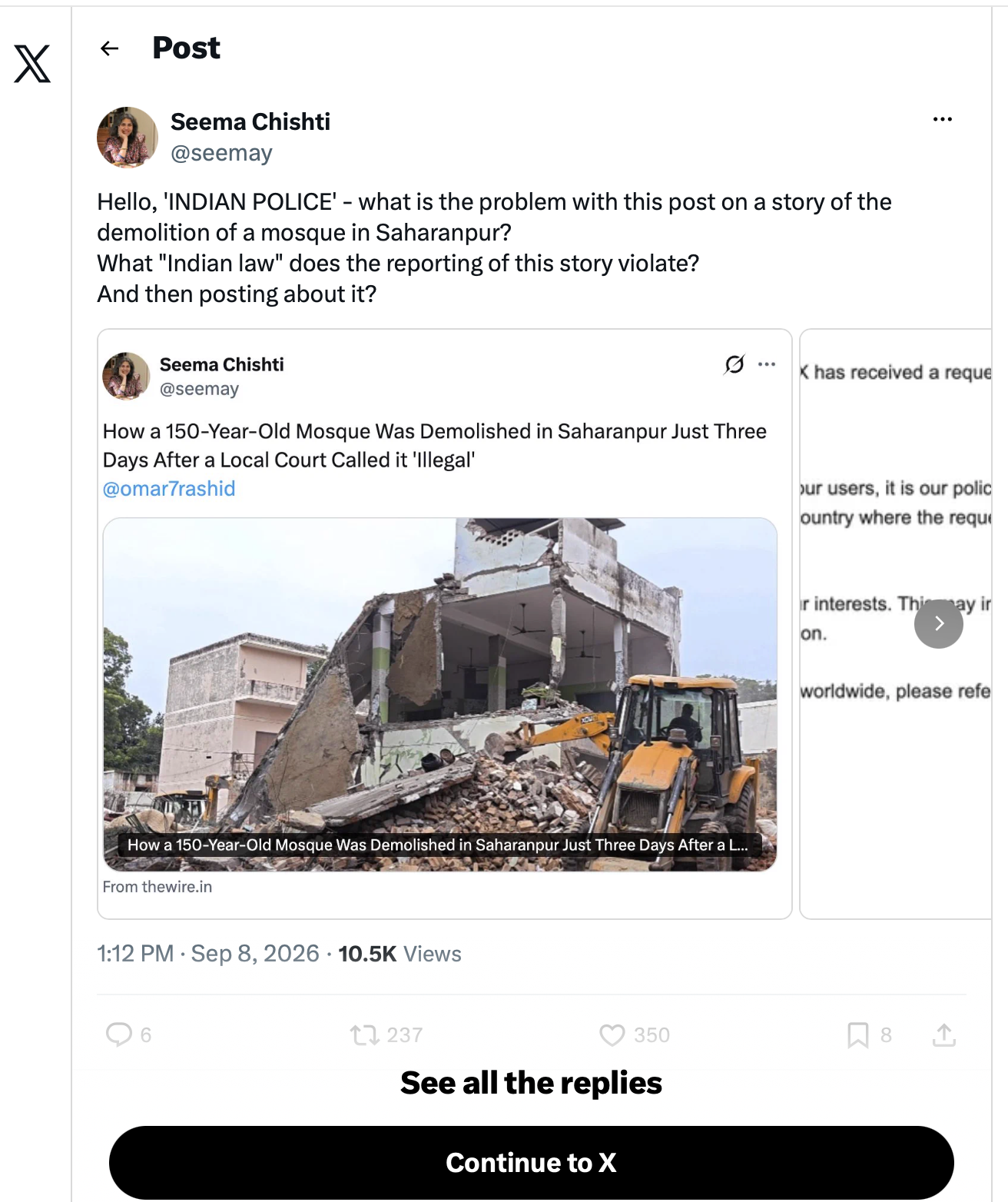
If we were wondering what possible legal grounds could have prompted this takedown, on X, editor of The Wire Seema Chishti asked the same question. Their report on the demolition of a mosque in western Uttar Pradesh’s Saharanpur, based on a court order, was the subject of a takedown request. X said it had received a request from the “Indian Police” regarding content that violated Indian law.
On 10 September, Instagram removed a post by Maktoob Media about West Bengal BJP leader Suvendu Adhikari’s ‘Saffron Honour March’ to Jadavpur University, an event covered by almost all mainstream news organisations.
From 36 Hours To 3
In an exhaustive piece this July, Kunal Purohit and Aaliyah Nair wrote in Article 14 that earlier this year, the government quietly shrank the time social media platforms have to act on government or court orders to take material, from 36 hours to three.
The union government’s stated reasons for amending the Information Technology Rules to make the change were not frivolous: deepfakes, child sexual abuse material, non-consensual intimate imagery and online fraud.
The unsettling question is what happens when a system designed for exceptional harms becomes an extraordinarily efficient mechanism for removing any material that the government may deem unlawful or offensive, without a hearing and often without a meaningful opportunity to challenge the decision before the material disappears.
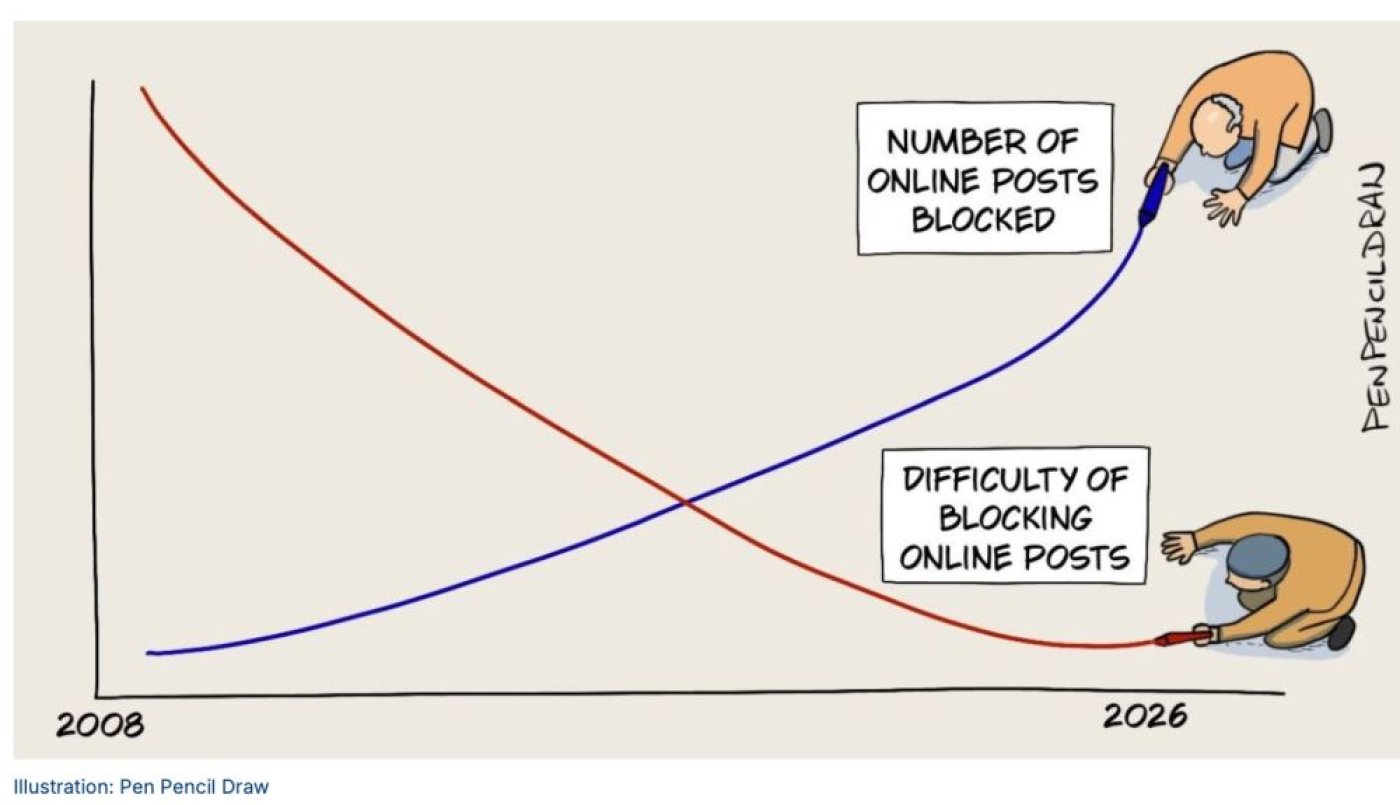
Between March and July this year, 298,000 URLs were sent to platforms for takedown, according to the government’s own figures. Of these, 244,000, or 82%, came from state governments and 51,000 were sent by the Indian Cyber Crime Coordination Centre, or I4C, in connection with cyber or stock-related scams.
The Indian Express reported that the government’s blocking orders to Instagram, Facebook and YouTube between March and July 2026 ran up to a total of 195,000 pieces of content or accounts. That works out to about 1,275 a day, or one every 68 seconds.
The Press Information Bureau said in response that with 600 million users in India “posting up to 78,703 items every 68 seconds”, it is “reasonable” to expect that on average one of these items “may not be lawful”.
Dramatic as the numbers are, this contention is more interesting, for it frames the problem as one of volume. Certainly, unlawful material will appear among tens of thousands of posts every minute. The question is what happens when the State acquires the power to identify which of the 78,703 posts going online every 68 seconds are unlawful; to order their removal; and then to have that decision acted upon within three hours—without the person affected having any opportunity to be heard.
Emergency blocking orders may remain confidential, leaving the person whose post was removed or restricted without access to the order that he or she might seek to challenge. But the three-hour ceiling creates a different problem: even the ordinary takedown process becomes functionally urgent. It is a fait accompli.
As policy researcher Prateek Waghre told Purohit and Nair, over the last several years, the union government expanded its capacity to intervene in online speech through successive legal and regulatory changes.
It appears that a Great Firewall of India is being erected, not unlike the Great Firewall of China.
Not every piece of expression suppressed by the Great Firewall may deserve protection from censorship. Without a doubt, the Internet contains hate speech, harassment, fraud, propaganda, deepfakes, and worse. The problem is giving the State the power to decide, at scale, what is valuable, what is harmful and what citizens should not be allowed to see, and then giving it the technological muscle to implement its decision before anyone can effectively contest it.
Removal Outruns Due Process
The architecture that provided safeguards against partisan, politically weaponised, vindictive, arbitrary or capricious censorship is being eroded, and it did not begin overnight.
Section 69A of the Information Technology Act, 2000, gave the government the power to block public access to online information. In 2015, when the Supreme Court struck down Section 66A as unconstitutional—a provision that allowed the State to criminalise a wide range of online speech on vague grounds—it upheld section 69A in part because of the procedural safeguards surrounding the blocking mechanism.
Section 66A criminalised speech. Section 69A is essentially a blocking power, allowing the State to prevent the public from accessing specified information online. It came with a framework requiring scrutiny and review. It included an emergency provision for cases where a delay in removing material from the internet was considered unacceptable, allowing an interim blocking direction without first hearing the affected party.
That emergency provision was meant to deal with emergencies. The concern now is what happens when the machinery of exceptional intervention becomes the ordinary machinery of regulating online speech.
As far back as 2024, when X challenged the government’s Sahyog portal (developed to automate the process of sending government notices to intermediaries under IT Act to facilitate the removal of material) in the Karnataka High Court, the microblogging site called it a “censorship portal”. The court rejected X’s challenge in 2025, describing Sahyog as a facilitation mechanism for regulation. X has now accused the MHA of trying to force it to join the Sahyog portal.
Technology has caught up with the tendency to curtail free speech. What was once a notice followed by a process is now increasingly an automated pipeline to identify, instruct, and remove.
The government has said it was Meta that requested and initiated an API integration with the Sahyog portal, in 2025. That integration allows directions uploaded through the government system to flow directly into Meta’s systems. This enables the platform to comply with takedown orders by automating the process, without human review.
That Meta sought the integration several months before the government imposed its new three-hour deadline hardly makes these developments less ominous. It is State power and technological capacity meeting with almost no friction. The State identifies a social media post as unlawful and the platform has systems at the ready to ensure its disappearance from a platform used by millions.
The PIB says only authorised officers can send takedown intimations through Sahyog: “All such intimations are reviewed by the concerned governments periodically.” That does not tell us whether every piece of content ordered to be taken down at the speed of once every 68 seconds between March and July 2026 was carefully examined, its context understood, the legal basis considered and the possibility of legitimate public interest weighed.
Satire needs context. Political criticism needs context. A protest video needs context. A journalist’s post needs context. Even identifying misinformation requires us to distinguish between what is false, what is disputed and what is simply inconvenient.
An API does not provide that context. It provides efficiency.
The central problem with speed in censorship is that removal is immediate; correction is not. To use the PIB’s framing, what “may not be lawful” would in normal circumstances be vetted through the safeguards that ordinarily attach to restrictions on speech. When the affected party has no opportunity to be heard before the material disappears, and no practical means of challenging the decision quickly enough to prevent the disappearance from becoming consequential, citizens lose censorship’s most important safeguard—due process under the law.
The concern, then, is not the numbers alone, or even whether every takedown is justified. It is the normalisation of vanishing posts, and takedowns so rapid they are difficult to contest.
And instead of due process, we are increasingly left with only the restraint of those operating the censorship machine.
(Kavitha Iyer is a senior editor with Article 14 and the author of ‘Landscapes of Loss’, a book on India’s farm crisis.)
Get exclusive access to new databases, expert analyses, weekly newsletters, book excerpts and new ideas on democracy, law and society in India. Subscribe to Article 14.