
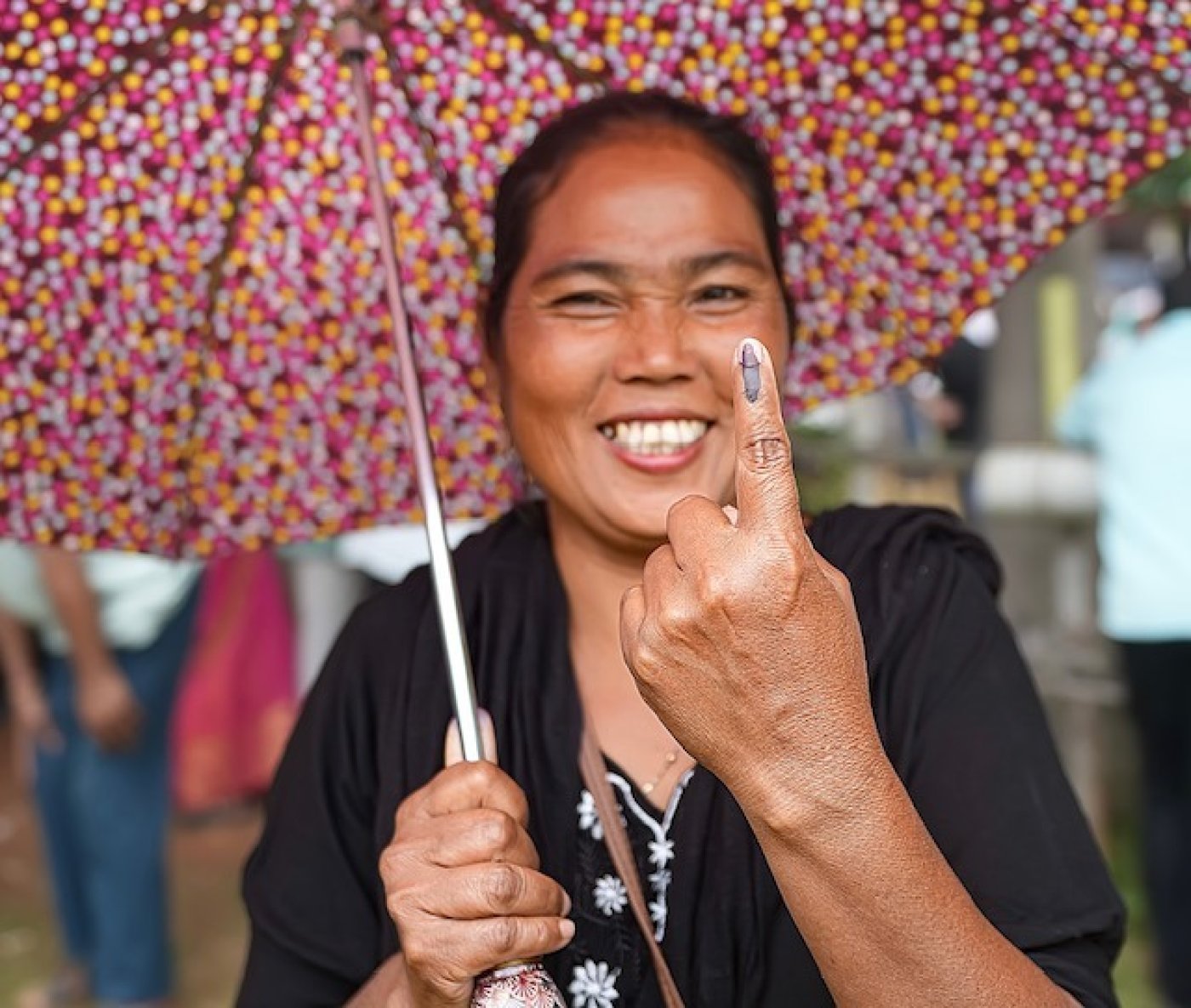
New Delhi: Women voted in larger numbers than men in all four major assembly elections held this year—Kerala, Tamil Nadu, Assam and West Bengal. According to Election Commission data, female turnout reached 80.86% in Kerala compared to 75.01% among men; 85.96% in Assam compared to 84.80%; 85.76% in Tamil Nadu compared to 83.57%; and 93.24% in West Bengal compared to 91.74%.
The figures come at a time when political parties across India are increasingly tailoring welfare programmes and election promises towards women.
In Tamil Nadu, new chief minister Vijay’s Tamilaga Vettri Kazhagam promised monthly financial assistance, free public transport and marriage support schemes. In West Bengal, programmes such as Kanyashree and Lakshmir Bhandar, promising financial incentives and guaranteed monthly income for women respectively, have become central to the state's welfare architecture. Assam's Orunodoi scheme, which promises monthly financial assistance to women from low-income households, now reaches millions of households. Kerala has expanded gender budgeting across sectors ranging from healthcare to livelihoods.
The convergence of these trends is difficult to ignore. Women are voting in greater numbers, governments are spending more on programmes directed at women, and parties increasingly view women as among the most consequential electoral constituencies in India.
Yet the growing political importance of women sits alongside a persistent economic reality. Women remain less likely than men to participate in the labour force, own assets, hold formal jobs or occupy elected office.
The result is a paradox that increasingly shapes Indian politics: women are becoming central to elections and welfare delivery, yet remain on the margins of many of the economy's gains.
A New Electoral Constituency
The growing prominence of women voters has been one of the most significant shifts in Indian elections over the last decade.
Historically, women voted in lower numbers than men. That gap has narrowed steadily and, in many states, reversed.
The turnout figures from Kerala, Tamil Nadu, Assam and West Bengal are part of a broader national trend in which women have become a decisive electoral constituency. Their voting patterns are now closely watched by parties, campaign strategists and governments.
This shift has coincided with the expansion of welfare programmes directed specifically at women.
Women have often borne a disproportionate share of economic shocks associated with inflation, food insecurity and unpaid care work. They are also more likely to depend on public services related to healthcare, nutrition, childcare and household welfare.
As a result, welfare programmes aimed at women have become an increasingly important component of electoral strategy.
The approaches differ across states.
Kerala's 2025-26 gender budget allocated Rs 4,840.12 crore, or 20.79% of the state's plan expenditure, across sectors including health, childcare, livelihoods and women's safety.
Tamil Nadu's welfare model combines direct support with measures aimed at mobility and opportunity. Recent electoral promises included monthly financial assistance for women, free public transport, marriage assistance schemes and employment programmes.
Assam has expanded direct cash transfers through the Orunodoi scheme while maintaining female labour-force participation rates above the national average.
West Bengal has built one of the country's largest welfare networks through programmes such as Kanyashree and Anandadhara, reaching more than one crore households.
The details differ, but the political logic is similar: women have become an increasingly important constituency for governments seeking electoral support.
The Limits Of Welfare
The growing political importance of women has not been matched by equivalent economic participation.
Data compiled in 2025 by Goldman Sachs India show that female labour-force participation remains substantially lower than in many other major economies. Female participation is estimated at around 30%, compared to roughly 60% in China and more than 50% in the United States, Japan and the European Union.
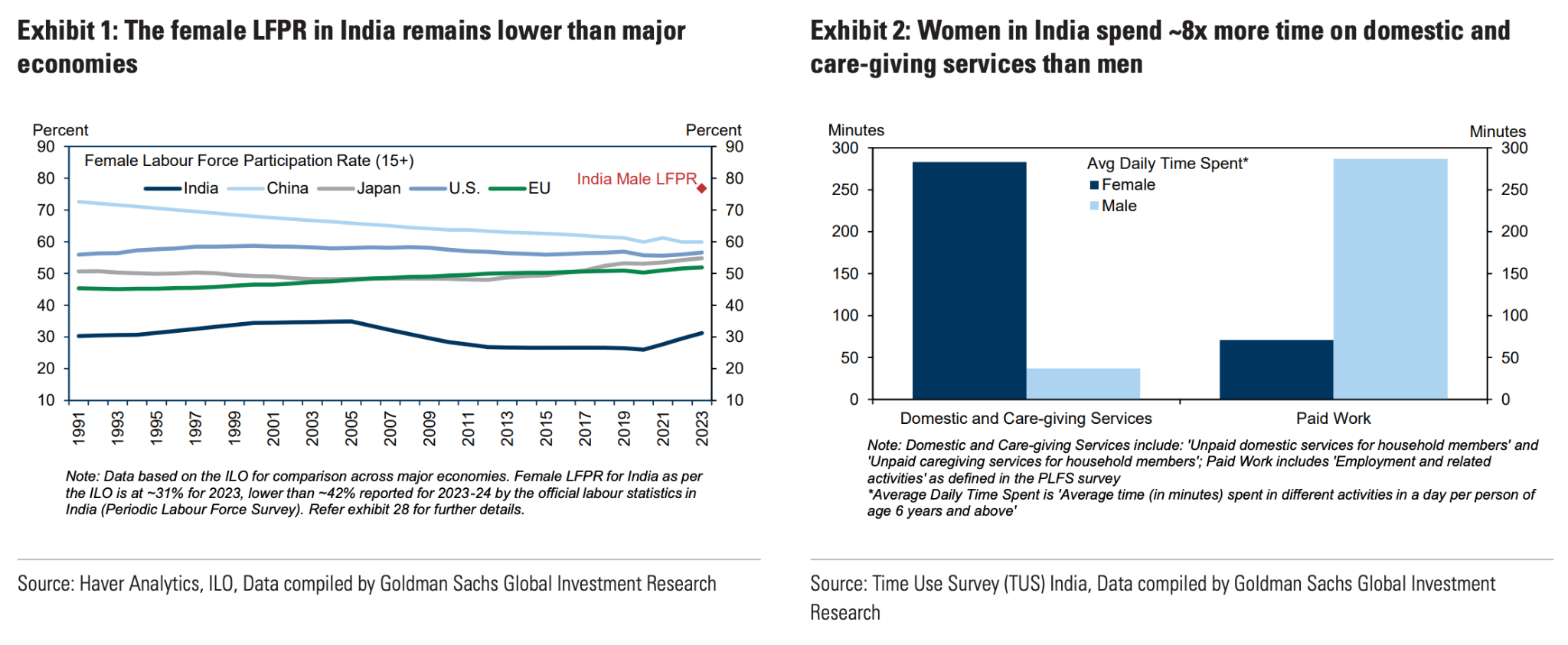
Male labour-force participation in India remains close to 77%.
The gap is partly explained by the unequal distribution of unpaid work.
Indian women spend nearly 280 minutes a day on unpaid domestic and caregiving responsibilities, compared to about 35 minutes for men.
The burden of childcare, elder care, cooking, cleaning and household management continues to fall overwhelmingly on women.
According to the World Bank Gender Data Portal, based on International Labour Organisation estimates, India's female labour force participation rate stood at 32.4% in 2025, compared with 77.6% for men.
Official Indian estimates are higher. The Periodic Labour Force Survey reported female labour force participation at around 41.7% in 2023-24, with subsequent surveys indicating further increases, particularly in rural areas.
Much of this increase is concentrated in informal and vulnerable employment rather than secure formal work. Nearly 78.2% of employed women work without formal contracts or social protection, while about 60% remain concentrated in agriculture and other low-productivity sectors.
The increase in participation, therefore, does not necessarily indicate an equivalent increase in economic security.
Bank Accounts & Asset Ownership
India has witnessed one of the world's fastest expansions of financial inclusion.
Around 89.2% of women now possess an account with a financial institution. Millions receive welfare payments directly through bank accounts linked to the Jan Dhan-Aadhaar-Mobile architecture, a nationwide digital governance framework that links bank accounts, Aadhaar IDs, and mobile phones to enable direct and efficient delivery of government benefits.
The spread of digital banking has transformed welfare delivery and expanded women's access to formal financial systems.
Yet financial access has not translated into equivalent ownership of productive assets.
Data from the World Bank Gender Data Portal indicates that in 76.4% of men own, either individually or jointly, a dwelling in 2021. Among women, the figure is 46.5%.
The gap reflects a broader pattern. Women have become increasingly visible within welfare systems, but continue to lag behind men in ownership of land, housing, businesses and other productive assets.
This distinction matters because ownership often determines access to credit, investment opportunities and long-term economic security.
According to NITI Aayog, the union government’s think tank, women entrepreneurs could generate between 150 million and 170 million jobs if barriers relating to finance, credit and market access were reduced.
Yet nearly one-third of women-led enterprises remain unable to meet basic credit-readiness requirements.
Social Progress, Economic Gaps
The expansion of welfare programmes has coincided with significant improvements in social indicators.
Maternal mortality declined from 658 deaths per 100,000 live births in 2000 to 80 in 2023. Adolescent fertility rates have fallen sharply. Female lower-secondary school completion rates have reached 88.3%, exceeding the average for lower-middle-income countries.
Women's participation in household decision-making has also increased.
These improvements suggest that welfare programmes have contributed to better outcomes in health, education and social development.
At the same time, economic indicators reveal a more uneven picture.
Women remain concentrated in informal employment, continue to perform the overwhelming majority of unpaid care work, and remain underrepresented in ownership of assets and political institutions.
Women account for a growing share of voters but hold only 13.7% of parliamentary seats nationally.
The contrast between political visibility and economic representation has become one of the defining features of contemporary India.
The Next Phase
The expansion of welfare programmes directed at women has altered both electoral politics and public policy.
What remains unclear is whether this shift will extend beyond welfare and translate into greater economic opportunity.
That would require investments in childcare, mobility, skills, enterprise financing and formal employment, areas that directly affect women's ability to participate in the economy.
Women have become indispensable to electoral success across much of India. The next challenge for governments may be whether they can convert that electoral centrality into broader economic gains.
The answer will help determine whether the rise of women in Indian politics remains primarily a story about welfare and voting, or becomes one about economic participation and power as well.
(Deepanshu Mohan is dean and professor of economics at O P Jindal Global University. He is currently a visiting research fellow at the University of Oxford’s department of international development and a visiting professor at the London School of Economics. Geetaali Malhotra is a research analyst with the Centre for New Economics Studies at O P Jindal Global University.)
Get exclusive access to new databases, expert analyses, weekly newsletters, book excerpts and new ideas on democracy, law and society in India. Subscribe to Article 14.