
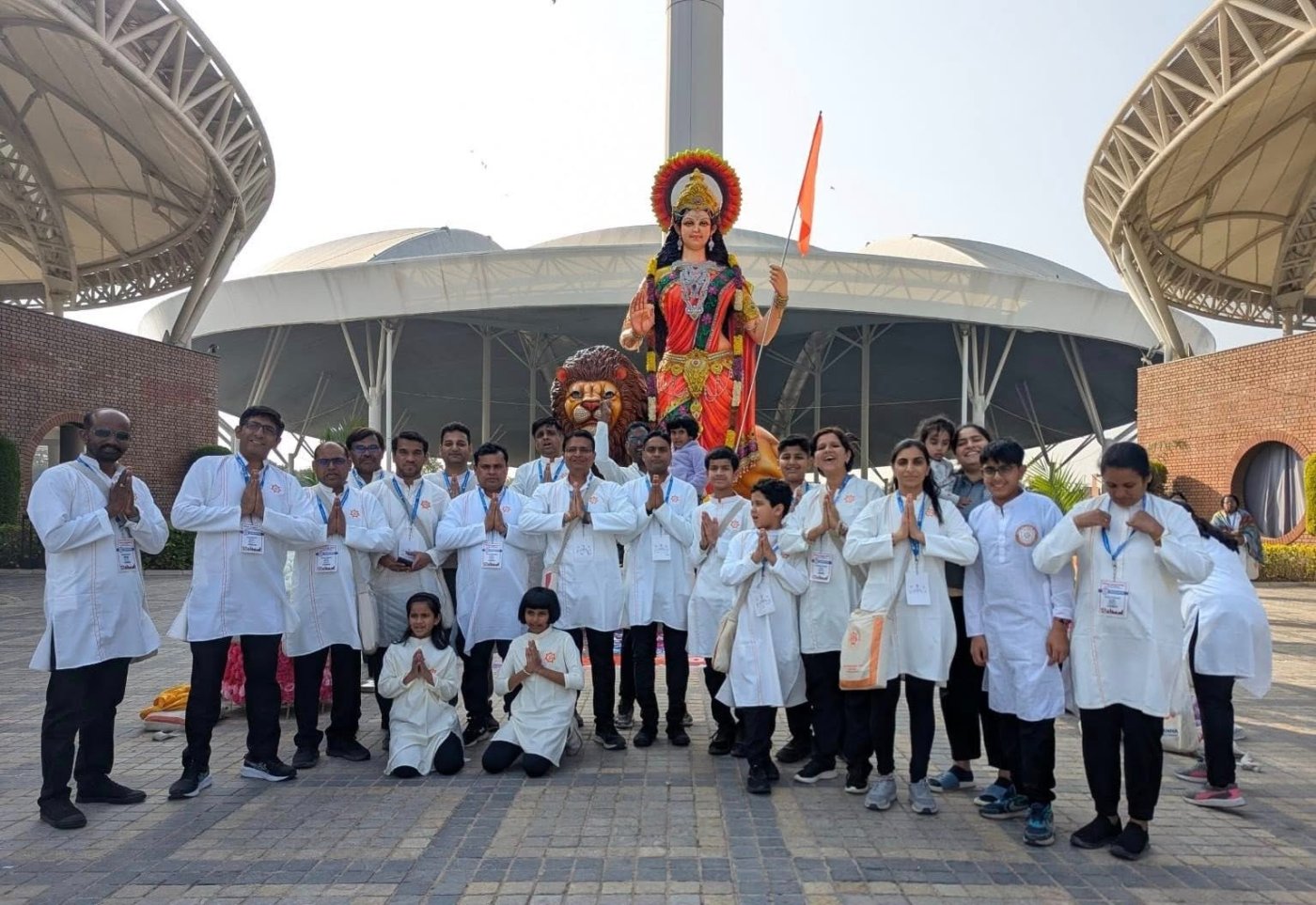
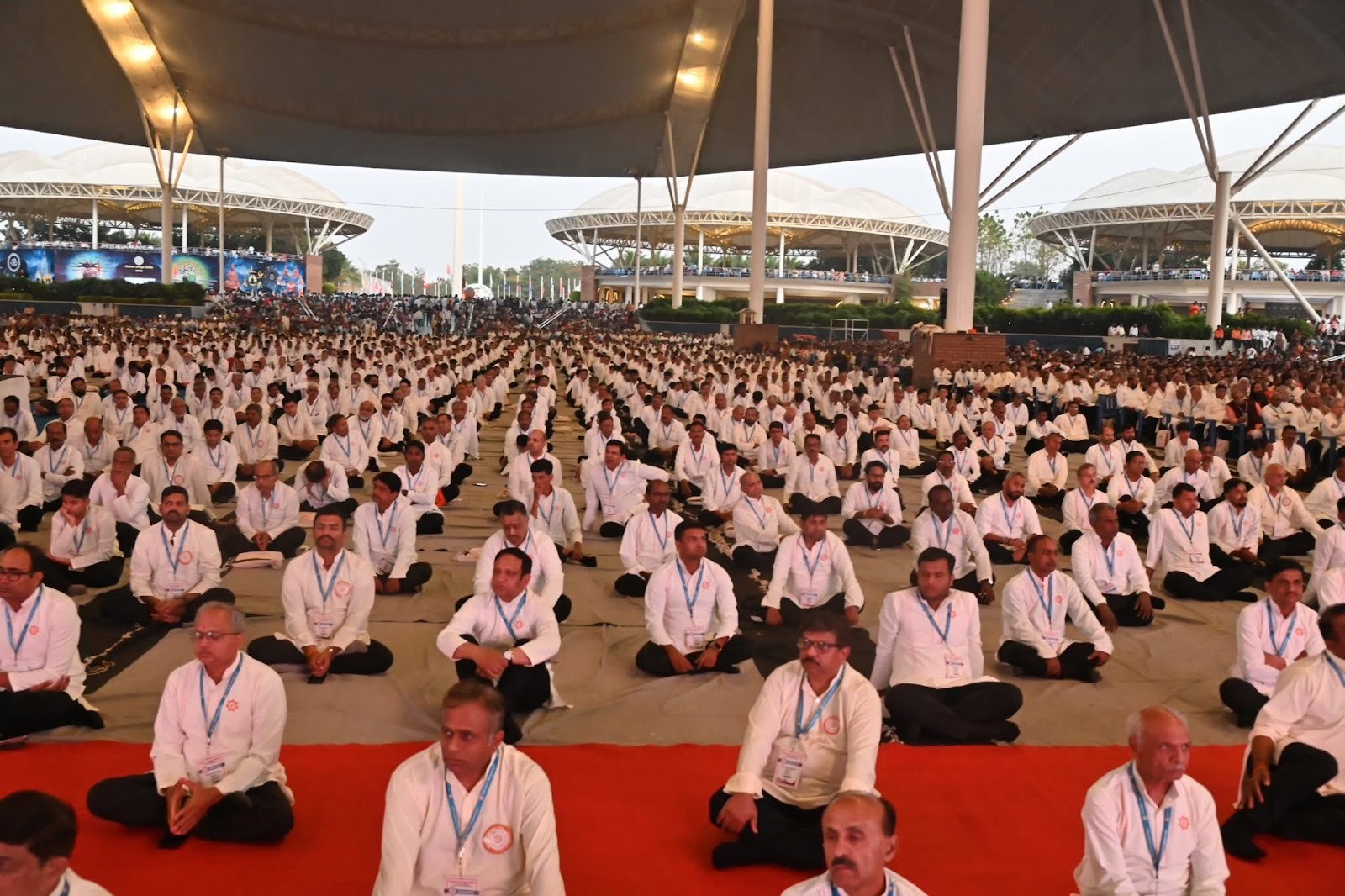
Kolkata: In the last week of December 2025, over 1,600 persons from 79 countries gathered in the southern city of Hyderabad to attend the Vishwa Sangh Shibir over five days, the seventh such edition.
This global gathering of swayamsevaks—volunteers of the Rashtriya Swayamsevak Sangh (RSS), the right-wing Hindu nationalist organisation that serves as the ideological fountainhead of the Bharatiya Janata Party (BJP)—took the form of a shibir, or camp, attended by functionaries of various RSS-linked organisations from overseas.
The “Sangh” refers to the RSS, while the collective of various organisations linked to the RSS is called the Sangh Parivar, or the RSS family.
The organisers billed the December 2025 event as a cultural and spiritual programme, for “collective action rooted in the timeless principles of Sanatan Dharma.” Hindu nationalist forces refer to Hinduism as Sanatan Dharma, or the eternal religion.
Ayyengari Surender Reddy, who works with the Sangh-affiliate Bharat Vikas Parishad, described the shibir as a collective effort of organisations, such as the Hindu Swayamsevak Sangh (HSS), Sanatan Dharma Swayamsevak Sangh (SDSS), Hindu Seva Sangh, Sewa International, Samskrita Bharati, and the Vishva Hindu Parishad (VHP).
The shibir of global “Sangh-inspired organisations” took place six weeks after Sunil Ambekar, the Akhil Bharatiya Prachar Pramukh (chief spokesperson) of the RSS, declared that the RSS works “only in Bharat”.
Ambekar’s statement was in response to a report on Prism, a US-based independent news website, that US lobbying firm Squire Patton Boggs (SPB) had disclosed receiving $330,000 from another lobbying firm, State Street Strategies (SSS), doing business as One+ Strategies, on behalf of the RSS.
The lobbying registration document said the “specific lobbying issues”, current and anticipated, were “US-India bilateral relations,” but quarterly filings showed that One+ Strategies paid SPB $120,000, $100,000 and $110,000, during January-March, April-June and July-September 2025, respectively, to “introduce the Rashtriya Swayamsevak Sangh (RSS) to US officials.”
This revelation created a major controversy. The Congress, India’s main opposition party, alleged that the RSS had betrayed the nation's interests.
Ambekar denied the charge, claiming that the RSS does not operate outside India and has not engaged any lobbying firm in the United States, reiterating the organisation’s long-standing official line. The RSS website says, “RSS works only in Bharat. But it is possible that we will be able to connect you to some like-minded organisation in your country.”
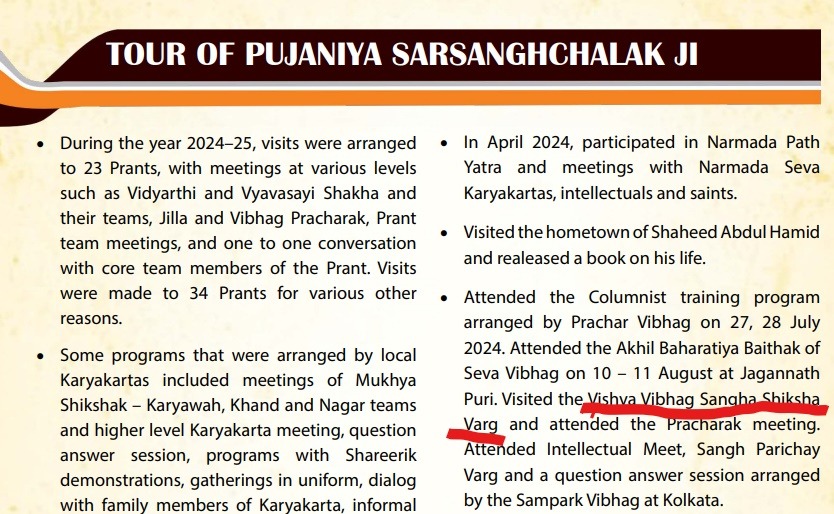
However, this story, a new database and RSS publications themselves belie that claim, with the organisation showcasing its ‘Vishwa Vibhag’ or world department. RSS chief or sarsanghchalak, Mohan Bhagwat, attended a Vishwa Vibhag sangha shiksha varg (training camp) in 2024.

In the first week of March 2026, a US government advisory panel recommended to the Donald Trump administration that sanctions be imposed on the RSS for its “responsibility and tolerance of severe violations of religious freedom”. The recommendation for sanctions, which could include freezing of assets and/or barring entry into the United States, was made in the 2026 report of the United States Commission On International Religious Freedom (USCIRF).
The USCIRF is an independent, bipartisan US government advisory body that monitors and reports on religious freedom abroad and makes policy recommendations to the president, the secretary of state and Congress. Its 2026 report, assessing religious freedom violations and progress in 29 countries during 2025, recommends that India be placed among “countries of particular concern”, alongside Pakistan, China, North Korea, Iran and others.
A Global Gathering
A report published by the RSS mouthpiece Organiser in 2006, after the conclusion of the 4th edition of VSS, described the shibir as “a gathering of Hindu Swayamsevak Sangh (HSS) activists once in every five years.” That year, Narendra Modi, then the chief minister of Gujarat, attended the event.
A press release on the VSS 1995 said that “all its delegates were from several affiliated organisations of the RSS, which operate abroad as Hindu Swayamsevak Sangh (HSS), Sewa International, Vishwa Hindu Parishad, Hindu Students Council (HSC) and Friends of India Society International (FISI)”.
Of them, the VHP is a militant right-wing organisation, Sewa International is the international arm of Rashtriya Seva Bharati, the RSS social work wing; HSC is a project of the VHP of America and FISI operates out of the UK.
Top RSS functionaries, including Bhagwat, attended the 2025 shibir, along with the US-based HSS global coordinator Saumitra Gokhale, the HSS’s USA chapter secretary Siddhesh Shevade, senior HSS UK functionary Sangeeta Thakkar, HSS Australia functionary Nitin Koriya and Mauritius-based HSS pracharak Jagan Mohan.
Apart from different HSS units, the attendees were associated with Myanmar-based Sanatana Dharma Swayamsevak Sangh, Sewa International, the UK-based Friends of India Society International, Samskrita Bharati and the VHP.
Senior BJP leaders, including India’s external affairs minister S Jaishankar and coal and mines minister G Kishan Reddy, attended the shibir. Jaishankar described the government of India’s efforts to engage the diaspora and mitigate global challenges in trade, security, and other areas.
At the concluding ceremony on 28 December 2025, organisers said the event “reaffirmed global coordination among Sangh-inspired organisations” and renewed the resolve to foster “unity within Hindu society worldwide.”
Keeping Hindus United
This writer's interviews with RSS functionaries who refused to be identified, as they are not authorised to speak on the matter, revealed that the Vishwa Vibhag’s operations are coordinated by a samyojak (coordinator), one or two sah-samyojak (co-coordinators), and a group of dedicated pracharaks (wholetime officers) for different continents.
Among the sessions at the Vishwa Sangh Shibir 2025, two were on the Vishwa Vibhag. Its report was presented on 26 December, and another session on 28 December was titled ‘Current focus areas of Vishwa Vibhag’.
A session for children on 28 December was titled ‘inspirational stories from the Vishwa Vibhag.’ The shopping corner included Vishwa Vibhag publications, including Daksha and Vishwa Prarthana.
A five-yearly report has been a tradition at the gathering. A report on the 2010 VSS published on the HSS Mauritius unit’s website, written by HSS Mauritius sanghachalak Ragoonath Deeal, says that during the event, Shankar Tatwavadi, the then RSS Vishwa Vibhag samyojak, “gave an overall view of Sangh work in different parts of the world”.
So, what does the Vishwa Vibhag do if the RSS does not operate outside India?
A press release on the Vishwa Sangh Shibir of 1995 said the shibir was “conducted on RSS ideology for NRI (non-resident Indian) workers, who, despite being away, are exerting hard to keep the Hindus united”, to undertake sewa (service) projects, to promote Hindutva and “lobby for” Indian causes with senators and government agencies overseas.
On 30 January 2026, Prism reported that the RSS had formally ended its lobbying in the US. SPB also filed several amendments to its lobbying registration and quarterly reports, retroactively changing details about its client, replacing the RSS with one Vivek Sharma.
The “specific lobbying issue”, however, remained the same: “Introduce the Rashtriya Swayamsevak Sangh (RSS) to US officials.”
This effectively means Sharma took responsibility for appointing the lobbyist to introduce the RSS to US officials.
Vivek Sharma and his wife, Vandana, are “long-time supporters” of Ekal USA, the US chapter of the “RSS-inspired” informal schooling project, Ekal Abhiyan.
In India, these informals coaching centres called Ekal Vidyalaya or single-teacher schools, which operate mostly in tribal-dominated districts, function as the starting point of influencing every major aspect of the entire village’s life the Hindutva way—education, health, economy, culture, sense of morality and the religion they follow.
The Vishwa Vibhag
Currently, a US-based man called Saumitra Gokhale serves as the samyojak, while the UK-based Ram Vaidya (Europe) and Anil Vartak (Asia) are sah-samyojaks. Jagan Mohan Bandi is the pracharak in-charge of East and West Africa, and Santosh Pillai is the karyalay pramukh or office in-charge in India. All are RSS pracharaks.
Some of them have participated in the annual meeting of the RSS, the Akhil Bharatiya Pratinidhi Sabha (ABPS), which is also attended by the national presidents, general secretaries and organising secretaries of at least 32 ‘RSS-inspired organisations’.
According to a VSS 2025 report published in Marathi, the HSS conducts regular activities in 61 countries worldwide, with over 1,750 active branches. It says VSS 2025 was “globally coordinated by Saumitra Gokhale,” who was assisted by Ram Vaidya, Anil Vartak and Rajendran.
The Vishwa Vibhag has a mouthpiece, Samwad, according to an article by Vishwa Vibhag’s then samyojak, Shankar Tatwavadi, published in the 2010 Vishwa Sangh Shibir souvenir. Samwad is published from New Delhi, India’s national capital, and circulated in more than 100 countries, it said.
While no such publication with the spelling Samwad has been traced, there exists one named Samvad, published by Shri Vishwa Niketan (SVN)—the outfit that organised VSS 2025. The Samvad fortnightly is published both as a blog and an epaper, and the first page usually carries a report on the programmes of the RSS chief, apart from important Sangh activities in India and abroad.
The SVN and Samvad have a postbox address at SRT Nagar, New Delhi. The SVN does not have a physical office address. It does not have a website.
The RSS describes it as “a Delhi-based organisation working for the promotion of Indian heritage and culture among NRI/PIO communities outside India.” PIO means a person of Indian origin. In 2017, it organised a training camp for overseas swayamsevaks, in the presence of top RSS functionaries.
Unravelling The Links
Our investigation reveals that the Vishwa Vibhag operates through the SVN, the New Delhi-based Antar Rashtriya Sahayog Parishad (ASRP) and the Mumbai-based Vishwa Adhyayan Kendra (VAK) in India; the HSS, Vishwa Hindu Parishad (VHP) and Sewa International units in different countries; as well as the US-headquartered International Centre for Cultural Studies (ICCS).
The ARSP’s Bangalore chapter hosted the first edition of VSS in 1990, while its Gujarat chapter organised the 1995 and 2005 editions. The VAK organised the 2000 and 2010 editions. Samvad dedicated an entire issue to the VSS 2010 proceedings.
Two government of India websites list Shyam Parande as secretary of Shri Vishwa Niketan, while he also serves as secretary-general of ASRP and global coordinator of Sewa International. RSS-linked organisations have also described him as Asia zonal coordinator of the ICCS.
Parande was one of the key figures at the Vishwa Sangh Shibir 2025.
Sewa International, Sewa Bharathi and Shri Vishwa Niketan have the same phone number (91-11-23684445) and fax number 91-11-23517722. Following RSS Vishwa Vibhag stalwart Chamanlal Grover’s death in 2003, Shankar Tatwavadi, as Vishwa Vibhag samyojak, called upon interested persons to send their memoirs / essays on him to the PO Box number of Shri Vishwa Niketan.
The VAK’s stated top objective is “to be a coordinating centre from Mumbai for HSS activities overseas,” and it lists HSS, ICCS, and Sewa International as associated organisations.
‘Seeing The Sangh’
On 15 August 2025, India’s Independence Day, Modi, himself a swayamsevak since his school days, said, “In a way, RSS is the biggest NGO of the world.”
About four months later, a research project named Seeing the Sangh: Mapping the RSS's Transnational Network called the Sangh Parivar “the largest far-right network in history”.
The project, led by academics Christophe Jaffrelot and Felix Pal, mapped over 2,500 organisations tied to the RSS. Of them, 2,240 are in India, 107 in the US, 34 in Australia, and 26 in the UK.
Many of these organisations share the same individuals, work out of the same addresses, regularly co-organise events together, claim overlapping spheres of work, and are tied by shared flows of money, both domestic and transnational.
“This evidence suggests that these organisations are not a loose family, as the RSS would like us to believe, but tightly networked parts of one large entity,” the report said.
The dataset—the result of “a rigorous six-year data collection process”—is stored in a repository hosted by the Paris-based Sciences Po Center for International Studies, where Jaffrelot teaches. Pal, a lecturer in political science and international relations at the University of Western Australia, led a team that compiled the data. The public can access an interactive map, though access to the data repository is restricted.
Pal calls the Sangh Parivar “the history's oldest, richest, largest far-right network”.
The listed organisations have been divided into three categories depending on their level of involvement—conclusive, probable and possible. It is an ongoing project, open to corrections and additions.
Who’s Who
According to Vishwa Vibhag’s former coordinator Shankar Tatwavadi, , swayamsevaks carry with them the discipline inculcated by the RSS. They start Sangh shakhas (units) wherever they go in the world. At present, this work is “being conducted in the name of ‘Hindu Swayamsevak Sangh’ all over the world, barring some exceptions,” he wrote .
Tatwavadi wrote that the “spread of RSS started in Kenya in 1947,” extended to England and spread in the US in the 1960s and later, Lakshman Bhide “undertook extensive tours to various countries and established the strong network of the RSS in different parts of the world.”
RSS pracharak Ravi Kumar Iyer has been described as a “senior pracharak of Vishwa Vibhag” who “travelled to 45 countries to spread and consolidate the work of HSS, ICCS and Sewa International.”
ICCS organiser Ratan Sharada described Yashwant Pathak both as a joint-coordinator of RSS Vishwa Vibhag as well as the joint-coordinator of the US chapter of the Hindu Swayamsevak Sangh (HSS) in one of his books.
Four books authored by Sharada on Sangh activities in Kenya, South Africa, New Zealand and Myanmar were released during the latest VSS in Hyderabad. There are other sources that referred to Pathak as Vishwa Vibhag joint-coordinator.
RSS pracharak or wholetime officer Saumitra Gokhale has been referred to as Vishwa Vibhag samyojak in multiple issues of Samvad—1 March, 2012, 16 March, 2020; 16 December, 2022; 16 January, 2023 and 1 October, 2023; among others. The same publication also referred to him as HSS Global Coordinator in multiple issues—1 August, 2020; 16 January 2024; 16 March 2025—raising the question of whether the Vishwa Vibhag samyojak and HSS global coordinator are the same.
On paper, Gokhale is a yoga instructor with the HSS USA—receiving an annual salary of $36,000 since 2019. The role he is known for is that of global coordinator of HSS. HSS Japan described him as “samyojak, HSS.” Hindu University of America, a VHPA initiative, describes him as ‘the Global Coordinator for the HSS.’
The HSS does not exist on paper—there only exist HSS units in different countries, such as HSS Nepal, HSS USA, HSS Japan, HSS UK, and so on.
Hindu Vishwa, the mouthpiece of Vishwa Hindu Parishad of America (VHPA), offers more clarity about Gokhale’s role. It described him in 2022 as Vishwa Vibhag samyojak (international coordinator) of RSS, based in the USA. “He travels constantly within the USA and across the globe to guide and motivate all Sangh organizations,” the VHPA journal said.
Former BJP president J P Nadda described Shankar Tatwavadi as “International Coordinator of HSS.” According to HSS UK, Tatwavadi was “a pracharak of HSS.” Vikas Deshpande, spokesperson of the HSS US chapter described him as “Vishwa Vibhag samyojak (international coordinator) for HSS.”
However, one article in Panchajanya, regarded as the Hindi mouthpiece of the RSS, described him as an RSS pracharak who played a key role in establishing the HSS branch in the US. Similarly, another article by Shyam Parande in Organiser described him as a Vishwa Vibhag samyojak who “made an indelible mark on a global scale by committing himself completely to RSS.”
The HSS Response
As the HSS does not exist on paper, Article 14 emailed HSS USA spokesperson Vikas Deshpande, asking if RSS Vishwa Vibhag and the HSS are the same.
In response, Deshpande said that the “HSS USA is an autonomous and independent organization having no legal or financial relationship with RSS.” He described himself as a volunteer of HSS USA and clarified that he was speaking strictly for HSS USA, not any other HSS unit.
Asked how the likes of Pathak, Gokhale and Tatwavadi have designations at both RSS Vishwa Vibhag and HSS, Deshpande said, “The individuals you referred to were/are not office-bearers of HSS, but they are volunteers/employees of HSS (USA).”
Asked if HSS and RSS Vishwa Vibhag share other aspects apart from leadership, including resources/donors, Deshpande responded that HSS USA is a legally and functionally independent organisation, registered and working in the United States. “It shares neither leadership nor resources/donors with anyone outside of the USA.”
We specifically asked if the HSS and the RSS Vishwa Vibhag are the same.
According to Deshpande, HSS USA does not have a division called Vishwa Vibhag. “The term is used as an expression referring to the efforts by organizations in the global Hindu diaspora beyond India working with similar ideals of sanskar (values), seva (service) and sangathan (organised efforts),” he said.
He argued that globally, the numerous “autonomous and independent organizations” sharing the philosophy mentioned above “comprise an informal network known as the Sangh.” Outside India, in many countries, they work independently as Hindu Swayamsevak Sangh following laws of their lands.
From time to time “they explore ways to interact and learn from each other the best practices” in serving the community needs and “positively contributing to the larger society” in their respective country of operation.
He insisted that “Vishwa Vibhag is an expression that is closely related to the word Hindu Diaspora.” It doesn’t create any formal or contractual relations between entities such as HSS and RSS, he claimed.
Pressed on how Vishwa Vibhag, being called an informal network, has organisers designated as coordinator/samyojak and sah-samyojak, Deshpande did not respond.
We drew his attention to the fact that RSS literature speaks of a Vishwa Vibhag being formed and shaped by the likes of RSS pracharaks Chamanlal Grover and Shankar Tatwavadi. “How different is the Vishwa Vibhag that the RSS refers to from the Vishwa Vibhag that you are referring to?” we asked Deshpande.
His answers to these questions are still awaited.
We also emailed similar questions to the RSS but are yet to receive any response.
Mohan Bhagwat had explained the relation between the RSS and the HSS in August 2025. According to a report in Panchajanya, Bhagwat was asked during an event marking the centenary of the RSS about the Sangh's vision for its international role.
Bhagwat said the RSS operates only within India. “The work it does abroad is carried out under the name of the Hindu Swayamsevak Sangh and in accordance with local laws.” They are registered as charity organisations in their respective countries. Their methodology is essentially the same as that of the Sangh in India, he said.
A World Map Of The RSS
The Seeing the Sangh report says the “obfuscation and shape-shifting” in its operations has allowed the RSS to ensure that little is conclusively known about how it moves resources, how authority travels through the network, and where its influence begins and ends.
“It also allows this network to appear like a loose archipelago of vaguely linked organisations, rather than a centrally-directed, bureaucratically-managed hierarchical network,” says the report.
The world’s first map of the RSS network reveals these organisations’ “concrete, traceable, material ties leading to the Sangh,” Pal said.
Their database shows that the VAK works in coordination with the ICCS, Sewa International, the Maharashtra-based Rambhau Mhalgi Prabodhini (RMP) and the HSS chapters in the US, UK and Mauritius.
The ARSP, on the other hand, is connected with International Forum for India's Heritage (IFIH), Sewa International, BJP and the Akhil Bharatiya Vidyarthi Parishad (ABVP). The ICCS is shown to work in coordination with VAK, RMP, the Hindwar-headquartered All World Gayatri Pariwar and the US-based India Development and Relief Fund (IDRF).
The database says that the ARSP maintains contacts with diplomatic missions of India in diaspora countries and those of diaspora countries in India, and regularly interacts with the leadership of countries like Mauritius, South Africa, Trinidad & Tobago, Guyana, Suriname, Fiji, Malaysia, Nepal and Bhutan.
Pal told Article 14 that the dataset project made it very clear that “the Sangh is, above all else, a chameleon.” According to him, in different diaspora contexts, the Sangh takes different forms and revolves around different organisational structures.
He said that when the Sangh begins its activities in any diaspora community, it usually begins by founding a local equivalent of either the VHP or the HSS. These may be named differently, but functionally act as wings of these organisations. Besides, almost always, the Sangh goes on to found an umbrella organisation, for example the Hindu American Foundation in the USA or the Hindu Council of Australia.
Such umbrella organisations are designed to include Sangh organisations and to co-opt non-Sangh organisations to make the umbrella organisation appear as representative as possible.
“It is through organisations like these that the Sangh then seeks to influence government policy and social opinion as ‘the’ representative of Hindu opinion in that particular context, even if this is not necessarily accurate,” Pal said.
For example, in 2016, HAF lobbied educational policymakers on how Hinduism is portrayed in California school textbooks, especially on caste-based oppression.
Unravelling Coordination
The coordination between different RSS-linked organisations becomes clear with a few examples.
Tatwavadi, who played a pivotal role in expanding Hindu Swayamsevak Sangh (HSS) activities in the USA and took charge as Vishwa Vibhag Samyojak in 1993, travelled to more than 60 countries to oversee major programs like Vishwa Sangh Shiksha Varg and Vishwa Sangh Shibir, returned to India in 2011 to serve as the margadarshak (guide) of Vijnana Bharati, the RSS’s science wing.
Ram Chandra Pandey, who served as in-charge of RSS’s Vishwa Vibhag in South Africa, later returned to India and took charge of Dharma Jagran Manch, an ‘RSS-inspired’ organisation that prevents “conversion” of Hindus to other religions and ‘re-converts’ Muslims and Christians to Hinduism in eastern UP.
Ravi Kumar Iyer, after serving as Vishwa Vibhag sah-samyojak (for Asia) till 2018, was entrusted with the work of the RSS Sampark Vibhag or communications cell and Prajna Pravah, an umbrella of Hindu nationalist think-tanks.
Vishwa Vibhag functionaries Gokhale, Parande, Tatwavadi and Iyer attended an ICCS conference held in 2015. In 2021, the ICCS organised an event commemorating RSS Vishwa Vibhag pioneer Chamanlal Grover—an event chaired by the then president of the HSS US, Ved Prakash Nanda.
Jaffrelot of SciencesPo-CERI told Article 14 that the overseas activities of the Sangh parivar are distinctive because they address the need felt by diaspora Hindus to remain connected to their religion.
Since the main objective is to teach Hinduism to children and organise festivals, the role of the VHP is particularly important—and it differs from what it is in India.
Over time, other objectives have emerged.
One of them is presenting Hindutva’s own definition of Hinduism against how it has been defined by scholars who analysed caste in a manner that Hindu nationalists did not like, in school textbooks for instance.
“This advocacy role is equally important today and as overdetermined by the diasporic situation as the educational one,” Jaffrelot said.
According to him, the Sangh parivar plays the role of an ethno-religious lobby in the US, Canada and the UK. “The fact that rich Hindus can help politicians to pay for their election campaigns and that their community forms vote banks in some constituencies needs to be factored in some cases, for assessing the impact of the Sangh parivar abroad,” he said.
Global Attention
In January 2025, global news organisations reported that a British government report had labelled Hindutva as ‘Hindu nationalist extremism’ and identified the ideology as a threat to Britain’s internal security.
This was the first time that a British government document identified Hindutva as extremism or a threat to Britain’s security. Since communal clashes in Leicester in 2022 over an India-Pakistan cricket match, there has been increasing discussion about the rise of Hindutva organisations in Britain.
The UK is not the only foreign land where Hindutva, the political ideology of the RSS and the BJP, is viewed as a threat to that nation—from Mauritius to Australia and the US, such allegations abound.
Since the late 1940s, the RSS built an extensive network across Asia, Africa, Europe, the Americas and Oceania. Over two dozen pracharaks, or whole-timers, oversee organisational activities, based in different parts of the world.
An October 2025 study by two professors of the University of Mauritius titled ‘Advent of Hindutva in Mauritius’ said that since 2019, continuous Hindu nationalist propaganda on social media has not only been trying to influence the election results in this African country, but also to create social division; and was largely successful.
In September 2025, the Australian Human Rights Commission launched an investigation into the Hindu Council of Australia for spreading anti-Muslim hatred, mentioned as part of the Sangh Parivar in a study published in June 2025.
In addition, over the past few years, especially after the recent ‘Gen G’ protests, allegations have been made against Hindutva forces in Nepal of conspiring to restore the monarchy and turn Nepal back into a Hindu state.
India has the world’s largest expatriate population, spread across many countries, such as the USA, the UK, Canada, Australia and the Arab world.
While many are Hindu, the diaspora also includes Sikhs, Muslims and Jains. Writing after the 2015 Vishwa Sangh Shibir, participant Ami Ganatra says she was told that, unlike Christianity or Islam, Hinduism lacks a global institutional network for second-generation Indians abroad—a gap that the Hindu Swayamsevak Sangh (HSS) seeks to fill.
About 750 volunteers from 45 countries attended the event, including participants from North America, Europe, West Asia, Africa and parts of Asia and the Pacific. Scholar Pal argues that the Sangh adapts its approach overseas, avoiding overt “hard” Hindutva.
Many diaspora-linked organisations are difficult to identify, said Pal, because some obscure their ideological commitments and others attract members seeking community rather than ideology. This, he noted, allows Sangh organisations to evade scrutiny while still helping transfer money, legitimacy and influence to the broader Sangh network.
(Snigdhendu Bhattacharya is a Kolkata-based author and independent journalist.)
Get exclusive access to new databases, expert analyses, weekly newsletters, book excerpts and new ideas on democracy, law and society in India. Subscribe to Article 14.