
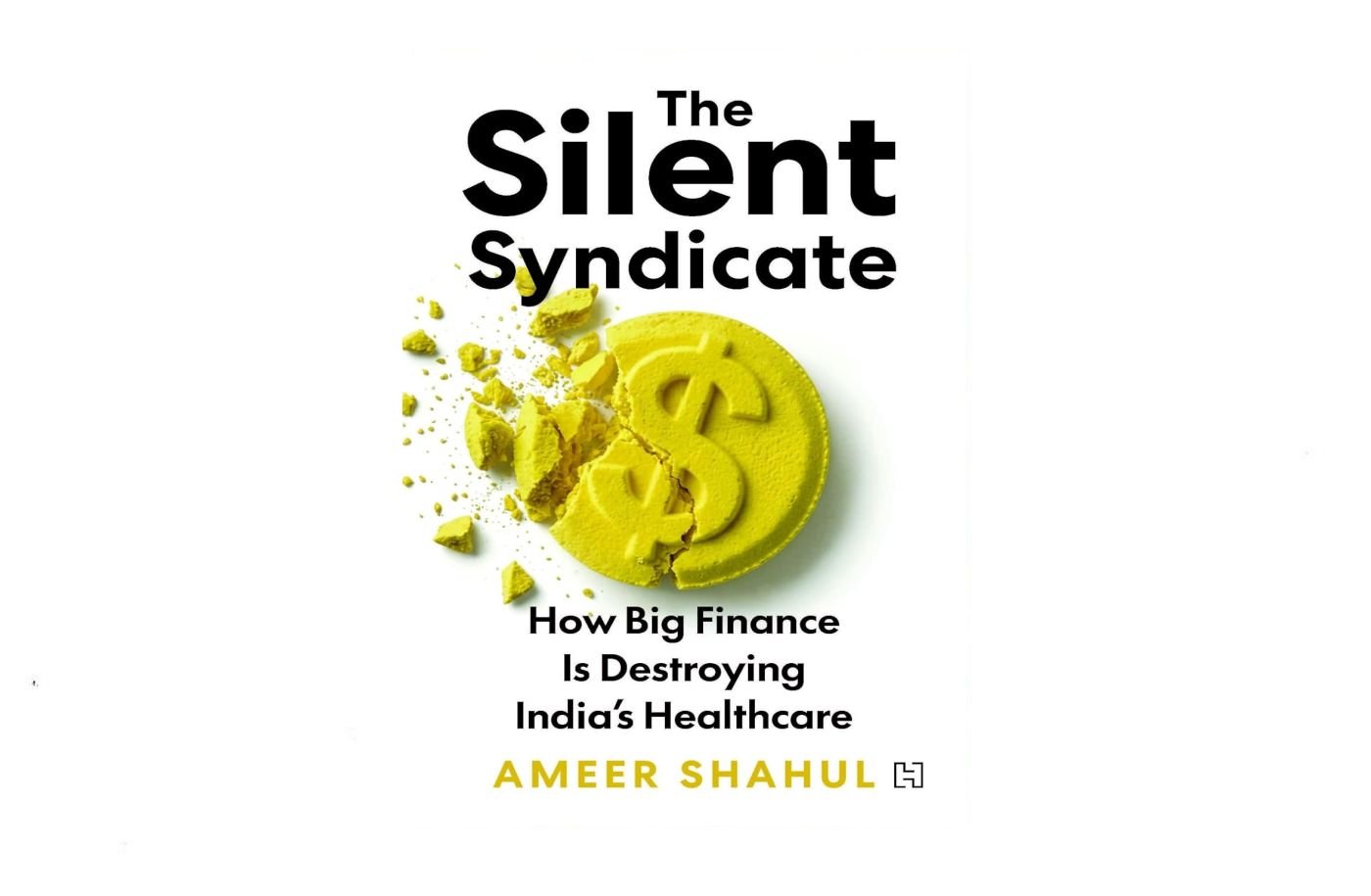
Healthcare in India has never been cheap. But an even more consequential transformation is now unfolding, largely out of public view. Global investment funds, private equity firms, reinsurers and financial conglomerates are quietly acquiring stakes across the country's hospitals, pharmaceutical companies, diagnostic chains and health insurers, reshaping one of India's most essential sectors.
In The Silent Syndicate: How Big Finance Is Destroying India's Healthcare, Ameer Shahul examines this sweeping financial takeover and asks what it means for India's healthcare sovereignty. Going far beyond a study of foreign investment, the book traces the financialisation of healthcare itself, and argues that a profound shift is underway: patients are no longer at the centre of the healthcare system—capital is.
The book carries endorsements from distinguished voices in Indian healthcare. Drawing on extensive research and investigative reporting, Shahul explores how global finance is influencing the priorities of hospitals, diagnostics, pharmaceuticals and health insurance, and what these changes could mean for doctors, patients and public health in the years ahead.
Shahul is an author, environmentalist and public policy expert. His previous books include Heavy Metal: How a Global Corporation Poisoned Kodaikanal and Vaccine Nation: How Immunization Shaped India.
—--------------------------------------------------------------------------------------------------------------------
EXCERPT
In early 2022, even as the heat of COVID-19 was abating, I witnessed at close quarters a long-drawn confrontation in the corridors of power in Delhi – a pitched
battle between big pharma and top government officials at NITI Aayog, the health ministry, and the Department of Pharmaceuticals.
The pharma lobbies were vehemently opposing the government’s move to clip the wings of transnational companies by refusing to recognize an unofficial programme, mostly run by these very corporations, known as the patient assistance programme (PAP).
Marketed as a philanthropic initiative for underprivileged patients, PAP was in truth a carefully engineered marketing strategy. Under this scheme, companies offered expensive cancer and neurological drugs through ‘buy one, get one’ or ‘pay for three, get 12’ and other such offers. But the underlying intent was to lock patients into long-term use of costly patented drugs, even where affordable generics existed. Insiders quietly admitted that the cost of these so-called ‘free’ drugs was eventually recovered, either from the same patient over time or collectively from the market.
Over the years, several PAPs had come to operate in India, mirroring a pattern. Novartis’s Glivec PAP distributed the cancer drug imatinib (Glivec), effectively ensuring patient dependence on a high-margin patented therapy while keeping competitors at bay. The company’s managed access programme (MAP) went a step further by providing ‘investigational’ or unapproved drugs under controlled access
– a move that blurred ethical lines between patient care and pre-market promotion. Roche’s Blue Tree extended similar strategies in cancer, haemophilia, and rare diseases, with the additional aim of embedding its diagnostic arm – Foundation Medicine – into India’s oncology ecosystem. Pfizer’s PAP India App, run in collaboration with Tata 1mg, digitized the enrolment process, making patient data collection and long-term retention easier under the banner of access. AstraZeneca’s oncology and diabetes programmes worked through hospitals and NGOs, effectively using medical networks to expand market reach while maintaining the appearance of social responsibility. Chennai-based organization MrMed, which tracks PAPs, lists 190 such schemes, many of which are offered by foreign pharma companies.
In 2023, Texas-based Association of Certified Fraud Examiners investigated allegations of PAP fraud in a multinational pharma company operating in India. It found that PAP funds were being ‘used as incentive to influence the prescribing habits of healthcare providers’; they were also ‘being misused to influence government officials and healthcare regulators’. Moreover, it reported that the specific PAP programme ‘did not have a tracking system to monitor the outcomes of financial assistance provided to patients’. In essence, it seems that many PAP schemes can become less about concern or compassion and more about influencing patients, prescriptions, and perception. Meanwhile, it appears that there is limited assistance available to patients with some of the rare diseases, for whom patented drugs are prohibitively expensive and inaccessible.
There is no denying the fact that PAP does help patients, and at least in some cases, Indian companies have excelled. Sun Pharma, for instance, has been distributing a generic version of Sanofi’s Rilutek (riluzole) drug under the brand name Rilutor free of cost to patients with Amyotrophic Lateral Sclerosis (ALS). The company doesn’t run a scheme, but provides the medicine to any patient carrying a prescription from a qualified physician.
However, in many cases, particularly those involving global big pharma, it seems that what began as corporate ‘assistance’ has evolved into a sophisticated form of soft capture, allowing some drug companies to shape patient choices and subtly resist India’s efforts to build a more affordable, self-reliant pharmaceutical delivery system, as strategized by India’s planning bodies.
It was during one such debate in 2021, between lobbies and the NPPA, that NITI Aayog’s health member Dr V.K. Paul challenged the legitimacy of such programmes and questioned their growing influence over public health policy. Paul questioned not just the intent of these programmes but also the growing power of multinational corporations to influence India’s health policy under the veil of altruism. His intervention came during the discussions over the government’s plan to introduce TMR. The NPPA had run a pilot project covering cancer drugs to demonstrate how TMR could benefit patients. In 2019, it invoked its extraordinary powers under the Drugs (Prices Control) Order, 2013 to cap trade margins on 42 non-scheduled anti-cancer drugs, which led to MRPs plunging by as much as 85 per cent. In July 2021, it tested TMR out on select medical devices too, including pulse oximeters, BP machines, nebulizers, digital thermometers, and glucometers.
TMR was conceived as a structural correction, an attempt to fix the profits charged across the pharmaceutical supply chain, from manufacturer to retailer, so that medicines reached patients at fair and transparent prices. For decades, trade margins had operated in near opacity. A drug that cost ₹10 to produce could end up selling at ₹1,000, with layers of distributors, wholesalers, and retailers each pocketing a cut. TMR sought to break this nexus of excess and bring rationality to a market long driven by opportunism.
But the pushback was immediate. Transnational pharma lobbies resisted tooth and nail and eventually settled for a phased rollout, starting only with high-value, non-scheduled drugs, and insisted that the reform apply prospectively, only to batches made after TMR’s notification. The lobbies pushed hard for price revisions to follow Para 20 of the DPCO, which pegs adjustments to a 12-month average – a mechanism designed to soften the blow of abrupt financial changes. Predictably, they also demanded exemptions – from Para 19 drugs (those vital to public health), government tenders, and PAPs, the very schemes whose legitimacy was now under scrutiny.
Laghu Udyog Bharati, an RSS-affiliated body representing small and medium enterprises, also appeared on the scene to oppose the move. It demanded that a section of the companies be exempted, and instead proposed a ‘One Nation– One Molecule–One MRP’ scheme, under which the top 100 firms should sell drugs under their molecule names at uniform, affordable prices. In essence, TMR was never rolled out thereafter. Deriving energy from the position taken by the RSS-affiliated body, Western pharma lobbies and their allied governments pushed back hard, ensuring the plan was quietly buried.
Despite the pilot project with cancer medicines and medical devices showing clear promise – reducing patient costs without destabilizing supply chains – the government, inexplicably, began to drag its feet. On record, the government said it could not agree with the industry on fundamental parameters of implementation: therapeutic categories, price bands, margin definitions, or even how to calculate the first point of sale price. In effect, the TMR policy that could have ushered in transparency, affordability, and equilibrium was held hostage to indecision.
The pushback from powerful lobbies – the same forces that had perfected the art of patient dependency through PAPs – revealed a deeper truth: in India’s pharmaceutical landscape, every reform that touches profit meets a wall built by global pharma interests.
(Excerpted with permission from The Silent Syndicate: How Big Finance Is Destroying India’s Healthcare published by Hachette India.)
Get exclusive access to new databases, expert analyses, weekly newsletters, book excerpts and new ideas on democracy, law and society in India. Subscribe to Article 14.