
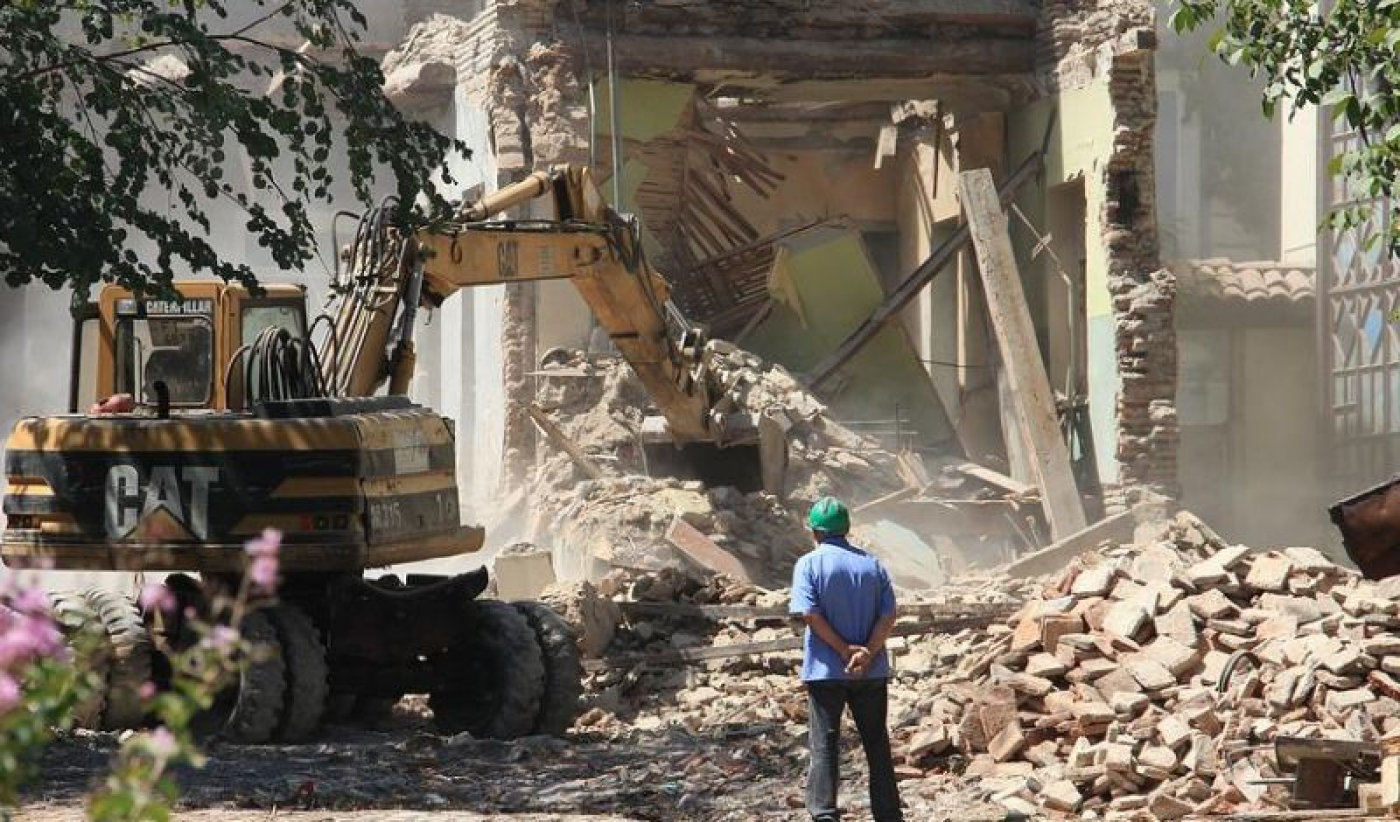
New Delhi: In response to years of targeted and punitive property demolitions, the Supreme Court finally ordered governments on 9 November 2024 not to demolish private property without due legal process, including a prior notice and hearing.
It is now an order that is notable for repeated violations—primarily because of its reluctance to address the issues of executive responsibility and the ideological foundation of demolitions over the last five years in particular.
The court’s ruling was clear enough, stressing that such demolitions must be preceded by due process of law and criticised extra‑judicial “bulldozer justice” practised by executive authorities.
The court held that no demolition should take place without a 15‑day notice containing the nature of unauthorised construction, specific violations, and grounds for demolition. The notice must be served by registered post and affixed to the property, and the demolition must be videographed. Violations were made actionable through contempt of court.
Chief Justice B R Gavai explained that a home “embodies the collective hopes of a family for stability, security, and a future” and that authorities must satisfy themselves that demolition is the only option. The court emphasised that the executive could not assume judicial powers by deciding guilt and executing demolition, which would violate the rule of law and the basic structure of the Constitution.
“A house is not just a property but [it] embodies the collective hopes of a family or individuals for stability, security, and a future,” said Justice Gavai. “If this is to be taken away, then the authority must be satisfied that this is the only option available.”
The court also reiterated the principle of separation of powers, asserting that the government cannot transform itself into a judge to find an accused guilty without trial and deliver “collective punishment” by wrecking homes with bulldozers. “Depriving innocent people of their right to life by removing shelter from their heads, in our considered view, would be wholly unconstitutional.”
Missing The Target
The court’s binding directives included procedural safeguards: a 15-day prior notice, detailing unauthorised construction and specific violations; opportunity for a hearing to challenge the State action; reasoned conclusions in orders, and videography of demolitions. These guidelines, unexceptionable in principle, closely resembled long‑standing judicial mandates that state and municipal governments routinely violate with minimal consequences.
The Supreme Court’s guidelines have already proved insufficient to restrain BJP governments from extrajudicial targeting of Muslim properties, as the previous part of this series reported. The Court’s refusal to punish repeated defiance by BJP- and Aam Aadmi Party-ruled governments, and its silence on the ideological character of demolitions, remains a critical gap.
The core problem with the court’s directives is that they do not confront the ideological character of recent demolition drives. The bias evident in these campaigns has been communal, not simply anti‑poor. While the court briefly noted that the selective demolition of some structures while sparing similarly situated ones could indicate deliberate intent, it did not go further to recognise communal targeting.
This was the only reference that the Supreme Court made about intentions: “When a particular structure is chosen all of a sudden for demolition, and the rest of the similarly situated structures in the same vicinity are not even touched, mala fide may loom large.”
Although the court’s order addresses lawless misuse of bulldozers, it does not punish or even restrict the political executive that has repeatedly violated its constitutional obligations. There is no redress, compensation, or penalty for unlawful past demolitions. The guidelines allow cost recovery from officials in future demolitions but do not hold the political leadership accountable.
Yet, the court did not confront the ideological underpinning of demolitions, which seek to marginalise Muslim and Christian minorities, operationalising it via hate crimes, attacks on livelihoods, and bulldozer demolitions as a tool of extra-judicial punishment. Bulldozers, framed as instruments of public pedagogy and State ideology, punish real or imagined crimes, such as alleged cow slaughter, love jihad, or religious conversions.
The Judicial Record
Few judicial interventions have directly named the communal nature of demolitions in the Modi era.
The Punjab and Haryana High Court questioned whether demolitions in Nuh, Haryana, in 2023 were effectively “ethnic cleansing”, noting that the home minister had termed the demolitions “ilaaj” (cure) before investigations were complete. The Haryana government denied any ethnic or religious motivation and claimed all procedures had been followed. The bench that heard the case was changed for the next hearing.
Editorials in The Hindu and Hindustan Times echoed these concerns, pointing to violations of due process and communal targeting.
In March 2025, Supreme Court judge Ujjal Bhuyan described bulldozer demolitions as “running a bulldozer over the Constitution,” threatening the rule of law. The November 2024 judgment had already stated, “Bulldozer justice is simply unacceptable under the rule of law… Justice through bulldozers is unknown to any civilised system of jurisprudence.”
“According to me, using a bulldozer to demolish a property is like running a bulldozer over the Constitution,” Bhyuan said at a public event. “It is a negation of the very concept of rule of law (sic) and if not checked, would destroy the very edifice of our justice delivery system.”
Yet, as I have said before, BJP governments routinely breach these orders without adverse consequences. When stays are granted, much of the damage is already done. As Ali Khan Mahmudabad, a political scientist at Ashoka University, told Time Magazine, “a lot has already been destroyed by the time an order stays the demolition; the damage has already been done”.
The Push for Enforcement
Many lawyers have urged the Supreme Court to enforce its own orders.
“These continued demolitions are attempts to tell courts that they don’t matter—that rule of law does not matter,” Sarim Naved, an advocate based in Delhi, told Scroll in March 2025.
Naved, who argued one of the petitions that led to the 13 November Supreme Court order, suggested the Court impose contempt sanctions, compensation, and reconstruction orders.
“These demolitions show that the state is not showing due deference to the Supreme Court’s directions,” Delhi based advocate-on-record Parasnath Singh, who petitioned the court on behalf of Muslims whose properties were demolished in Ahmedabad, told Mint in March 2025. "Such impunity cannot be allowed in a democracy with rule of law.”
Asked why the executive was violating the orders of the Supreme Court, Singh said; ``The SC must enforce order. If the court is not seen as being serious, how can you expect the government to be serious?”
Limited Protections
Occasionally, courts have stayed demolitions:
- Uttarakhand: In May 2025, the Uttarakhand High Court stopped demolition after communal violence, noting no law allowed property destruction for alleged crimes.
- Nagpur: In March 2025, the Bombay High Court stayed further demolitions after communal unrest involving the tomb of the Mughal emperor Aurangzeb.
In a rare instance in April 2025, the Supreme Court criticised illegal demolitions of properties erroneously linked to alleged gangster Atiq Ahmad, ordering Rs-10 lakh compensation per victim, paid from the public exchequer, with no personal liability for the officials responsible.
The demolition of Ahmad’s properties, said the Supreme Court, sent a “shocking and wrong signal”. It criticised the process of simply affixing a notice on the property.
“It cannot be that the person entrusted with the job of serving notice goes to the address and affixes it after finding that on that day the person concerned is not available,” said the Court.
Such cases”, said the Supreme Court, “shock our conscience”
Yet, many Supreme Court interventions have often deferred to high courts, delaying justice and allowing demolitions to proceed in states. Some examples: Uttar Pradesh, Gujarat, and Maharashtra.
In the aftermath of the Bareilly violence of September 2025, the Supreme Court, on 4 December 2025, declined to stay the demolition of two houses, rejecting claims of a “targeted” demolition drive by the State. “The court has already given a detailed judgment,” said the Court. “Approach the High Court and take the benefit of that judgment.”
Similarly, on 20 February 2025, the Supreme Court refused to entertain a plea alleging that Maharashtra authorities had violated its earlier directions by issuing only a one-day notice.
A Bench of Justices B R Gavai and Augustine George Masih said, "Why don't you go to the high court? We can't monitor everything here. Our November 2024 order states that the judgment does not apply to structures on public roads. Had you shown us the sanction plan, we would have entertained…”
On 3 March 2025, the same Bench declined to hear a contempt petition on alleged punitive demolitions in Gujarat, permitting the petitioner to approach the Gujarat High Court. “We are not inclined to entertain the present petition in this court,” said the judges. “We request the High Court that in the event the petitioner approaches the High Court, the grievance of the petitioner shall be attended expeditiously (sic)."
Legalising Punitive Demolitions
There have now been attempts to bring punitive demolitions into formal law.
The Rajasthan Prohibition of Unlawful Religious Conversion Bill, 2025, passed in September 2025 by that state’s legislative assembly and formally written into law after the governor’s assent on 8 October 2025, allows demolitions of properties linked to “illegal” conversions.
The new law, said an October 2025 Article 14 analysis, allows criminal cases based on allegations by “any person”, life imprisonment, and seizure and demolition of properties without conviction, providing judicial cover for extrajudicial and illegal acts.
These political signals of collective punishment continue: after the 2025 Bihar assembly elections, deputy chief minister Samrat Choudhury of the BJP announced, “bulldozers are ready” for identified “mafia members”.
Choudhury was the latest to signal that his party and government did not believe themselves constrained by the Constitution, the law and the courts in holding out the bulldozer as the paramount symbol of and strong, decisive governance.
'The Bulldozer Adapted'
No public official has been held personally accountable for demolishing properties outside the law, nor required to cover the costs of the razed property from their own funds.
Compensation continues to be borne from the public exchequer. The Polis Project noted the impact of the Supreme Court ruling: “The Supreme Court did not prohibit punitive demolitions—at best, it just framed the new contours within which they occurred. The bulldozer did not retreat, it adapted.”
Activist Kavita Krishnan noted that even on the day of the Supreme Court’s order, UP chief minister Adityanath showcased bulldozers at campaign rallies as symbols of governance, echoing Prime Minister Modi’s remarks on teaching opposition leaders to “run bulldozers”.
“Only someone with a ‘dil and dimaag’ (heart and mind) as strong as a bulldozer can operate one,” Adityanath said. “Those who bow before the rioters cannot take the wheel of a bulldozer.”
Fifth of a six-part series.
(Harsh Mander is a peace and justice worker and writer. Omair Khan provided research support. This work was supported by Diaspora In Action for Democracy and Human Rights.)
Get exclusive access to new databases, expert analyses, weekly newsletters, book excerpts and new ideas on democracy, law and society in India. Subscribe to Article 14.