
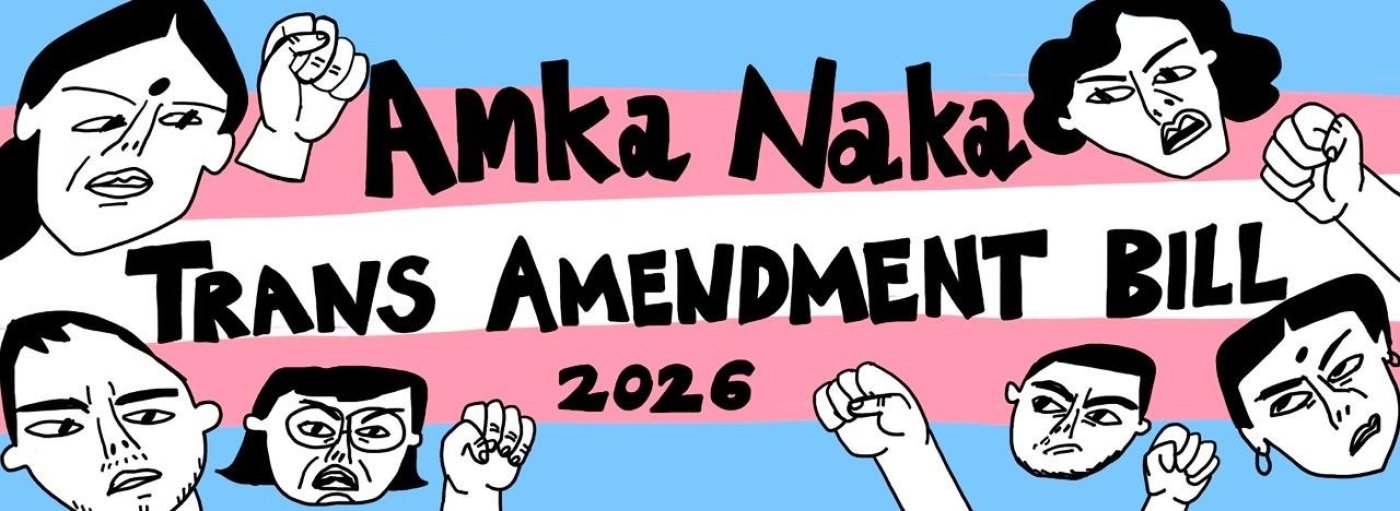
Since Virendra Kumar, the minister of social justice and empowerment, tabled the Transgender Persons (Protection of Rights) Amendment Bill in the Lok Sabha on 13 March 2026, the trans, non-binary, and intersex communities have been seized with panic and fear.
This is no ordinary amendment.
It expressly sets the legal framework for lakhs of trans, non-binary and intersex people back by decades. It aims not just to withdraw the rights and recognitions people have enjoyed under the law for a mere seven years, but also to erase them as if they never existed.
While the bill, as is typical, is followed by a statement of objects, the text itself makes it clear that this assessment is not hyperbolic.
Changing the definition of trans people to narrow it down to transgender women belonging to “traditional communities” and people with intersex variations, the bill adds, “Provided that it shall not include, nor shall ever have been so included, persons with different sexual orientations and self-perceived sexual identities.”
The Transgender Persons (Protection of Rights) Act of 2019 included, in accordance with the 2014 National Legal Services Authority v. Union of India judgment (NALSA), that transgender people had the right to self-determine their identities, without having to medically transition.
With this amendment, trans men, non-binary persons, and people of other gender identities are erased. The implications are far-reaching, and none of the outcomes are clear.
Take, for instance, transgender people in legal heterosexual marriages.
A trans man who has changed his gender identity in legal documentation is entitled to marry a woman, whether cis or trans herself.
If the trans man’s documentation is deemed never to have been valid, what of their marriage?
The bill also criminalises the act of “influencing” someone to present as trans or to undergo surgery.
What does this mean for the thousands of healthcare providers in private therapy practices and in clinics and hospitals who provide affirming hormonal and surgical interventions?
What of even queer support groups that recognise and affirm trans identities?
My own transition is at the stage of coming out in my social circles, which, as I have described elsewhere, is the product of many years of internal turmoil. Now, just as self-acceptance has come within reach, the goals have changed again.
I have heard from people whose legal transitions are in the pipeline who are rushing to get their identity cards before the window closes if the bill is passed.
Others are trying to schedule surgeries before faceless medical boards are constituted to interfere in operating rooms. Should I decide to pursue hormonal interventions, will I be able to find doctors willing to take the risk of working with me, in a profession that is already notoriously transphobic?
Earlier this year, an op-ed in the Times of India by Jahnavi Nilekani introduced word-for-word the western fearmongering about transgender rights to a very Indian context.
The queer and trans community rallied against it at the time, but beneath that was an uneasy fear that this was the portent of more circumscription to come, along the lines of the United States or the United Kingdom.
Even for those of us who read the wind about this, the amendment bill goes beyond the pale.
In a very particular casteist Hindutva manner, those transgender women that it recognises must belong to “sociocultural” communities that are recognised in Hindu scriptures, such as hijras, kinnars, jogtas and aravanis.
It does not mention the multitude of other transgender communities from across the country that have also existed for centuries, though it might just hold space for them by implying the named communities are not an exhaustive list.
It assumes that these women are interchangeable with people with intersex characteristics, whose separate recognition will be deleted according to the bill.
The legal rights enshrined by NALSA and partly enacted by the 2019 Act were intended to form the framework on which societal acceptance would have been built.
Trans people, regardless of whether they belong to “traditional” communities, face horrendous discrimination and violence, starting with their natal families, who often violently reject the idea that their children are moving out of their control.
There is a reason that so many shelter homes and helplines exist for trans people—familial acceptance is fraught with conditions, if ever entirely accepted.
In the public sphere, trans people find it difficult to move in public, rent houses, and consistently accept low-paying jobs just for survival.
Even with just my social transition, I have been denied service at a restaurant in Mumbai when I was accompanied by other trans friends.
When I have a beard, people visibly do a double-take when they look at my chest, and their minds short-circuit as they try to clock my gender.
My budding beard has also discomfited several gynaecologists, who are aghast that I do not see it as a source of shame, even as they confidently—and wrongly—tell me that my gender identity either does not matter or is undoubtedly aligned with my assigned sex.
I have repressed my dysphoria just to survive.
Yet the more I write and read about the bill, and the more the trans community across boundaries rallies together to stand with each other in solidarity, I feel reassured that we are
not fracturing, as the bill would have us do, into smaller subgroups.
Hijra groups have spoken out against the bill, as have trans men and intersex people who are fighting their own erasure. Dalit groups stand in solidarity with the trans community, and protests and press conferences are populated by people from across caste and class divides. We are not alone.
(Mridula Chari is an independent journalist.)
Get exclusive access to new databases, expert analyses, weekly newsletters, book excerpts and new ideas on democracy, law and society in India. Subscribe to Article 14.