
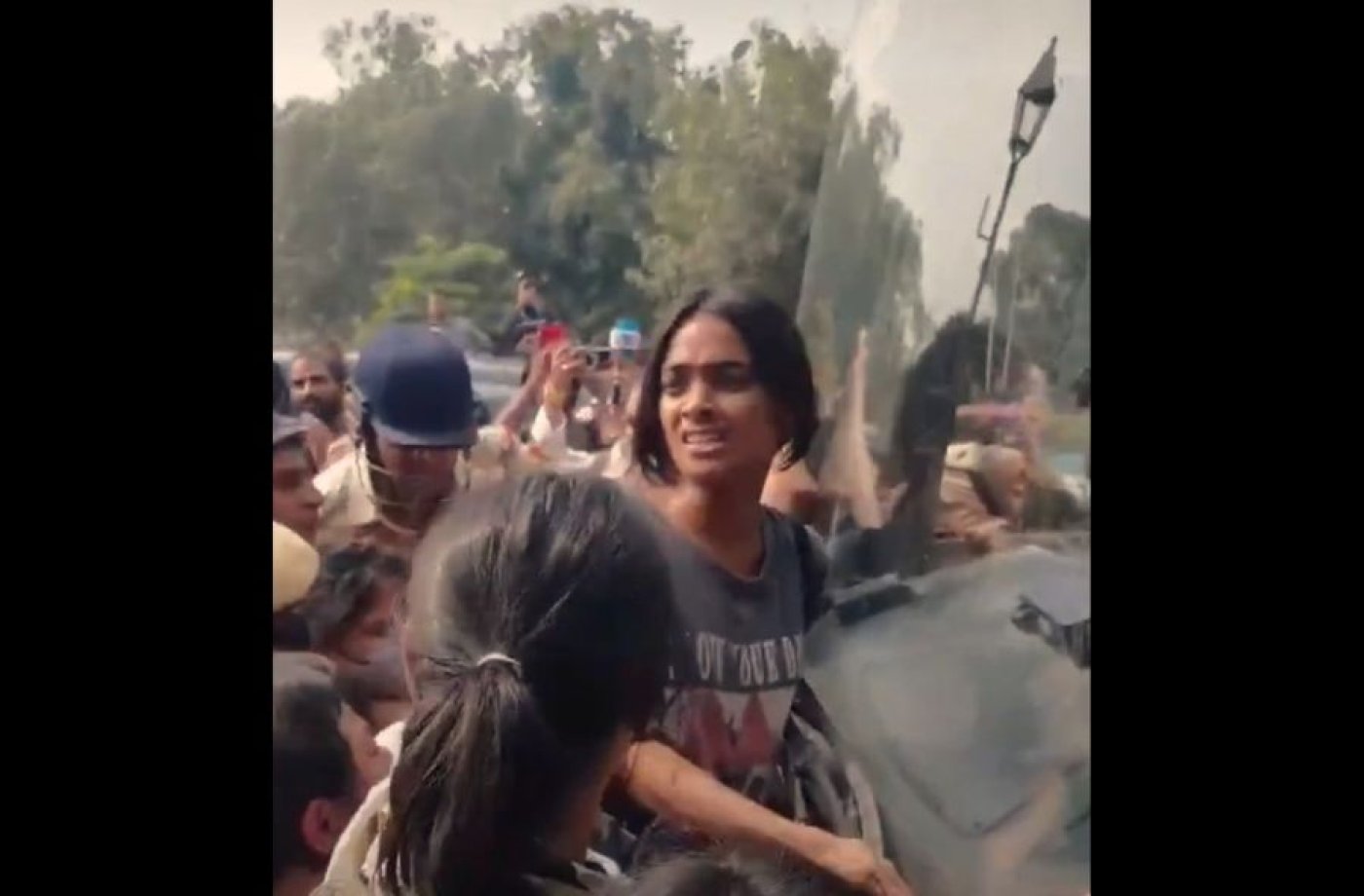
NEW DELHI: By 11 October 2026, a video went viral across social media platforms such as X, which captured sexual harassment by a Delhi police officer against a woman protester.
The clip shows police encircling young women protesters at the INA market flyover in south Delhi.
A young woman was seen standing pinned against a police van to block the detention of her fellow protesters, who had taken to the streets against the demonstrably flawed and suspect revision of India’s electoral rolls and to demand the resignation of the chief election commissioner, Gyanesh Kumar.
In the clip, a male police officer was seen pressing his body directly against the woman, leveraging the crushing momentum of the crowd and the chaos around them to do so.
As the footage circulated online, amplified by prominent political voices including member of Parliament Mahua Moitra and senior Congress Party leader Supriya Shrinate, public outrage mounted over what appeared to be a very explicit act of sexual harassment
Weeks have passed since the brutal Delhi police crackdown on protesters between 10 and 12 October, captured in videos and photographs, including allegations of sexual harassment against women protesters.
Despite condemnation from independent experts appointed by the United Nations Human Rights Council, Opposition leaders, and complaints filed with the National Human Rights Commission (NHRC), the National Commission for Women (NCW), and Delhi Police by victims, political and media women’s groups, public attention has faded, with little apparent push for accountability. The victims told us they expect none.
Central reserve police force (CRPF) officer Rahul Solanki filed a formal complaint with the NHRC, NCW and Delhi Police regarding the severe ill-treatment and mistreatment of women protesters by law enforcement and central armed police forces (CAPF).
The NHRC, on 8 October, took suo motu cognisance of alleged sexual harassment of three journalists by Delhi Police personnel during a protest at Jantar Mantar, New Delhi on 3rd October 2026, calling for a detailed report on the matter from the Delhi Police commissioner within two weeks.
Delhi Police public relations officer ACP Rajiv Ranjan warned that sharing the personal information, identities, or details of on-duty police officers on social media is “entirely inappropriate and illegal”.
We spoke to two women—a protester and a journalist—who alleged sexual harassment by male police personnel. Another woman journalist said she was groped in a police van full of male officers and detainees. A fourth woman alleged that she was sexually harassed by women police personnel.
In addition to the two women we spoke to, other media publications reported instances of sexual harassment alleged by female protesters, including groping and inappropriate touching by male police and uniformed personnel amid detentions, pulling the clothes of protesters, and being hit on the breasts and kicked on the private parts.
On social media, clips have circulated, such as that of women police officials assaulting Congress Party workers, and a video of a policeman touching AISA leader and activist Neha Bora’s chest while attempting to stop her.
In response to a petition by the Network of Women in Media, India (NWIMI), the Supreme Court appointed a high-powered enquiry committee to probe alleged harassment during the anti-SIR protests,
which will hold a two-day sitting on 29 and 30 October. The committee will hear affected people and record evidence related to the alleged use of pellet guns, targeted harassment, harassment of female protesters, excessive force and property damage by both sides.
Before the 10 October protests, a week earlier on 3 October, journalist and content creator Rosy, who goes by her first name, accused assistant commissioner of police (ACP) Vivek Bhagat of sexual harassment—squeezing her breasts and pushing her—during the protest on 3 October.
ACP Bhagat reportedly said that he would not take up the charge of additional commissioner of police until an inquiry against him was completed.
The Delhi Police on 13 October registered an FIR against Rosy, alleging that she made casteist slurs and humiliated ACP Bhagat.
In his complaint, Bhagat accused Rosy of saying, “This is Bhagat; they are Meghwals, belonging to a lower caste. They do sewing and stitching work. How…this fellow became an ACP?”
Questions were sent to the Commissioner of Police and Public Relations Officer (PRO) of the Delhi Police, seeking their responses to the allegations of sexual harassment made by the people we interviewed for this report.
Questions were also sent to the chairperson of the NCW and their public information officer, Binu Peter, regarding taking cognisance of sexual harassment against women during the ongoing protests.
This story shall be updated if they respond.
Activist Alleges Harassment
Article 14 found the young woman in the viral video.
Ananya Raturi, a 22-year-old MA student at Delhi University and a member of the All India Students Association (AISA), affiliated with the Communist Party of India (Marxist-Leninist) or CPIML.
Reflecting on the events of 10 October, Raturi recounted how she and fellow activist Neha Bora had joined afternoon demonstrations near the INA area. When police moved in to detain Neha, brutal assaults broke out between 2:00 PM and 2:30 PM.
"It was male police personnel who pushed against us, and I don't know what they were doing, but this has been the key tactic of the Delhi Police," Raturi said.
"If there were no cameras, this would’ve gone unnoticed...the police were pushing the women protesters, so he was pushing himself onto me, and I couldn’t comprehend what happened at that moment,” she said.
“He was just pushing himself on me”, she said, and added that while trying to detain her, police personnel dragged her by the pants. “They were pulling my pants; they just tore them."
Amid the confusion, a sympathetic bystander handed her a dupatta to cover herself as her pants were almost slipping off in the presence of a crowd, she added.
"I was literally shouting at them, telling them that my pants were getting torn, but they didn’t listen. This was done by women police and male police,” she said. “At one point, my T-shirt was also tearing. I was shouting.”
The abuse did not stop on the streets.
Detained and crammed into a prison bus headed toward the Maidan Garhi area in south Delhi, the young AISA activist said she faced further hostility.
When she complained of breathing difficulties caused by thick smoke emitting inside the vehicle, a female policewoman slapped her.
"Who would we even complain to? Who can we even demand action from when it comes to all this police harassment and abuse?" Raturi asked.
She said officers wore no name badges and that, even on buses, unrecognised personnel operated in plain clothes.
Journalists Allege Harassment
Sonal Pateria, a reporter with Jist News, arrived at the INA flyover around 2:15 PM on 10 October after hearing that left-wing student groups were staging a demonstration.
As police detained AISA activist Raturi inside a bus, Pateria attempted to interview her while Raturi was inside the bus.
According to Pateria, police sought to isolate media personnel to prevent them from recording testimonies.
"There was a policeman who was using a baton to push people away. First, he used it to poke my back to drive me away, and then he brought the baton to my breasts, and I started calling this out. After that, he touched my breasts in an attempt to push me away. He groped me while trying to push me away from speaking to the detainees,” she recounted.
"But AISA activist Anjali was sitting inside the bus and from an elevated position she could see more clearly what he was doing in that crowd,” said Pateria.
“She started shouting, ‘Keep your hands away, what are you doing!’ For at least 45 to 50 seconds, he was trying to touch my breasts, and that’s when I asked my camera person to show his face, and I called him out,” she said.
In their published YouTube video report, Inside 'Historical Protest' of 10th October 2026 ft. Sonal, the reporter, can be heard exclaiming in frustration at the brazenness of the assault, and the policeman in question has his face covered under a helmet, along with the absence of any name badge.
Pateria also said she saw an officer with three stars on his shoulder lapels laughing while police officers kicked a fallen protester with their boots, an act of harassment that could easily have turned fatal. None of the police wore name badges, and some had even covered their faces with helmets or masks, further escaping accountability]
Astha Savyasachi, a 32-year-old investigative reporter with Newslaundry, faced direct aggression while covering the protests.
While reporting near the Park Hotel in central Delhi around 11:00 AM on 10 October 2026, Savyasachi and her colleague Ashwini rushed to investigate the detention of their colleague and fellow journalist, Anmol Pritam, outside the New Delhi railway station.
When they questioned police officers there, officers manhandled Ashwini, snatched Savyasachi’s phone, and called three women police personnel to drag her into a detention bus, where she fell heavily on the floor.
"When I was inside the detention bus, I noticed there were just two or three women, and it was mostly stuffed with men," Savyasachi recalled.
"A man standing behind me was touching me and pressed himself against me. Out of panic and as a reflex, I twisted his hand to try and stop him. He immediately let go and ran off. I couldn’t pursue it further with the police because there was so much happening, so much chaos."
Writing about her ordeal in Newslaundry, Astha Savyasachi also asks why she was “[P]ut on a bus stuffed with just only three other women, including one policewoman, and 20–25 men in the first place?”
Speaking to Article 14, she reiterated that she couldn't pursue further action with the police because so much was happening, and there was a manufactured sense of chaos.
“Based on my experiences as a woman—forget as a journalist —these issues never really get solved,” she said. “Such instances of harassment on public transport happen in normal circumstances; people report to the police, but the accused never gets caught, so I have no reason to believe any action would be taken, especially when this happened in a detention bus".
No Justice Expected
Aman, 32, who preferred to be called only by his first name, a lawyer who joined the AISA protest at the INA flyover, witnessed the police physically dismantling the demonstration.
"The cops, instead of pulling the women protesters’ legs, started pulling the jeans. And I could see with my own eyes, one of the girls’ jeans literally starting to slip off," Aman said.
When he intervened and shouted at officers over the violation of dignity, police dragged him behind a police bus, kicking him, striking him with lathis, and throwing him inside.
Bleeding profusely from a head injury, Aman was kept on the detention bus for 1.5 hours before receiving rudimentary first aid at a local clinic, ultimately requiring stitches to his head at Max Hospital.
Devyani Sarkar, a 24-year-old activist with the Disha students' organisation, detailed a systematic routine of physical and sexualized abuse by security personnel.
"I was grabbed by my breasts by women police officers. Because they’re women, they got an excuse and impunity since it’s not seen as sexual assault," Sarkar said. She recounted fellow protesters being choked, dragged by the hair, and subjected to deep nail scratches on their backs.
Sonal Pateria, the journalist, said they didn't even expect justice or accountability.
“More than 7 lakh people have seen this on our YouTube channel now, so they’ve seen what happened, but I don’t think the police care even if you tag them with all this evidence”, she said.
(Sabah Gurmat is an independent journalist and writer based in New Delhi)
Get exclusive access to new databases, expert analyses, weekly newsletters, book excerpts and new ideas on democracy, law and society in India. Subscribe to Article 14.