
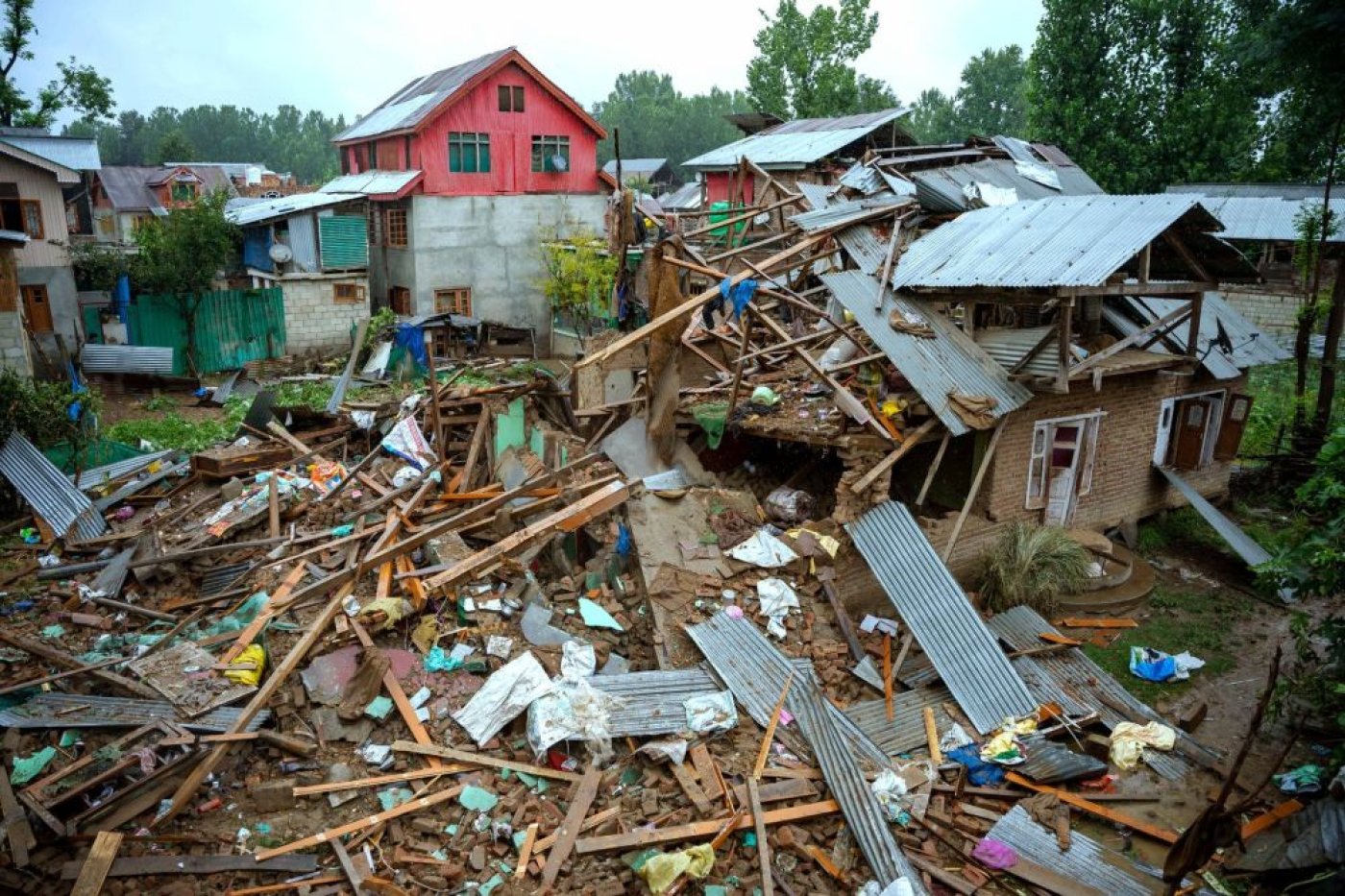
Hassanpora (Anantnag district), Jammu and Kashmir: Less than eight hours after head constable Ashiq Hussain Qureshi was shot dead by a lone gunman at 12:30 pm near Lal Chowk in Anantnag on 22 July 2026, security forces arrived in Guree village, a 15-minute drive away.
Residents said they first took control of the family of Adil Ahmad Thoker, a local man who has been missing for nine years, and photographed his newly constructed three-storey house as well as neighbouring homes around 8 pm.
A couple of hours later, they returned.
This time, villagers said, they came with more vehicles and personnel. After 10 pm, residents watched security forces move through the neighbourhood, taking photographs and revisiting the house.
“At around midnight, several more security vehicles arrived,” said a local man who refused to be identified for fear of reprisal. “Everyone in the neighbourhood became frightened. People started asking each other, khabar kya chu? Asi chu aaz shayad raats nebar behun shurr heth (‘What’s happening? It looks like we will have to spend the night outside.’).
Shortly after 3 am on 23 July, before the fajr or dawn call to prayer, an explosion ripped through the village.
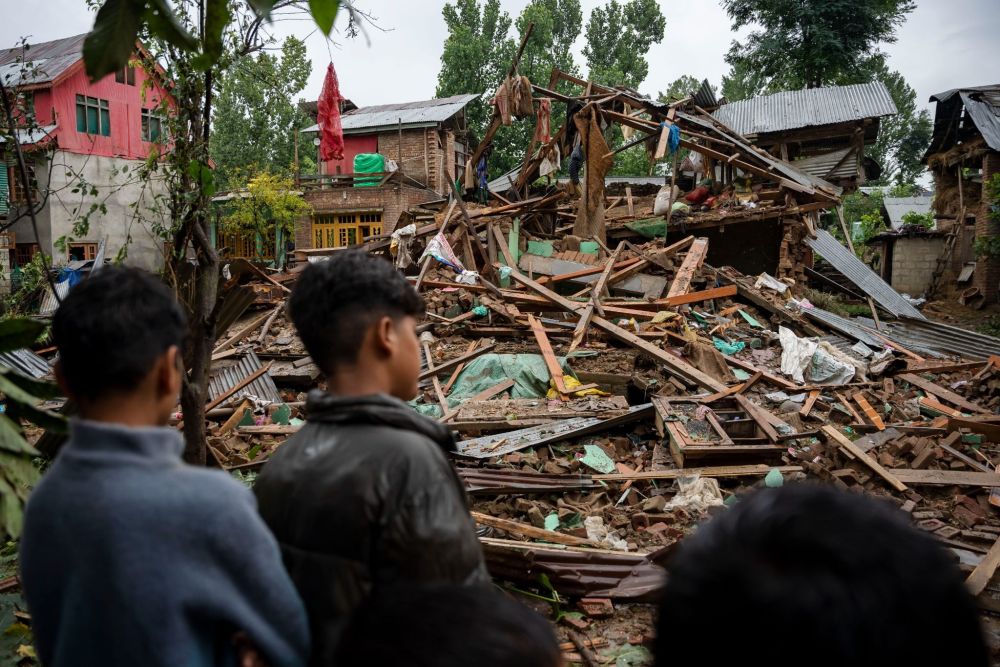
By morning, Thoker's house had been reduced to rubble, 15 hours after Qureshi was shot dead.
2,500 Arrested
That same night—at about the same time as Thoker’s house was blown up—in the village of Hassanpora, 9 km to the southeast, security forces also demolished the house of Haroon Rashid Ganai, whom officials described as a Lashkar-e-Taiba militant. The operations were conducted jointly by the Jammu and Kashmir Police, the Army and the paramilitary Central Reserve Police Force.
The demolitions were part of a Valley-wide crackdown launched after Qureshi's killing, during which authorities detained more than 2,500 people and carried out raids across several districts. Interviews with young men detained reconfirmed that many were picked up after every terror attack.
For residents of Guree, the night's events unfolded with little warning.
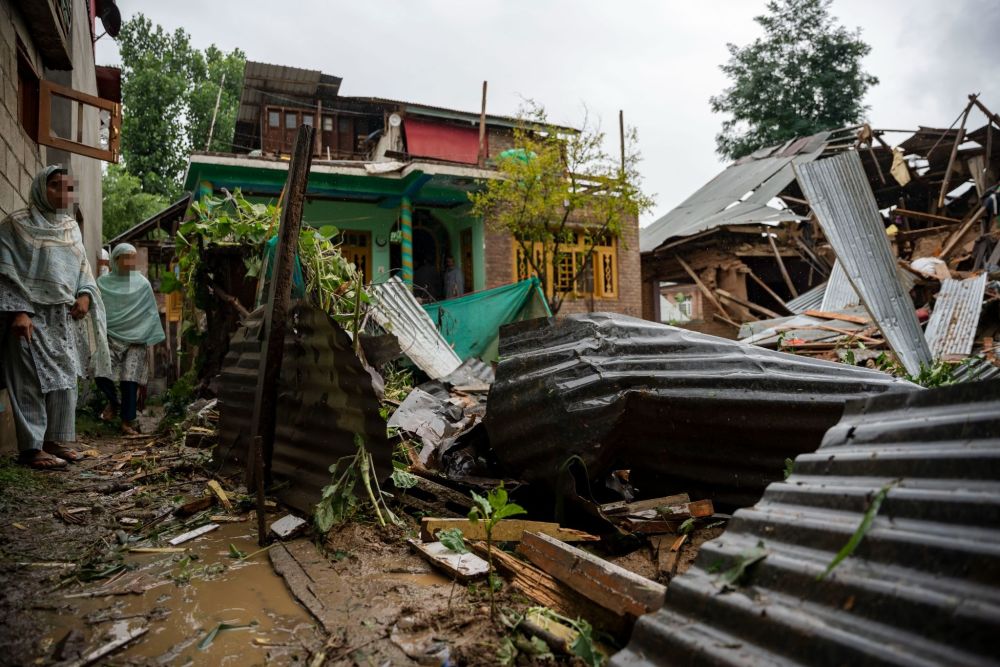
Several neighbouring homes were damaged in the blast, according to villagers, who said they spent the night fearing they too might be forced from their houses.
No evacuation notice was issued, residents said, nor were reasons provided for the demolition. Lawyers said the operation appeared inconsistent with due-process safeguards laid down by the Supreme Court to prevent punitive demolitions, including requirements for prior notice and an opportunity to challenge the action.
Lawyers said the operation violated the Supreme Court's November 2024 ruling against “bulldozer justice”, which prescribed procedural safeguards before demolitions and expressly stated that “no demolition should be carried out in the early morning or late evening/night”.
“Here in Kashmir, when one person is accused of wrongdoing, it feels as though the consequences extend beyond the individual to families and entire communities,” said a neighbour, speaking on condition of anonymity. “That is the injustice many people feel.”
Legal Questions Over Demolitions
Since the revocation of Article 370 in 2019, authorities have repeatedly demolished homes linked to alleged militants, suspects and, more recently, alleged drug traffickers in the union territory.
In the days following the 22 April 2025 Pahalgam attack, authorities demolished at least nine homes linked to suspected militants, Reuters reported, while Scroll put the figure at 10 by 27 April. The demolished properties included the first demolition of the Guree village home of Thoker, whom investigators alleged was one of the attack's perpetrators.
Advocate Sajad Farooq Rather of the Jammu & Kashmir and Ladakh High Court said the demolitions were in conflict with Supreme Court directions governing the demolition of residential structures.
On 13 November 2024, in In Re: Directions in the Matter of Demolition of Structures (Writ Petition (Civil) No. 295 of 2022), the Supreme Court laid down nationwide guidelines requiring authorities to follow due process before carrying out demolitions.
Among other safeguards, the Court directed that, apart from the early-morning and late-night prohibition, those affected should ordinarily receive prior notice, and that a minimum period be provided to challenge the action.
Rather said the demolition of the two houses on the night of 22 July appeared to raise questions under those guidelines.
“Any policy or practice of demolishing residential homes as a security response must be tested against legality, procedural fairness and constitutional safeguards,” said Rather.
Violating Supreme Court Orders
Residents of Guree village told Article 14 that no evacuation notice was issued before Adil Ahmad Thoker's house was demolished at around 3.15 am on 23 July.
Residents in Hassanpora Tawella said neighbouring families were asked to vacate before the demolition of Haroon Rashid Ganai's house, but said they were unaware of any formal notice being served.
Article 14 could not independently verify whether demolition notices were issued in either case.
We sought comment, on the allegations that Supreme Court orders were violated, from Anantnag senior superintendent of police Amod Ashok Nagpure over whatsApp and the district collector Bilal Mohiuddin Bhat over email. There was no response until the time this story was published. If they respond, we will update this story.
The Supreme Court's 2024 judgment followed a series of demolitions across several states after communal violence and other incidents. The Court held that executive authorities could not demolish property as a punitive measure and that actions must comply with statutory procedures and constitutional safeguards.
The demolitions in Anantnag also follow a pattern after the April 2025 Pahalgam attack, when authorities demolished a number of homes linked to alleged militants (here and here).
Legal experts then questioned whether the actions complied with due process requirements and whether family members could be held responsible for consequences arising from allegations against relatives.
Rather said a central issue in such cases is whether action is being taken against a property owner on the basis of their own conduct or because of allegations involving a family member.
“In a constitutional system, liability is ordinarily individual,” he said. “Questions arise when consequences extend to persons who have neither been accused nor convicted of any offence.”
‘Intensify Area Domination’
Among the 2,500 detained across Kashmir after the killing of head constable Qureshi were alleged “over ground workers” (OGWs)—as sympathisers are called by the police—suspected militant sympathisers and individuals previously named in first information reports (FIRs).
Raids and detentions were carried out in the districts of Srinagar, Anantnag, Baramulla, Budgam, Shopian, and Ganderbal.
The Kashmir Observer, a Srinagar-based English newspaper, reported on 24 July that the director general of police, Nalin Prabhat, asked officials to “intensify area domination, strengthen intelligence-led operations and reinforce the security grid to maintain peace and counter the remaining militant networks”.
For many residents, the crackdown revived memories of earlier security operations.
Large-scale detentions have followed several major militant attacks in Kashmir in recent years, including the April 2025 attack in Pahalgam, when thousands were questioned during security operations across the Valley.
‘We Live In Fear’
A 28-year-old daily wage worker from Anantnag, A*—detained for 24 hours and released after questioning, and similarly picked up after the April 2025 Pahalgam terror attack—said repeated detentions had become a recurring feature of life after major security incidents.
During questioning, A said he asked why he had been picked up. An official told him it was because “superiors” had so ordered, according to him.
“I always stay on my toes because Kashmir has become a place of incidents,” said A. “And we are the first targets to be taken to the police station for questioning, or to be held for a day, two days, three days, depending on their mood.”
“These days we live in fear,” he said. “Just walking on the road feels scary because you don't know who will pick you up.”
Recalling his detention, he said: “Why was I caught and taken to the police station? I had nothing to do with that attack, and neither did many of the youths who were arrested. By doing this, the authorities deliberately create fear among the public.”
‘I Just Want To Ask, Why Me?’
F*, another one of those previously detained, said his family had encouraged him to seek work abroad.
“They tell me to go to Saudi Arabia or somewhere else so I can at least live peacefully and avoid these unjustified arrests,” he said. “Many Kashmiris work outside India, but I can't get a passport because of this bad character record, a label I don't accept.”
Many young men were reluctant to discuss their experiences publicly.
“There are young boys across Kashmir, especially in the south and in Anantnag, who refuse to talk about their experiences because they fear being named and caught again by security forces,” said F. “There are hundreds of such stories.”
‘I’m Fed Up With This’
Z*, 31, from Anantnag district, said he was among those taken in for questioning after the shooting of constable Qureshi, as he was “many times” after the Pahalgam attack.
“I'm used to these arrests,” he said. “Whenever anything happens in South Kashmir, I expect I'll be picked up. I'm fed up with this pick-and-release pattern. I do manual labour; I want to earn money and support my family. But incidents like this make me feel pushed to give up on everything.”
He said repeated detentions had affected his mental health.
“They may think it's easy to pick us up and then let us go, but it leaves a real mark on our lives,” said Z. “I'm mentally disturbed. It plays on my mind that I could be taken at any time if something were to happen. But why? I just want to ask: why me?”
Z said the shooting took place in Anantnag town, about 30 km away from his home.
“What did I do? If you're going to take me because of this, then keep me; don't play this pick-and-drop game,” he said. “Life starts to feel meaningless. I have long been interested in mainstream politics and want to serve my community. I don't want to be involved in violence; I never have been. Please let me do my work.”
Waheed Parra, member of the legislative assembly from Pulwama from the Peoples’ Democratic Party, said that at a time when governments elsewhere were withdrawing cases against student protesters, he said, Kashmir continued to be treated differently.
“If reconciliation is the right path for young people elsewhere in India, why is it considered the wrong path for Kashmir?” said Parra. “Applying one standard to the rest of the country and another to Kashmir sends a dangerous message and risks deepening alienation.”
*Denotes identities withheld on request.
(Ilhak Tantray and Umer Farooq Zargar are independent journalists based in Srinagar.)
Get exclusive access to new databases, expert analyses, weekly newsletters, book excerpts and new ideas on democracy, law and society in India. Subscribe to Article 14.