
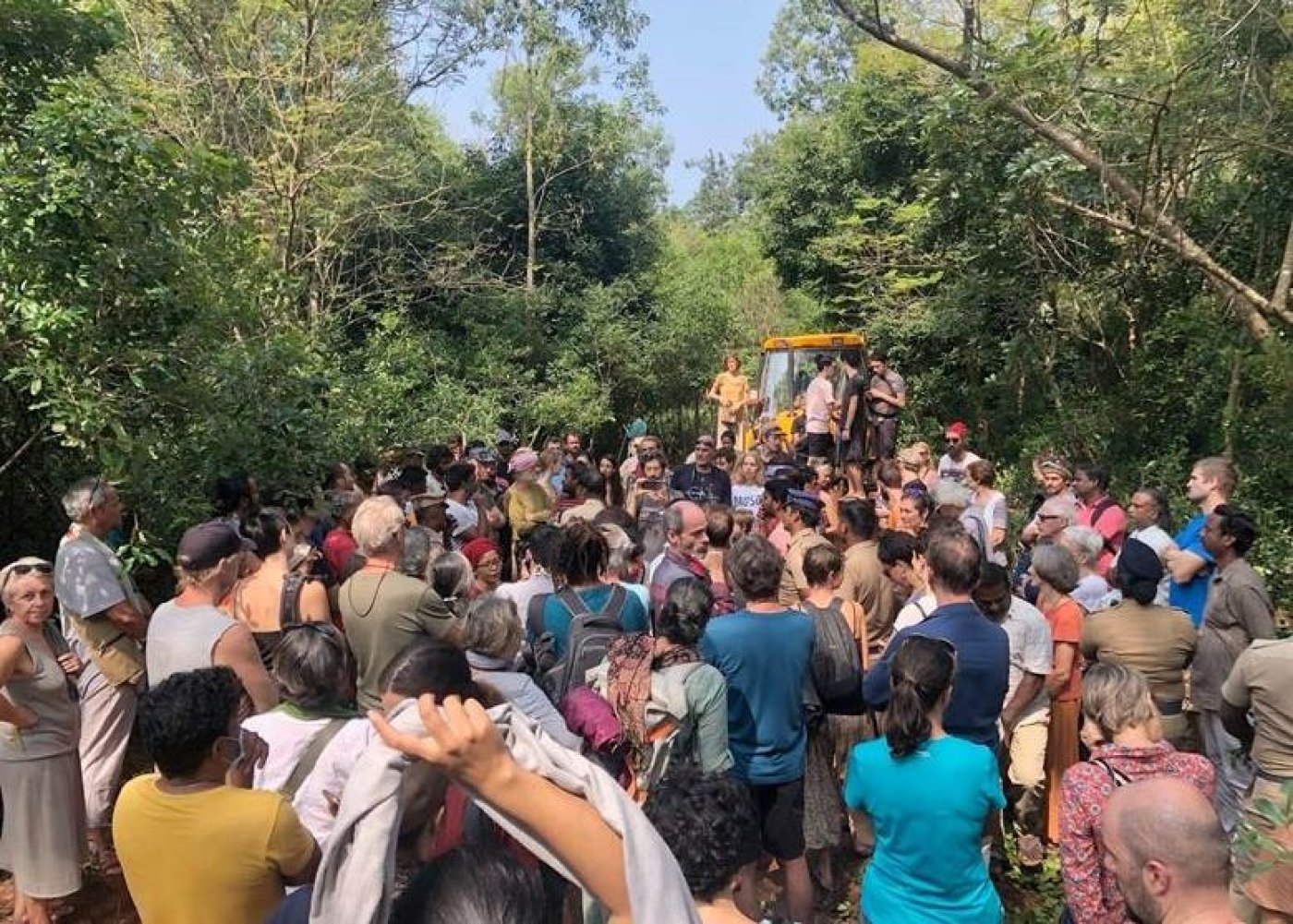
Auroville, Tamil Nadu: "It was never a place where you came to become rich," said 51-year-old Kundhavi Devi, who moved to Auroville in 2005 after her marriage. "But in terms of quality of life, it was a rich place to live."
For the tall, grey-haired Kundhavi, Auroville represents a rare experiment in human unity.
She said the atmosphere changed dramatically after demolition drives began in December 2021, with trees being cut down and the township’s youth centre demolished to make way for the Crown Road, a 4.3 km ring road project.
“It was heartbreaking to watch the trees being destroyed,” Kundhavi said. “We Aurovillians have spent years nurturing this land and building this community. To see it being demolished like this left us feeling shocked, helpless and deeply angry.”
As demolition crews moved in again on 20 March 2026, the Crown Road project once again became a major point of conflict.
Residents claimed around 30 people appointed by the Auroville Foundation arrived at the youth centre to demolish the remaining structures. This led to clashes with residents and renewed opposition to the project.
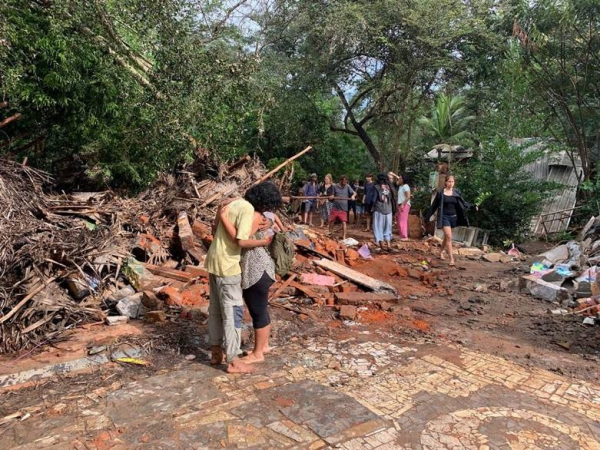
Residents said the project could damage more community property and green spaces.
The Auroville Foundation, however, said it is implementing the township’s long-delayed original concept, known as the Galaxy, first prepared in 1968 and revived by the Foundation in recent years.
But the Galaxy is not simply a blueprint for a conventional ring road.
Auroville's own archival material describes a more complex, evolving urban concept. There are also disagreements within Auroville over how the Crown should be interpreted and built. One Auroville planning account, for instance, describes the Crown as a backbone for predominantly non-motorised and slow transport.
Residents opposed to the current administration argue that implementing the plan has come at the cost of cutting thousands of trees and losing homes and community land.
They also allege that Auroville's governance has drifted from its founding ideals, that foreign nationals have been deported after speaking out against the administration, and that growing Union-government influence has reshaped the township.
According to Kundhavi, many residents now fear losing their homes and jobs or, for foreign nationals, their visas.
She claimed that around 300 foreign residents have left Auroville in recent years, while many others remain uncertain about their future.
“We are not against development. We only want the government and the residents to work together,” she said, adding that Auroville's founding purpose depends on dialogue and cooperation between the community and the administration.
Administrative Changes
Founded in 1968 in Tamil Nadu’s Villuppuram district, Auroville is home to nearly 3,000 residents from more than 60 countries. Conceived by Mirra Alfassa, known as “The Mother”, it was intended as a universal township where people could live together beyond nationality, caste, religion and private ownership.
Under the Auroville Foundation Act, three bodies govern the township: the Residents’ Assembly, the Governing Board appointed by the Union government, and the International Advisory Council, whose members are also appointed by the Union government.
Residents said the township changed significantly after Jayanthi S Ravi, an IAS officer from the Gujarat cadre, was appointed secretary of the Auroville Foundation in 2021 by the Appointments Committee of the Cabinet, a two-member panel comprising the prime minister and home minister.
They alleged that decision-making had since become more centralised, with the administration taking a larger role in development, land, and environmental decisions previously made with resident participation. They also alleged that the secretary was making decisions without the participation of the Residents’ Assembly and advisory committee.
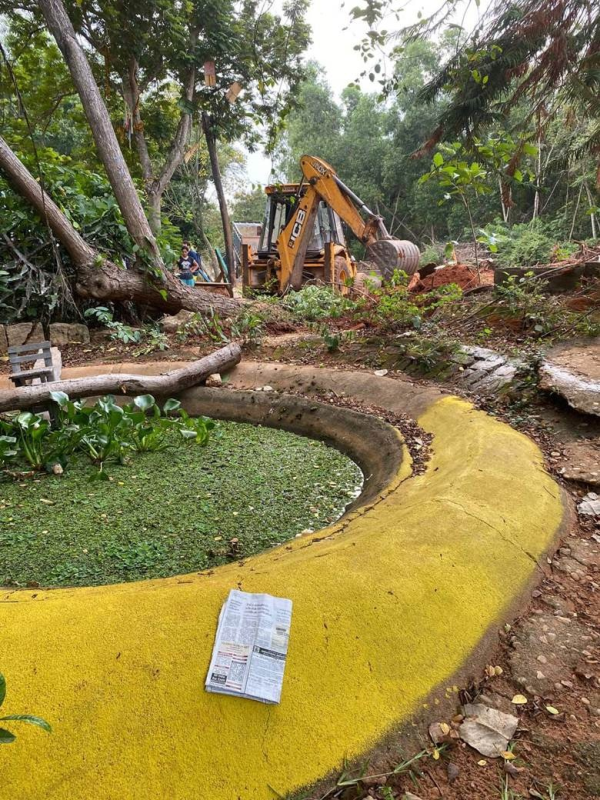
Asokumar Arumugam, who has lived in Auroville for more than three decades, said decisions once reached through community discussion were now increasingly being made by the administration.
Residents also alleged retaliation against those who challenge the administration. Rajendren Narayanasamy, an employee and volunteer, said experienced staff had been removed or pressured to resign. He also claimed he received multiple notices and was accused of being “mentally unfit” after questioning administrative decisions.
Chennai-based advocate Senthil J said the disputes raise questions about governance, residents’ rights, land and environmental laws under the Auroville Foundation Act, which gives both the Governing Board and Residents’ Assembly roles in governing Auroville and its community properties.
The Land Battle
The Auroville Foundation owns all land in Auroville, but residents and community members have managed much of it for decades.
In 2023, the Foundation proposed transferring about 100 acres to IIT Madras for a research and development campus. Residents opposed the move because it could affect community spaces and farms, including Annapurna Farm, which supplies food to residents.
In July 2025, the Foundation and IIT Madras signed an MoU granting IIT Madras a 33-year lease of 100 acres at no cost. A declaration to the police by activists opposing the lease, accessed by Article 14, claimed the land was worth Rs 500 crore.
A resident challenged the lease in the Madras High Court. After initially granting an interim stay, the court dismissed the petition on 16 April 2026, holding that the petitioner was “merely a permissive occupant” without legal title to the farmland.
A separate complaint alleged that the lease deed, registered on 23 December 2025, contained survey numbers that differed materially from those in the July 2025 MoU, amounting to an unauthorised deviation.
Residents questioned how community-used land could be leased without informing them, noting that no Residents’ Assembly body was party to the agreement. The Working Committee’s media wing, which Auroville authorities deem unauthorised, said the deal reflected a pattern of unilateral decision-making since July 2021.
The Foundation rejected the suggestion that it was dismantling Auroville’s founding ideals. Sindhuja Jagadheesan, its media coordinator, said the Governing Board had approved the IIT Madras project, which she said was consistent with Auroville’s founding ideals. She stressed that the land was leased for 33 years, not permanently transferred.
The land disputes did not end there. On 7 April 2026, the Foundation Office allegedly registered an exchange involving about two acres of Auroville land known as Auro Annam.
Residents said registration documents showed the Auroville land given up was valued at Rs 4.53 crore, while the land received in exchange was valued at Rs 19.5 lakh—a difference of roughly 23 times. The transaction prompted a police complaint accessed by Article 14.
Advocate Senthil J said the central question was whether Auroville’s public assets were “dealt with transparently, at fair value, and in accordance with the law”.
He said the transactions raise questions under provisions of the Bharatiya Nyaya Sanhita and the Tamil Nadu Public Property (Prevention of Damage and Loss) Act, 1992. He identified Section 318(1) (cheating), Section 316 (criminal breach of trust), Section 306 and Section 61 (criminal conspiracy) as provisions that could apply to claims of deception in property transactions.
Jagadheesan, responding to criticism of the land deals, said the Foundation could not invoke the Land Acquisition Act because compulsory acquisition was the government’s prerogative. She said Auroville land had historically been acquired through voluntary purchases, donations, negotiated settlements and exchanges.
The Eternity Incident
Many residents said they can no longer recognise the community they helped build.
"I have never known a home outside Auroville," says Anan Skoles, 39. His parents moved there in 1986, he said, and he grew up planting trees, building homes and helping transform the once-barren landscape.
At the centre of his family's concerns is an 18.5-acre coastal property, known as Eternity, which they had managed for nearly four decades.
According to Skoles, his family and other residents restored the land to a forest that now supports groundwater recharge, wildlife and nearby villages.
Skoles said the Auroville Foundation had proposed exchanging the property for smaller parcels elsewhere and issued the family an eviction notice on 16 March 2026 asking them to relocate to an apartment complex within 14 days.
While he said he was not opposed to a land exchange, he believed it should follow due process and be based on community approval.
“Even if the Foundation owns the land, it must follow due process before evicting people,” said advocate Senthil J. “This includes giving them proper notice and a fair chance to respond.”
“People who have lived in their homes for decades cannot be evicted arbitrarily,” he added. “Any eviction must follow the principles of natural justice.”
In March 2026, Skoles' petition to the Madras High Court was dismissed on the grounds that the residents were deemed “permissive occupants” rather than legal titleholders.
Soon after, Skoles said Foundation personnel broke the lock at the site entry and began fencing the land.
On 5 May 2026, the secretary issued an order directing the residents to complete their relocation within seven days.
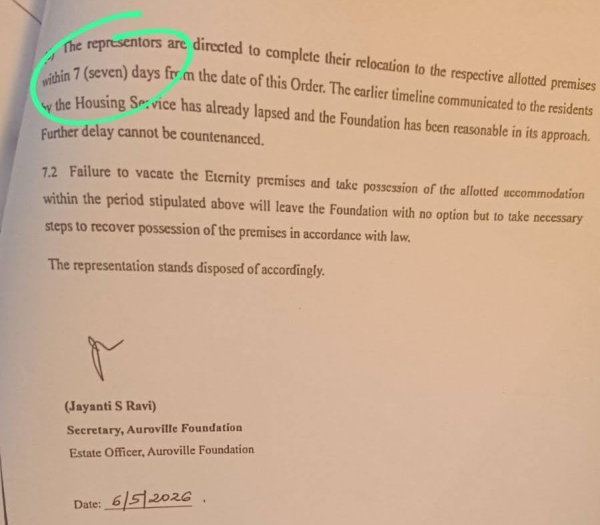
Skoles alleged that, on 10 July 2026, members of the Auroville Foundation attempted to enter the property and forcibly evict its occupants.
Mandakini, Skoles' wife, filed a civil suit seeking an interim injunction against eviction and relocation actions except under due process of law, which is pending before the Pondicherry Munsif Court.
Skoles also alleged that the Foundation's fencing has disrupted wildlife movement and that the conflict has taken a heavy emotional toll on his family, particularly his father, who is nearly 80.
“To ask someone who has spent more than half his life here to leave is inhumane,” he said. “The Auroville spirit is not there anymore.”
Ecological Concerns
Residents said the physical transformation of the township's landscape is equally concerning.
For several decades, residents restored thousands of acres of land into one of India's largest tropical dry evergreen forest regeneration projects.
Many residents fear that these trees are now in danger.
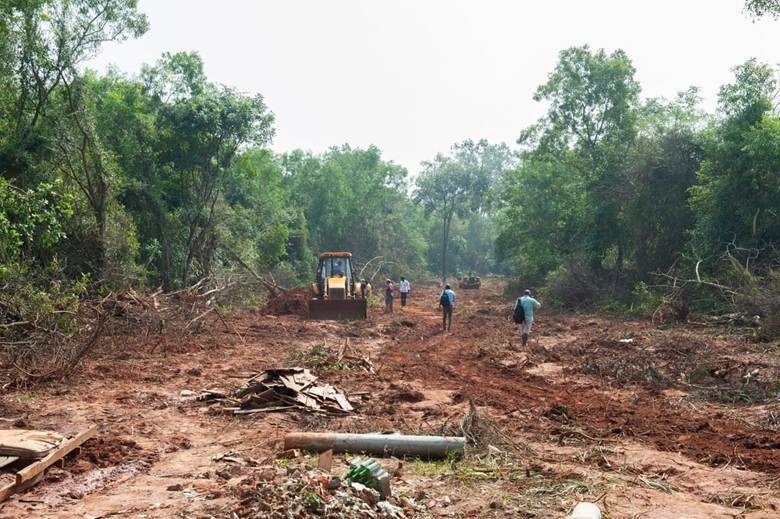
Residents previously opposed the proposed Crown Road project because it could lead to tree cutting and damage Auroville’s forests and green spaces.
In December 2021, demolition drives removed over 900 trees and community structures.
Jagadheesan, the Foundation’s media coordinator, said the Crown Road is part of Auroville’s original concept and was essential to the township’s planned development.
Arun Ambathi, an Auroville volunteer and member of the Auroville Forest Group, who came to Auroville in 2018 to study forestry, said he soon found himself drawn into a widening conflict over governance, land and environmental protection.
"What began as concerns about tree-cutting slowly unfolded into what I believed were much larger issues," he said.
On 28 April, 2022, the National Green Tribunal (NGT) ordered the Auroville Foundation to stop construction and prepare a proper development plan because of environmental concerns.
Yet, he said, the situation worsened in June 2023 when around 1,863 trees were cut in the Revelation Forest in Auroville.
Ambathi also alleged that he was threatened and physically assaulted while documenting timber transport and trying to stop the felling of what he believed was an illegally cut mango tree.
On 17 March, 2025, the Supreme Court overturned the NGT order and allowed Auroville’s expansion to continue.
According to Ambathi, land acquired over decades for ecological restoration, water conservation and long-term environmental planning is being undervalued and repurposed without community approval.
‘I Consider Myself Almost Indian’
Visa renewals have become a major source of anxiety for many foreign nationals and their families. Several foreign residents spoke on condition of anonymity, fearing that speaking publicly could affect their ability to remain in India.
For S* a 75-year-old French national who arrived in India in 1974 and has spent more than five decades in Auroville, the possibility of being forced to leave the country she now considers home is deeply unsettling.
She said many foreign residents fear visa cancellations or deportation.
"I have lived here more years than I have lived in France," she said. "I consider myself almost Indian. To be told that maybe you have to go back to your country is very difficult because this is my country. Sometimes I have panic attacks."
Another French resident, M*, now 80, first travelled to India in 1969 and eventually made Auroville his permanent home.
Speaking on condition of anonymity because of concerns about his visa status, he alleged that he has been unable to secure a long-term visa renewal despite spending most of his life in India.
According to him, the Auroville Foundation questioned his association with the Exit Review Committee, a review body created under Auroville's earlier governance framework that decided who should be recognised as a resident of Auroville.
"They told me that because I belonged to this committee, which was considered to be in opposition to the current administration, I should not expect to receive a visa," M said.
He said visa renewals, once a routine process every five years, had become increasingly uncertain.
"The biggest change is that the authority to manage and organise the life of Auroville has been taken away from the people themselves," he said, adding that decisions that were once made collectively are now increasingly taken by a small group of authorities.
The Auroville Foundation has not publicly stated that visa renewals are linked to residents' views or activities. Immigration decisions ultimately fall within the jurisdiction of the Union government.
‘Fight For Accountability’
Outside Auroville, the conflict has begun receiving support from activists and civil society groups.
Piyush Manush, an activist from Salem closely associated with Auroville residents resisting recent administrative changes, said he believed the crisis facing Auroville began with the appointment of the new secretary in 2021.
According to him, the years since had been marked by growing disruptions, conflicts and uncertainty for residents, with the central issue being that the land transactions involving Auroville property, including transfers, leases and proposed exchanges, were carried out without transparency or consultation.
He said the resistance movement had gathered momentum in recent months, with activists and residents registering police complaints and first information reports in cases involving alleged violence against Auroville residents.
“The fight for accountability in Auroville is far from over,” he said.
(Jagisha Arora is a Delhi-based journalist who writes on social, gender, cinema and political issues.)
Get exclusive access to new databases, expert analyses, weekly newsletters, book excerpts and new ideas on democracy, law and society in India. Subscribe to Article 14.