
Bhopal, Madhya Pradesh: “Who did you give it to?”
“It is signed by someone else”
“Did you give it in the morning or evening?”
“We can’t find it”
“Come again later today”
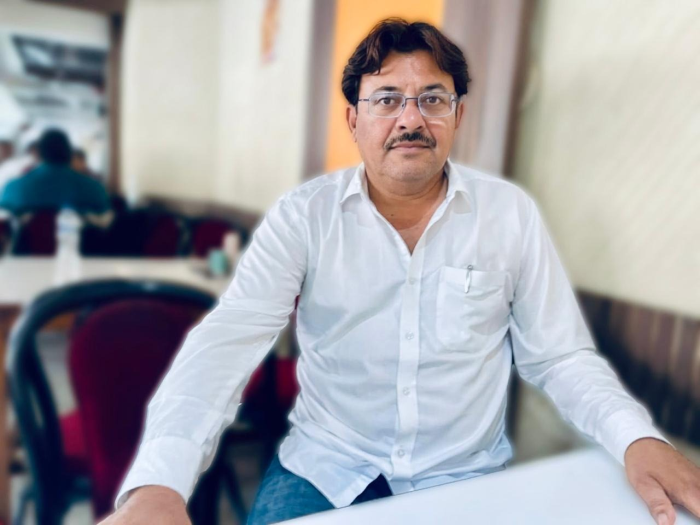
These were some of the things said to Pyare Khan when he went for the fourth time to follow up on a complaint he had submitted a month earlier to a police station in Bhopal, the capital of the central Indian state of Madhya Pradesh.
Each policeman he approached told him to go to another. He was sent to a room where a man in civilian clothes looked over a logbook and told him he wasn't a policeman and should speak with one.
Eventually, one policeman, who asked that his name not appear, told this reporter that no police case had been registered against Khan’s complaint accusing a housing society of religious discrimination against Muslims.
Then, another policeman chimed in, saying, “We are investigating. First there is an investigation, then we register a case.”
On 23 October, 48 days after his complaint, Khan said no FiR had been registered.
Assistant sub inspector of the Habibganj police station, Mahesh Dhurve, said he would follow up on the complaint.
Under Indian law, however, police must register a first information report (FIR) if the complaint alleges a cognisable offence, punishable with three to seven years in prison, and then investigate. If the complaint's allegation is unclear, police must complete a preliminary inquiry within 14 days before registering the FIR.
Sections of criminal law on outraging religious feelings and threatening communal harmony are cognisable offences. They are routinely invoked, and FIRs are almost immediately registered when the complaints are directed against Muslims.
Outside the Habibganj police station, which serves some of Bhopal’s more affluent neighbourhoods and markets, the noon sun beating down, Khan, 50, a father of four, said, “They won’t register the case. The men behind this are connected to powerful people in the government.”
“But I have to keep trying for the sake of my children, otherwise I cannot look them in the face,” he said. “How do we live in a country where such a thing can happen and there is nothing one can do about it?”
Rent To Hindus
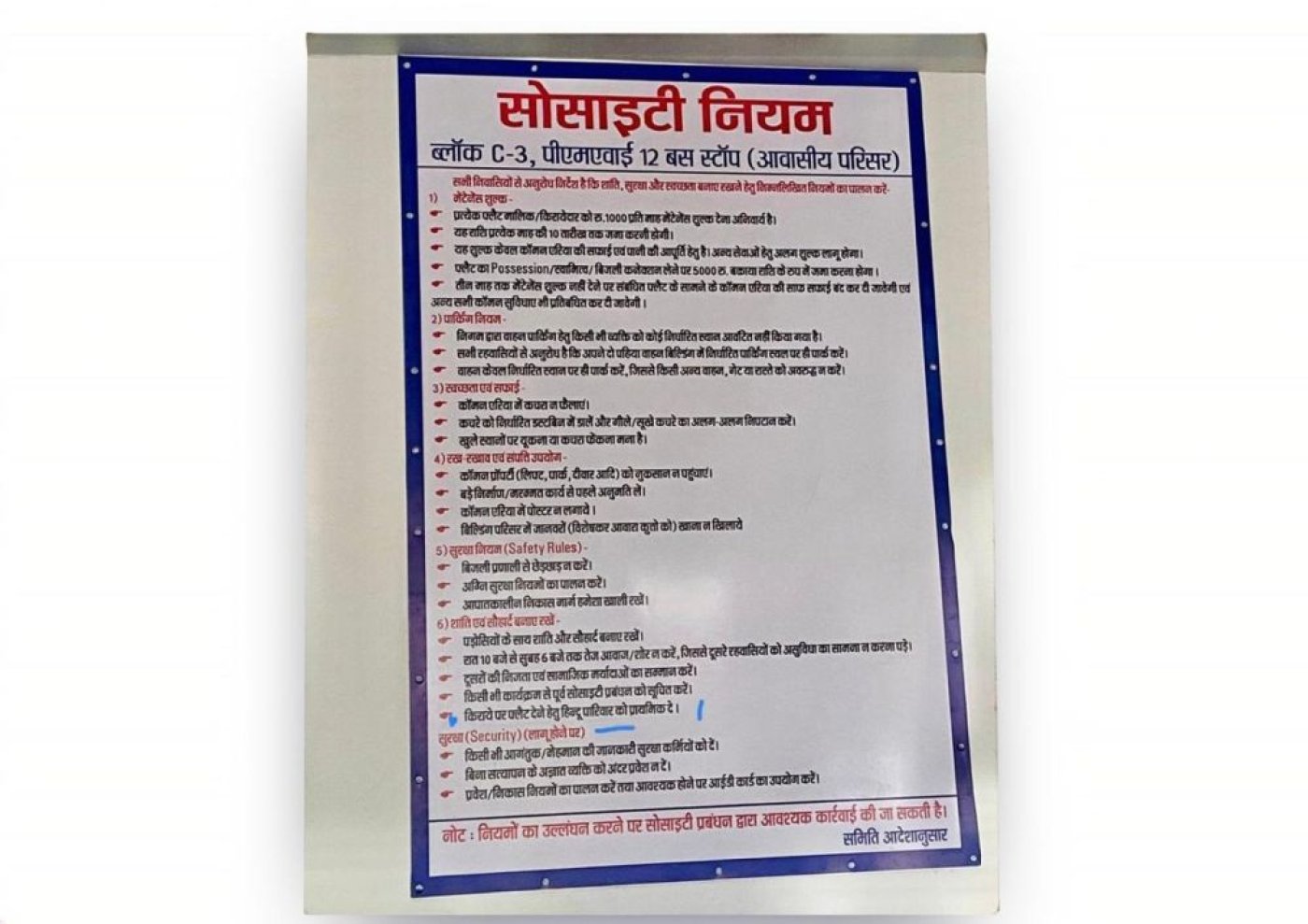
In September, Khan discovered a list of instructions posted on the wall of the new residential society built by the Nagar Nigam, the city’s municipal corporation, in an area called the 12 Number Bus Stop. A single line in the lower half of the notice said homeowners should give preference to Hindu families when renting them out.
The notice was signed “as per the order of the committee”.
It is not unusual in India for Hindus to refuse to rent homes to Muslims. The practice is widespread and has led to the ghettoisation of Muslims in many Indian cities. But this time, the refusal wasn't just something a landlord said privately or masked behind an excuse.
It was written on the notice board of an apartment complex built by the municipal corporation under the central government’s flagship housing scheme, the Pradhan Mantri Awas Yojana (PMAY), launched by Prime Minister Narendra Modi in 2015.
Khan added that the land on which the new apartment complex stood once belonged to his grandfather, a zamindar (a landowner). The state government acquired the land for public purposes in 1962, during sweeping land reforms under Prime Minister Jawaharlal Nehru, when India abolished the zamindari system and transferred land rights from landlords to the state or to tenant farmers.
Khan said his grandfather once owned 150 acres of land in Bhopal, and he has moved the court to recover six acres on which nothing has yet been built. But, he said, the case has not moved forward in the past three years because the government lawyer never showed up, leaving him with one court date after another.
‘It Is Deeply Personal To Me’
“It is not news that many Hindus do not rent to Muslims, but to write it so openly shows people feel they can practice discrimination without any fear or shame,” said Khan. “Even though Muslims know that many Hindus do not want to rent to us, it was still shocking and very painful to see it openly stated as a rule and displayed on a notice board.”
“It is deeply personal to me,” he said. “My grandfather once owned the land these houses are built on. They took it for public purposes, and he never objected. But now you are saying that my children cannot rent a house built on the land that once belonged to their great-grandfather.”
Shaking his head over a to-go cup of cold coffee, Khan repeated, “Are you telling me that today, in India, in our home state of MP, in our home city of Bhopal, my children cannot rent a house built by the government on land that once belonged to my grandfather, their great-grandfather, simply because they are Muslim,” he said. “I just cannot believe such a thing.
ETV Bharat first reported this story in early September. Khan said that aside from a few news outlets, there wasn’t much coverage by the local media
In many states ruled by the Bharatiya Janata Party (BJP), the media has become subservient to the party and its Hindu nationalist ideology.
Much like in other parts of North India, Islamophobia, the vilification of and violence against Muslims, has deepened over the past ten years in MP.
Spreading Islamophobia
Right-wing groups, operating with the government’s tacit support and in cahoots with police and politicians, have incited Hindus to boycott Muslim businesses, pushed Muslim traders and salesmen out of work, broken up interfaith marriages, beaten Muslims on the streets, in addition to enforcing a wider social and economic boycott.
The government has ordered the demolition of Muslim-run schools and Muslim houses often in the aftermath of communal violence. The police weaponise the law, pursuing cases which are so poorly fabricated, they fall apart in courts, but only after the wrongfully accused have spent months or years in jail.
The police are accused of bias, but they also face immense pressure from right-wing groups to target Muslims, while, at the same time, ruling party and government officials pressure them to go easy on the right-wing groups. Even when an FIR is registered, the case usually goes nowhere.
Limited media coverage of the instruction to rent to Hindu families created some pressure, but Khan said it took three weeks for the notice to be taken down.
As he started his motorcycle and headed from the police station to the Nagar Nigam office, Khan said, “I don’t trust them.”
“They have taken down the notice, but they have spread the poison. They did not even issue an apology,” he said. “Unless some action is taken, they will put it up again when the heat is off. You just see.”
“I want to know who was responsible for writing such an instruction and how they will be punished under the law,” he said.
Talking into the wind as he sped along an empty road, he said, “Imagine if Muslims had done such a thing. What would the police and courts have done? How can the law be applied so unequally? How can citizens be treated so differently?”
Passing The Blame
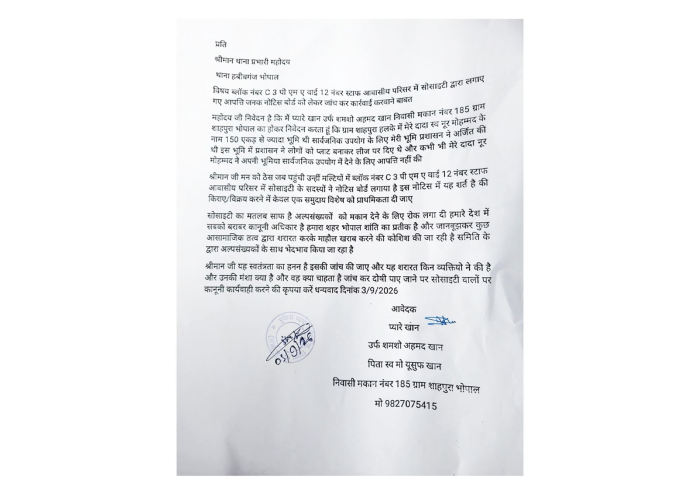
In his complaint to the Habibganj police station dated 3 September 2026, Khan wrote that his grandfather never objected when the government acquired 150 acres of his land and made plots on it.
“But the heart is hurt” when society members put up a notice saying that “members of one community should be given preference for the rent and sale of houses”.
“The meaning is clear. There is a prohibition against giving homes to minorities. Everyone is equal under our laws. Our city Bhopal is a symbol of peace, but some anti-social elements are trying to spoil the atmosphere. The society is disseminating against minorities.”
“This is a violation of independence. This should be investigated to identify who is behind this mischief and what their intention is. Take legal action against members of the society.”
In phone calls with Article 14, officials involved in the PMAY housing project and residents denied having anything to do with the instruction to rent to Hindus, with people either distancing themselves from the project or blaming each other for the instruction.
One resident said, “It was a mistake. No one knew about it. It comes under the Nagar Nigam.”
At the Nagar Nigam PMAY office, zonal officer Kajal Mishra said the Nagar Nigam knew nothing about the instruction. They handed over the building's operation and maintenance to the resident welfare association (RWA).
For a Nagar Nigam building, the sub-divisional magistrate’s (SDM) office approves the RWA.
Another official chimed in, saying the RWA for the 12 Number Bus Stop housing complex was not “fully final”, but that an “ad hoc RWA” was in place.
“We have not done this,” said Mishra. “It is not in our knowledge. There is no discrimination on our part.”
Later that day, Khan told us that he had also given his complaint to Mishra.
“Let’s see if anything happens,” he said. “Of course, they all know. They are all protecting each other. They know no one can be punished.”
On 23 October, close to three weeks after he submitted his complaint, Khan said he had yet to hear back from the Nagar Nigam.
(Betwa Sharma is managing editor of Article 14.)
Get exclusive access to new databases, expert analyses, weekly newsletters, book excerpts and new ideas on democracy, law and society in India. Subscribe to Article 14.