
In the closing narration of the 2004 film, Troy, an otherwise slightly flat, faintly bland retelling of the Trojan War, Odysseus says: “Let them say I lived in the time of Hector, tamer of horses. Let them say I lived in the time of Achilles.”
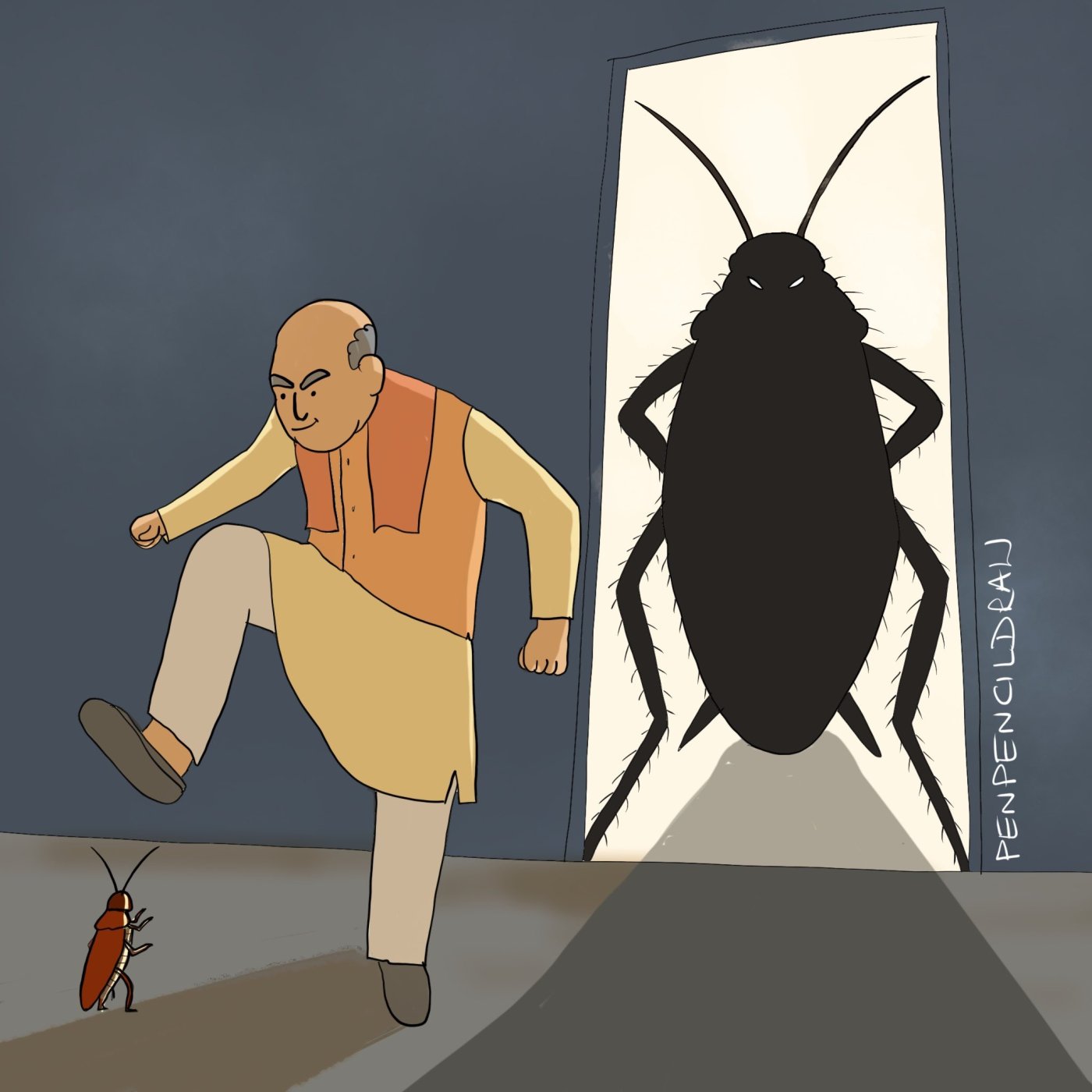
And, in a comparison that is admittedly a little absurd, I can probably say: I lived through the week when a young Norwegian journalist sent the Indian Prime Minister’s foreign visit into a tailspin, and when a movement, born out of satire, riffing on the invincibility of cockroaches, exploded, amassing more than 21 million followers on Instagram within days, leaving BJP’s nine million in the dust.
Journalist Helle Lyng’s asking the leader of the world’s largest democracy, who has not addressed a press conference at home in 12 years, to take a question upended the tightly managed optics that usually mark Prime Minister Narendra Modi’s appearances and triggered a frenzy among the right-wing ecosystem and their loyal mainstream media.
The Cockroach Janata Party (CJP) was a response to Chief Justice Surya Kant’s astonishing remarks, calling unemployed youth “cockroaches” and “parasites” who turn into media figures, social media users, RTI activists, and “start attacking everyone”. (He later said that he was misquoted and that is not what he meant. He wasn’t misquoted).
All this may well be forgotten in the coming days and weeks, but what matters is the swift, spontaneous, mammoth reaction: an urgent, almost primal demand for a free press allowed to question its leaders, and the raw frustration among young people over lack of opportunity, lack of transparency, rising inequality and prices, and an environment consumed by hate, bigotry, bravado, and propaganda, in the absence of meaningful change.
What began as a joke party for the “lazy,” “unemployed,” permanently online generation resonated because there was truth in its absurdity, and the “cockroach” was the perfect symbol: unwanted, hard to eliminate, and surviving every attempt to crush it.
Even as the BJP continues to rack up electoral victories through money, muscle power, control over institutions like the Election Commission, and the strategic tweaking of electoral rolls, an unmistakable wave of discontent has been building for some time now, visible in everyday conversations and across social media.
If anything, the Opposition has failed to effectively tap into or channel this sentiment.
The backlash and crackdown this week have felt less like the response of a government secure in its many electoral victories and more like that of an insecure regime with a thin skin, frightened about real and rising discontent.
The state that claims civilisational confidence somehow finds itself threatened by an internet satire account and by a single question from a journalist on a different continent.
Social media accounts were suspended, furious television debates ensued, and the familiar language of “national security”, “ sovereignty”, and “anti-national forces” quickly entered the conversation.
Helle Lyng was hit with the usual wave of misogynistic abuse and a media pile-on more aggressive than anything that Modi has faced as Prime Minister, as if asking about human rights or press freedom needs some grand qualification instead of basic journalism.
Shortly after her question went viral, and amid intense online backlash, Lyng’s Facebook and Instagram accounts were suspended by Meta, with no clear explanation.
The CJP’s X account, run by Abhijeet Dipke, an Indian living in the US, who reportedly once volunteered for AAP, was withheld after a “legal demand” was issued by Indian authorities over “national security concerns”.
Dipke has claimed there have been multiple attempts to hack CJP’s Instagram account.
The fact-checking website, Alt News, found the claim by BJP leaders and right-wing influencers that most of CJP’s followers were based in Pakistan to be false.
The playbook has become painfully familiar.
If the person asking questions is foreign, they are immediately painted as colonial-minded, funded by some foreign agency, working for another country’s interests or hostile to India’s growing global profile.
And people within India who agree with those criticisms are painted as self-loathing and unpatriotic.
If they are Indian, there are real-life consequences: call them anti-national, accuse them of endangering sovereignty or national security, unleash the social media trolls and media on them, and then start piling on cases under the harshest laws available.
Dipke has said that he and his family are receiving death threats.
Who knows what will happen to him?
His parents are worried that he could be arrested, as so many critics and dissenters have been before him.
The judiciary appears to be faring no better than the government.
Contempt proceedings have been initiated against journalist Saurav Das after he reported on an alleged conflict of interest involving a Delhi High Court judge who was hearing the liquor policy case against Arvind Kejriwal.
His reporting raised questions about whether the judge should have continued hearing the matter, ultimately leading the judge to step away from the case.
Eventually, Justice Swarna Kanta Sharma stepped away, saying she was not recusing herself but doing so because she had initiated contempt proceedings against Kejriwal, who refused to appear before her.
Now, another contempt petition has been filed against Das, Kejriwal and two other AAP leaders by an advocate, one Ashok Chaitanya, before the High Court, alleging a “coordinated campaign” against Justice Sharma.
The High Court issued notice to the journalist.
The contempt case raises serious concerns about press freedom, especially given Das’s record of reporting on judicial accountability and institutional power, including his work with Article 14, where he questioned former Chief Justice of India D Y Chandrachud on the allocation of politically sensitive cases, among other hard-hitting stories that have often gone where many in the press don’t.
Earlier this year, a Supreme Court bench comprising the Chief Justice issued a contempt notice against NCERT over a class 8 textbook chapter on “corruption in the judiciary,” ordered its withdrawal, saying it undermined public confidence, and blacklisted its authors.
Contempt proceedings have a chilling effect on the judiciary's scrutiny by academics and journalists.
Or, as Das put it, “Questions cannot be contempt.”
(Betwa Sharma is managing editor of Article 14.)
Get exclusive access to new databases, expert analyses, weekly newsletters, book excerpts and new ideas on democracy, law and society in India. Subscribe to Article 14.