
Mumbai: The Bharatiya Janata Party (BJP) government led by Prime Minister Narendra Modi has systematically weakened India's democratic institutions, undermined parliamentary accountability and used state agencies to target political opponents, religious minorities and government critics, according to a new report by international rights organisation Human Rights Watch (HRW).
Titled “So What’s This Democracy We’re Talking About?”, Modi’s Authoritarian Playbook in India, the 95-page report examines developments since the BJP came to power in 2014. It argues that the erosion of democratic safeguards is not confined to individual institutions but reflects a wider pattern of political interference in bodies meant to keep the executive accountable.
The report identifies four principal areas of concern: the undermining of parliamentary procedures and suppression of the Opposition; the weaponisation of federal investigative agencies for political purposes; the weakening of constitutional and statutory oversight institutions, including the Election Commission of India (ECI) and human rights commissions; and executive interference in the judiciary, alongside the courts’ own failure to consistently uphold fundamental rights.
The report draws on research and interviews conducted between January 2025 and September 2026. Its findings are based on more than 40 interviews with former government officials, serving and former judges, lawyers, journalists, activists, researchers and academics, as well as analysis of government actions, official documents, court decisions, academic research and reports by civil society organisations and international bodies.
“The Modi administration’s actions over the past decade are not isolated institutional failures but mutually reinforcing elements of an authoritarian playbook,” Elaine Pearson, Asia Director at Human Rights Watch, told Article 14.
“This is because a weakened opposition has fewer means to resist laws that entrench executive control.” While institutions led by political appointees, such as federal and state human rights commissions, have not responded adequately to efforts to prevent the silencing of civil society, “coercive investigations” have further weakened opposition parties and silenced independent critics, Pearson said. “The cumulative effect is the dismantling of safeguards that enable people to challenge those in power, leaving the government ever less accountable and the institutions meant to constrain it ever less able to act.”
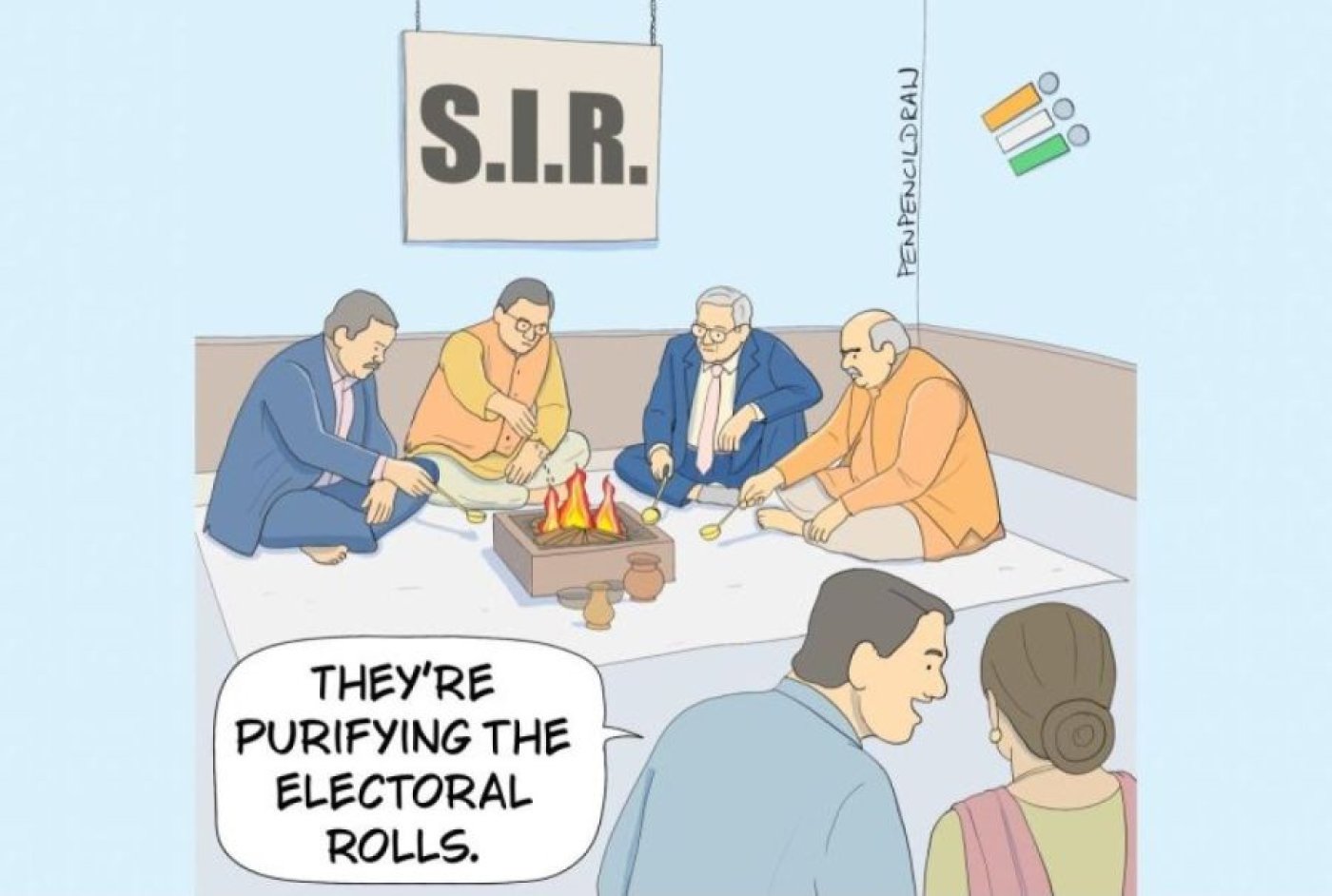
The report's most immediate concern is the Election Commission's conduct during the Special Intensive Revision (SIR) of electoral rolls, which began in June 2025. By October 2026, the exercise had resulted in the deletion of more than 130 million names, disproportionately affecting women, people living in poverty, religious minorities, particularly Muslims, and other marginalised communities, said HRW, which also published a detailed research paper on the SIR in October 2026.
The report says the process was deeply flawed, arbitrary and opaque, and was conducted in several states shortly before elections. It cites instances in West Bengal where the number of voters flagged for scrutiny fell from 16.7 million to approximately 9.5 million within weeks following public criticism, raising questions about the criteria used to identify voters for deletion.
The impact, HRW said, was particularly pronounced among Muslims. One example in the report is of Patharpratima constituency in South 24 Parganas district, where more than 92% of those deleted from the rolls were Muslims, although Muslims constituted only 9% of the population.
The report also cites the restoration of deleted voters as evidence of the scale of wrongful exclusion. About 93% of the appeals against deletions decided in West Bengal resulted in voters being restored to the electoral rolls. More than 3.4 million appeals, however, remained pending before appellate tribunals. The Calcutta High Court estimated that resolving these appeals could take at least 21 years.
The West Bengal experience “showed the kind of burden and hardship the process imposed on people, especially on those from marginalised communities,” according to Pearson.
The consequences extended beyond the right to vote. The report notes that state governments used information about deleted voters to deny access to social security programmes, food entitlements, passport renewals, and residential certificates required by students.
It also documents the expulsion of ethnic Bengali Muslims to Bangladesh without due process, and the use of the SIR exercise alongside the BJP government's 'detect, delete and deport' policy. HRW recommends that the government immediately scrap the SIR, restore the right of every citizen to participate in elections, and establish an independent investigation into allegations of politically motivated interference.
Investigative Agencies Weaponised
The report describes the use of federal investigative agencies, including the Enforcement Directorate (ED), Central Bureau of Investigation (CBI) and National Investigation Agency (NIA), as instruments through which the government has consolidated political power.
It says the agencies have pursued allegations of corruption and financial irregularities against opposition politicians, activists, human rights organisations and independent media organisations, often in circumstances that suggest political motivation.
Citing figures from the Union finance ministry, the report says the ED registered cases against 193 politicians between April 2015 and February 2025. This represented an increase of more than 600% over the preceding decade, when the agency investigated 26 politicians.
The report also points to a pattern in which opposition politicians facing investigations received relief after joining the BJP. At least 23 prominent opposition politicians who faced federal investigations were given a reprieve after crossing over to the ruling party, it says.
The report mentions a former minister in Maharashtra, Harshvardhan Patil, who left the Congress to join the BJP in 2019 and was quoted as saying, “I get sound sleep as there are no inquiries."
The report also examines the NIA's use of the Unlawful Activities (Prevention) Act (UAPA), 1967, arguing that the counterterrorism law has been used to keep activists, journalists and members of minority communities in prolonged detention, without adequate evidence.
It cites the cases of human rights defenders G N Saibaba and Stan Swamy, both of whom died after being imprisoned under the UAPA, as examples of the consequences of institutional failure to protect the rights of vulnerable detainees.
Saibaba, a wheelchair-user who advocated for Dalit and Adivasi rights, was arrested in 2014 and sentenced to life imprisonment in 2017. The Bombay High Court acquitted him in March 2024, finding that the state had failed to establish a credible case against him. He died in October that year, seven months after his release.
Swamy, an 84-year-old Jesuit priest and Adivasi rights activist who had Parkinson's disease, died in custody in 2021 after being arrested in the Bhima Koregaon case.
The report cites a study by the London-based School of Oriental and African Studies (SOAS) and published by Article 14, which examined UAPA cases in Karnataka between 2005 and February 2025. It found that nearly eight in 10 people accused under the law were booked during the BJP's 10.5 years in power in the state. More than 84% of those accused were Muslim.
In nearly 37% of cases, charges were dropped before trial, while acquittals were five times higher than convictions. Of those convicted, 80% had entered guilty pleas, raising questions about possible coercion in custody.
HRW contrasts the treatment of Muslim accused with the handling of cases involving alleged Hindu extremist violence. It notes that the NIA took over investigations into five bomb attacks between 2006 and 2008 in which most victims were Muslim. Nearly 30 Hindus were charged, but by 2025 all but three had been acquitted. A prosecutor in one of the cases had alleged that the NIA pressured her to go soft on the accused after the BJP came to power, an allegation the agency rejected.
The report cites the examples of raids and cases against various independent organisations and individuals who were critical of the administration. Among others, it lists Amnesty International India, which shut down operations in 2018 after authorities accused the group of receiving foreign funds illegally; the Lawyers Collective and its co-founders, Indira Jaising and Anand Grover, who were raided by the CBI in 2019; and the repeated targeting of human rights activist Harsh Mander.
Mander told HRW, “I have been determined from the start of these attacks―and they have been going on for years―that I will not let anything that the state does to me silence my conscience, or my voice, or crush my work.”
Parliamentary Scrutiny Weakened
The report says parliamentary oversight began weakening during the BJP's first two terms, when it enjoyed a full majority in the Lok Sabha, between 2014 and 2024.
It cites data from PRS Legislative Research showing that the proportion of bills referred to parliamentary committees fell from 28% during the BJP's first term to 16% during its second. This compared with 71% and 60% during the two preceding UPA governments.
It refers to the suspension of 146 Opposition MPs in December 2023, while Parliament passed legislation replacing the Indian Penal Code, the Code of Criminal Procedure, and the Indian Evidence Act. The three laws, HRW says, were passed with little parliamentary debate and carry significant implications for civil liberties and the right to a fair trial.
The Viksit Bharat – Guarantee for Rozgar and Ajeevika Mission (Gramin) (VB-G RAM G) Bill, 2025 which replaced the 2005 Mahatma Gandhi National Rural Employment Guarantee Act, India’s flagship rural employment guarantee law, was passed by both houses of parliament within 48 hours, “despite significant concerns from labour rights groups and opposition parties, and calls that the government send it to a parliamentary committee for further scrutiny”. The report says, “It replaced a 20-year-old landmark social security law that would affect tens of millions of rural households, without consulting workers, economists, civil society groups, or allowing for any meaningful deliberation in parliament.”
The report flags the government's use of money bills to pass legislation with significant implications for fundamental rights, bypassing the Rajya Sabha's scrutiny. Examples include a money bill to enact Aadhaar, India’s national biometric identification system, even though petitions on violations of privacy and discrimination were pending at the Supreme Court at the time. In 2018, when the SC upheld the constitutionality of Aadhaar, Justice D Y Chandrachud said in a dissenting opinion that the Aadhaar Act, 2016 failed to qualify as a money bill.
The report also examines the government's use of investigative agencies to target independent media organisations. It cites raids on NewsClick, NDTV and the BBC, among other instances, as examples of the financial and legal pressures faced by media organisations critical of government policy.
In the case of NewsClick, the Delhi High Court in June 2026 dismissed the Enforcement Directorate's foreign-funding allegations against the organisation and its founder, Prabir Purkayastha, describing the proceedings as a "gross abuse of the process of law" and an arbitrary attack on independent journalism.
The report argues that legal and regulatory restrictions on online expression, including the Information Technology Rules, 2021, have further expanded the government's powers to control digital content and restrict critical speech.
Independent Oversight Bodies Compromised
A central argument of the report is that India's constitutional and statutory oversight institutions, intended to function independently of the executive, have been weakened through legislative changes, politically influenced appointments and administrative interference.
These include the Election Commission, the National Human Rights Commission (NHRC), the National Commission for Women, the National Commission for Minorities, the National Commission for Protection of Child Rights and the Central Information Commission.
HRW says the NHRC and other statutory bodies have repeatedly failed to act on allegations of human rights violations, including custodial abuse, police violence and attacks against religious minorities.
It cites the NHRC's failure to intervene effectively in the treatment of Saibaba in prison, despite repeated complaints about his health and disability. It also documents the failure of the National Commission for Women to respond adequately to complaints of sexual violence during the Manipur conflict in 2023, including complaints received more than a month before a video of two Kuki women being paraded naked by a mob triggered national outrage.
In March 2025, the Global Alliance of National Human Rights Institutions, a UN-linked body, recommended downgrading India's NHRC from category A to category B, citing concerns about its independence.
The report also examines the weakening of the Central Information Commission following the 2019 amendments to the Right to Information Act, 2005. These transferred control over the tenure, salaries and service conditions of information commissioners to the central government, increasing executive influence over a body meant to ensure transparency and accountability.
The Lokpal, established under the Lokpal and Lokayuktas Act, 2013, did not have a chairperson for five years after the BJP came to power in 2014. The Lokpal chair was vacant once again for nearly two years from May 2022 to February 2024. Amendments in 2016 diluted provisions requiring public officials to disclose their assets, while appointments to the institution have been criticised for being dominated by government representatives.
Judiciary’s Constitutional Checks Missing
The report's assessment of the judiciary is particularly critical. It argues that the courts have become an increasingly unreliable safeguard against executive overreach, with concerns over judicial appointments, transfers, selective allocation of cases and inconsistent protection of civil liberties.
It cites allegations by sitting and former judges, lawyers and activists that the executive has interfered in judicial appointments and promotions, while judges perceived as critical of the government have faced professional disadvantages.
The report also examines the Supreme Court's handling of politically sensitive cases, particularly those involving prolonged detention under the UAPA.
In January 2026, the Supreme Court denied bail to student activists Umar Khalid and Sharjeel Imam, who have been in detention since 2020 in connection with the Delhi riots conspiracy case. In May 2026, another Supreme Court bench criticised the January ruling for violating judicial discipline and failing to follow established precedent.
HRW contrasts this with the Delhi High Court's 2021 decision granting bail to three other activists in the same broader case. The court had warned that the state was blurring the distinction between the constitutional right to protest and terrorist activity, adding that such a development would put democracy in peril.
The report also cites the detention of climate activist Sonam Wangchuk under the National Security Act, 1980 and the prosecution of academic Ali Khan Mahmudabad as examples of cases in which the authorities eventually withdrew allegations after months of legal harassment, without the courts adequately reprimanding the state.
It raises concerns about judicial responses to criticism of the judiciary itself, including the Supreme Court's February 2026 decision to ban a school textbook chapter referring to corruption in the judiciary. The court subsequently recalled its ban on the academics associated with the chapter.
A serving Supreme Court judge, interviewed by HRW in June 2026, described the deterioration of civil liberties as particularly pronounced within the judiciary. "There is an ideological convergence with the executive," the judge said, adding that some judges felt this was the only way their careers could progress.
The report also documents the normalisation of discriminatory rhetoric and violence against Muslims, Christians and other religious minorities, and the use of laws and administrative measures to restrict their rights. It argues that the weakening of independent institutions has made it easier for the government to harass critics and has contributed to a climate in which discrimination and violence can take place with impunity.
Asked about instances in which the courts have, at different moments, intervened to protect civil liberties and have restrained executive action, Pearson said while there have indeed been important judgments where the courts have protected rights, the judiciary has contributed to erosion of democratic safeguards “through prolonged delay in deciding certain constitutional matters, not stemming the government’s weaponisation of the law against critics and members of religious minorities”. “In some cases, judges have used language that was blatantly communal or partisan, in line with the executive’s ideology,” Pearson said.
Calls For Institutional Reform
HRW's recommendations call for structural reforms to restore institutional independence, strengthen parliamentary oversight and protect fundamental freedoms.
The report says Parliament must ensure that bills affecting fundamental rights are referred to committees; the role of the Opposition must be strengthened in determining the parliamentary agenda; and the Parliament must establish permanent oversight of intelligence agencies.
It has called on the government to end political interference in the judiciary and independent oversight bodies, reform the appointment process for election commissioners, repeal sweeping legal immunity granted to them and investigate allegations of politically motivated interference in electoral rolls.
It has also recommended reforming or repealing laws it considers incompatible with international human rights standards, including the UAPA, PMLA, Foreign Contribution (Regulation) Act, 2010 and National Security Act, 1980.
The report urges international governments and intergovernmental organisations to raise concerns about India's democratic backsliding in bilateral engagements, trade negotiations and international forums, while supporting independent journalists, civil society organisations and human rights defenders.
Asked if the trajectory shifted after 2024, when the BJP lost its single-party majority in the Lok Sabha, Pearson said the 2024 election indeed restored a degree of parliamentary debate and visibility of the opposition and their ability to set the political narrative. “However, these changes have not yet translated into a systematic restoration of institutional checks and balances. Political polarisation, constraints on civil society, weaponisation of central agencies for political ends and weakened constitutional and statutory bodies such as Election Commission or human rights commissions cannot be undone by an election alone,” she said.
(Kavitha Iyer is a member of the editorial board of Article 14 and the author of Landscapes of Loss, a book on India’s agrarian crisis.)
Get exclusive access to new databases, expert analyses, weekly newsletters, book excerpts and new ideas on democracy, law and society in India. Subscribe to Article 14.